
U.S. Clean Energy Race Against Trump's Tax Credit Deadline: A Now-or-Now Investment Opportunity
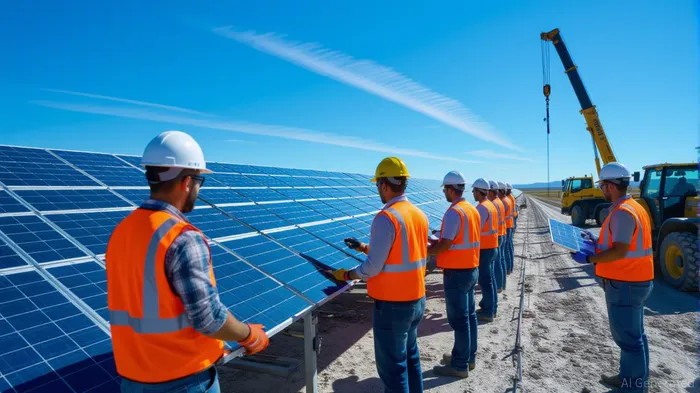
The U.S. clean energy sector is in a high-stakes race against time. With federal tax credits set to expire by December 31, 2025, under President Trump's “One Big Beautiful Bill Act” (OBBBA), developers, utilities, and states are scrambling to finalize projects before the financial lifeline vanishes. For investors, this creates a rare window of opportunity—and risk. The stakes are clear: projects that secure these credits could see cost reductions of 30–50%, while those that miss the deadline face a 50–100% price hike. The question is no longer if to invest, but when and how.
The Policy-Driven Market Shift
The OBBBA has rewritten the rules for renewable energy development. Previously, the Inflation Reduction Act (IRA) allowed a gradual phaseout of tax credits through 2032. Now, projects must either begin construction by July 5, 2026, or be fully operational by December 31, 2027, to qualify. The Treasury Department's revised guidance has further tightened the screws, eliminating the 5% cost threshold for “commence construction” and requiring continuous physical work on-site. For developers, this means no room for delays—any hiccup in permitting, supply chains, or labor could disqualify a project.
Xcel Energy's Aggressive Playbook
Xcel Energy, a linchpin in the U.S. clean energy transition, is leading the charge in Colorado. The utility has filed a proposal with the Colorado Public Utilities Commission (PUC) to fast-track 4,500 megawatts of wind, solar, and battery storage projects. This includes 4,000 MW of renewables, 300 MW of natural gas, and 200 MW of storage, all aimed at securing the 30% Investment Tax Credit (ITC) and 2.75 cents/kWh Production Tax Credit (PTC). Governor Jared Polis has directed state agencies to eliminate administrative barriers, ensuring permits and interconnection approvals are prioritized.
Xcel's timeline is razor-thin: a request for proposals (RFP) is expected by late August 2025, with bids due by October 6. PUC approval is targeted for early February 2026, allowing construction to begin by July 2026. The company's Just Transition Solicitation (JTS) plan, which seeks 8,500 MW of new capacity over a decade, is now a parallel effort to the 2025 tax credit race. For investors, Xcel's aggressive procurement strategy signals confidence in its ability to lock in cost savings—critical for maintaining affordability amid rising inflation and supply chain bottlenecks.
Sector-Wide Urgency: Beyond Xcel
The rush to meet deadlines isn't limited to Colorado. Maine regulators launched an accelerated procurement in August 2025, seeking 1,600 gigawatt-hours of renewable energy—enough to meet 13% of the state's demand. Developers were given just two weeks to submit proposals, underscoring the compressed timeline. In California, lawmakers are pushing to streamline permitting and interconnection processes, with a focus on repurposing retired gas plant sites to fast-track solar and wind projects.
These state-level efforts highlight a sector-wide pivot. Clean energy developers like NextEra EnergyNEE-- (NEE) and First SolarFSLR-- (FSLR) are also accelerating projects, leveraging the remaining tax credits to offset costs. The risk of missing the window is stark: without the ITC and PTC, solar costs could rise by 50%, and wind by 100%, according to Energy Innovation. For investors, this creates a binary outcome—projects that secure credits will thrive; those that don't will face margin compression and higher capital expenditures.
Strategic Investment Timing: Now or Never
The investment case for clean energy infrastructure has never been more time-sensitive. Here's why:
1. Cost Arbitrage: Projects securing 2025 tax credits will enjoy a 30–50% cost reduction, creating a competitive edge over peers.
2. Regulatory Tailwinds: States are aligning policies to fast-track approvals, reducing the risk of delays.
3. Demand Surge: Electrification of transportation, AI-driven data centers, and building electrification are driving long-term demand, making early movers more resilient.
However, the risks are equally pronounced. Regulatory shifts, supply chain disruptions, and inflation could erode margins. Investors must prioritize companies with:
- Strong Permitting Pipelines: Firms with pre-approved projects (e.g., Xcel's 4,500 MW portfolio).
- Diversified Portfolios: Developers with exposure to both solar and wind to hedge against sector-specific risks.
- State Partnerships: Utilities and developers with close ties to state agencies (e.g., XcelXELB-- in Colorado, NextEraNEE-- in Florida).
Conclusion: Positioning for the 2025 Deadline
The 2025 tax credit expiration is a pivotal inflection pointIPCX-- for the U.S. clean energy sector. For investors, the next 12–18 months are critical. Xcel Energy's accelerated projects, coupled with state-level reforms, offer a blueprint for success. However, the narrow window demands swift action.
Investment Advice:
- Buy into Xcel Energy (XEL): Its Colorado initiative is a high-conviction play on tax credit capture.
- Diversify with NextEra Energy (NEE) and First Solar (FSLR): These firms are scaling projects across multiple states, reducing geographic risk.
- Monitor State Policy Shifts: Colorado, Maine, and California are leading the charge; follow their regulatory updates for early signals.
The clean energy transition is no longer a long-term bet—it's a race against the clock. For those who act now, the rewards could be transformative. For those who wait, the cost of entry will only rise.





Comentarios
Aún no hay comentarios