
Clean Energy Infrastructure: The Overlooked Powerhouse Fueling the AI Revolution
The artificial intelligence (AI) boom has ignited a frenzy of investment in chipmakers and data center operators, yet one critical enabler of this revolution remains underappreciated: clean energy infrastructure. As AI-driven data centers consume increasingly vast amounts of electricity, the need for reliable, scalable, and sustainable power solutions has never been more urgent. Brookfield RenewableBEP-- Partners (BEP) and Brookfield Renewable CorporationBEP-- (BEPC) are emerging as pivotal players in this space, leveraging their global renewable energy expertise, strategic partnerships, and dividend growth potential to position themselves as a compelling, low-volatility alternative to speculative AI stocks.
Strategic Partnerships: Powering the AI Infrastructure Revolution
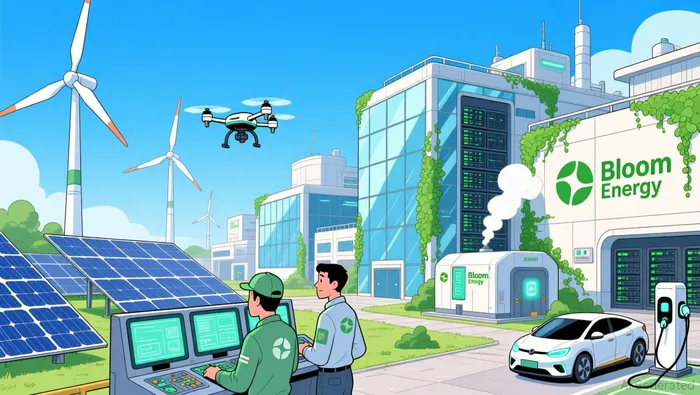
Brookfield Renewable has taken a proactive stance in addressing the energy demands of AI by forging high-profile partnerships. In 2025, the company announced a $5 billion collaboration with Bloom EnergyBE-- to develop "AI factories" that integrate computing power, energy supply, and infrastructure into a unified system. These facilities, powered by Bloom Energy's fuel cell technology, operate independently of traditional grids, offering a scalable and clean energy solution for data centers. This partnership marks Brookfield's first investment under its dedicated AI Infrastructure strategy, which aims to invest in large AI factories, power solutions, and compute infrastructure.
 Complementing this, Brookfield launched a $100 billion global AI Infrastructure program in partnership with NVIDIA and the Kuwait Investment Authority. This initiative spans the entire AI value chain, from energy and land to data centers and compute. By aligning with industry leaders, Brookfield is not only securing long-term revenue streams but also addressing the projected surge in U.S. AI data center power needs, which could exceed 100 gigawatts by 2035.
Dividend Growth and Energy Reliability: A Stable Foundation
Brookfield Renewable Partners (BEP) offers an attractive 5.16% dividend yield, significantly outpacing the Utilities sector average of 3.33%. This yield, supported by an annualized dividend of $1.47 per share, reflects the company's commitment to shareholder returns. While BEP's 5-year dividend growth rate is modest at 2.70%, its distribution policy targets 5% to 9% annual growth in cash distributions, anchored by a payout ratio of 70% of funds from operations (FFO). This conservative approach ensures sustainability, even as the company navigates the challenges of a rapidly evolving energy landscape.
In contrast, AI chipmakers like NVIDIA and data center operators face volatile earnings and uncertain dividend policies. For instance, NVIDIA's stock beta of 2.31 (2023–2025) highlights its extreme sensitivity to market fluctuations, whereas Brookfield's beta of 0.71 underscores its lower volatility. This stability is further reinforced by Brookfield's long-term power purchase agreements (PPAs) with tech giants such as Google and Microsoft. These contracts, including a 3 GW hydroelectric framework with Google and a 10.5 GW renewable energy agreement with Microsoft, provide predictable cash flows and reduce exposure to short-term market risks.
Energy Reliability: Meeting the Grid's Evolving Needs
As data centers consume 22% more grid power in 2025 and are projected to triple their demand by 2030, Brookfield Renewable's global renewable energy portfolio-spanning 33,000 megawatts across five continents-positions it as a key solution provider. The company's focus on expanding its renewable development pipeline, targeting 10.5 GW of new capacity by 2030, aligns with the industry's shift toward energy efficiency and grid compatibility. By prioritizing technologies like hydroelectric and solar power, Brookfield ensures that AI infrastructure remains both environmentally sustainable and operationally resilient.
Moreover, Brookfield's partnerships with Microsoft and Google exemplify its ability to deliver grid-stable energy solutions. For example, its 20-year PPAs with Google for 670 MW of hydroelectric capacity at Holtwood and Safe Harbor facilities demonstrate the company's capacity to meet the stringent reliability requirements of AI-driven operations. These projects not only enhance Brookfield's revenue visibility but also contribute to decarbonizing the energy mix for tech firms under increasing regulatory and consumer pressure.
A Low-Volatility Alternative to Speculative Tech Stocks
While AI chipmakers and data center operators have delivered eye-popping returns in 2023–2025, their high volatility and speculative nature make them unsuitable for risk-averse investors. For instance, Lumentum's 361% stock surge in 2025 contrasts sharply with Brookfield's steady, albeit more modest, growth. However, Brookfield's lower beta and consistent dividend growth offer a more balanced risk-reward profile.
The company's financial metrics further reinforce this argument. With $4.7 billion in liquidity and 90% of cash flow derived from long-term contracts, Brookfield Renewable is well-positioned to navigate economic cycles. In contrast, AI stocks like NVIDIA face valuation skepticism and regulatory scrutiny, as evidenced by its market cap fluctuations above and below $5 trillion. For investors seeking exposure to the AI boom without the volatility of tech stocks, Brookfield Renewable represents a compelling, diversified play.
Conclusion: The Overlooked Powerhouse
As the AI revolution accelerates, clean energy infrastructure will become increasingly critical to sustaining its growth. Brookfield Renewable's strategic partnerships, global renewable energy reach, and attractive yield/distribution profile make it a standout investment. By offering reliable power solutions, stable dividends, and lower volatility compared to speculative tech peers, Brookfield is not just powering the AI boom-it's redefining the energy landscape for the digital age.





Comentarios
Aún no hay comentarios