
Classover's AI Tutor: A Disruptive Leap in K-12 EdTech and AI Personalization
The K-12 EdTech market is undergoing a seismic shift as AI-driven personalization redefines the educational landscape. With the global AI in K-12 education market projected to grow at a compound annual growth rate (CAGR) of 38.1% from 2025 to 2033, reaching USD 7,949.9 million by 2033, companies that can scale adaptive learning solutions are poised to dominate. ClassoverKIDZ--, a pioneer in AI-powered education, is emerging as a standout player. Its Classover AI Tutor-a real-time, adaptive learning system combined with physical robotics-positions the company to capture a significant share of this rapidly expanding market while addressing critical gaps in traditional EdTech.
Strategic Market Capture: Hybrid Innovation and Policy Alignment
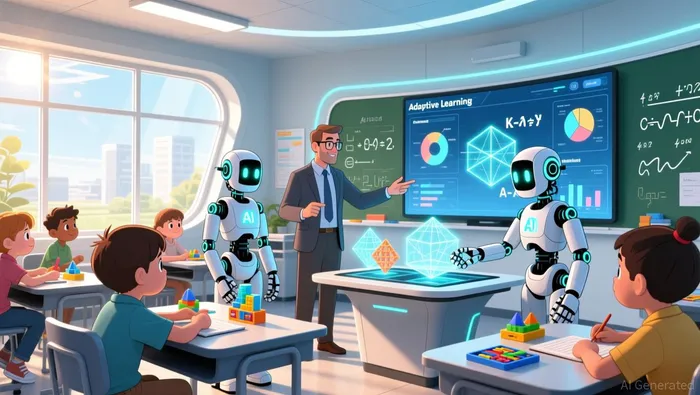
Classover's competitive edge lies in its hybrid model, which merges AI-driven digital tutors with data-trained interactive robots, a first in the industry. This approach tackles two major pain points: the static nature of online platforms and the lack of real-time feedback in virtual learning. By integrating physical robots into its ecosystem, Classover creates an immersive, hands-on experience that enhances comprehension in complex subjects like math and coding according to reports. This differentiation is critical in a market where 45.62% of the AI tutor segment in 2024 was dominated by platforms offering limited personalization.
 The company's strategy is further bolstered by policy trends. Initiatives like Germany's Digitalpakt 2.0 and India's National Education Policy explicitly prioritize AI integration in education according to data, creating a favorable regulatory environment for Classover's expansion. Additionally, Classover's focus on affordability-offering a subscription-based "Netflix for Learning" model according to company statements-aligns with global demand for accessible, on-demand education. By targeting both individual families and institutional partners, the company is building a dual revenue stream that accelerates market penetration.
Operational Scalability: Data-Driven Efficiency and Zero-Marginal-Cost Growth
Classover's scalability is underpinned by its 300,000-hour dataset of real teacher-student interactions, which trains its AI tutor agents to deliver high-quality, personalized instruction. This proprietary dataset ensures that the AI Tutor mimics human teaching nuances, such as adjusting explanations and pacing based on real-time signals like answer accuracy and thinking time according to technical documentation. The result is a system that combines the efficiency of AI with the adaptability of human educators, reducing reliance on global supply chains while maintaining educational quality.
Financially, Classover has already demonstrated profitability on a modest revenue base, a rare feat in the EdTech sector. As AI tutoring becomes the primary delivery method, the company's marginal costs approach zero, enabling explosive growth. This model mirrors the scalability of streaming platforms, where content delivery costs remain constant regardless of user base size. By leveraging a network of U.S.-based teachers for hybrid support according to company reports, Classover further stabilizes its operations, mitigating risks associated with remote labor markets.
Competitive Differentiation: The Learning Genome and IP Expansion
Classover's Learning Genome-a secure, evolving record of a student's learning journey-sets it apart from competitors. This "blueprint of education" allows the AI Tutor to generate personalized practice problems, feedback, and teaching styles over time, creating a lifelong educational roadmap. For parents, this transparency fosters trust, while for educators, it provides actionable insights into student progress.
The company is also aggressively expanding its intellectual property (IP) portfolio, securing a U.S. trademark and acquiring datasets and AI tools to refine its algorithms. This IP-driven strategy not only protects Classover's innovations but also enhances its ability to partner with schools and AI model providers. By integrating cloud-based platforms and machine learning, Classover ensures its solutions remain flexible and scalable, adapting to evolving market demands.
Challenges and Mitigations: Balancing Innovation with Reliability
While Classover's approach is groundbreaking, it must navigate challenges inherent to AI systems. Research indicates that reasoning models can struggle with high-complexity tasks and may exhibit increased hallucination when enhanced for reasoning. However, Classover's focus on real-time adaptive learning-rather than abstract reasoning-minimizes these risks. By prioritizing practical, task-specific applications (e.g., personalized problem-solving in math), the company avoids the pitfalls of over-engineered AI. Additionally, its hybrid model with physical robots provides a human-like feedback loop, further reducing errors.
Conclusion: A High-Conviction Investment in EdTech's Future
Classover's AI Tutor represents a disruptive leap in K-12 EdTech, combining strategic market capture with operational scalability. Its hybrid model, data-driven efficiency, and policy alignment position it to outpace competitors in a market growing at nearly 40% annually. For investors, the company's profitability, low marginal costs, and IP expansion make it a compelling long-term bet. As AI transitions from an experimental tool to a core educational infrastructure, Classover is not just adapting to the future-it is defining it.





Comentarios
Aún no hay comentarios