
Clarity Pharmaceuticals and the Breakthrough Potential of 64Cu-SAR-bisPSMA in Prostate Cancer Imaging
The global oncology diagnostics landscape is undergoing a seismic shift, driven by advancements in radiopharmaceuticals that promise to redefine early detection and treatment of prostate cancer. At the forefront of this transformation is Clarity Pharmaceuticals, whose 64Cu-SAR-bisPSMA agent has emerged as a disruptive force in prostate-specific membrane antigen (PSMA) imaging. With clinical data demonstrating superior lesion detection and a robust regulatory and commercialization strategy, the company is positioning itself to capture a significant share of a rapidly expanding market. For investors seeking exposure to next-generation therapeutics with clear clinical differentiation and scalable commercial potential, Clarity's pipeline represents a compelling case study in strategic innovation.
Clinical Differentiation: A New Standard in Prostate Cancer Imaging
The cornerstone of Clarity's value proposition lies in the clinical performance of 64Cu-SAR-bisPSMA. According to a report, the Co-PSMA trial-a Phase II investigator-initiated study-achieved its primary endpoint by demonstrating that 64Cu-SAR-bisPSMA PET/CT detected significantly more PSMA-positive lesions than the standard-of-care (SOC) 68Ga-PSMA-11 in patients with low prostate-specific antigen (PSA) levels (ranging from 0.2 to 0.75 ng/mL). This is critical because patients with biochemical recurrence often present with minimal disease burden, making early and accurate imaging essential for curative salvage therapies.
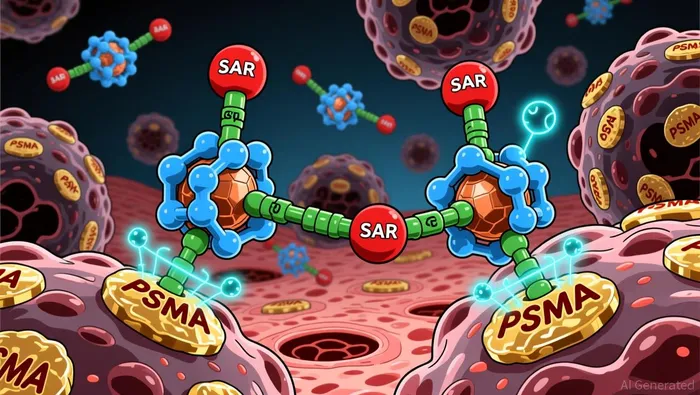
The results align with earlier findings from the COBRA trial, which showed that 64Cu-SAR-bisPSMA identified smaller lesions (as small as 2 mm) and detected them earlier than SOC agents. These advantages are underpinned by Clarity's proprietary SAR (stabilized aromatic ring) technology, which secures copper isotopes in a chelator structure, minimizing copper leakage and enhancing diagnostic precision. The agent's ability to image with greater sensitivity and flexibility-allowing for delayed imaging sessions due to the longer half-life of copper-64 compared to gallium-68-further strengthens its clinical utility.
Market Potential: Capturing a $3 Billion Opportunity
The global PSMA PET imaging market, currently valued at approximately $2 billion, is projected to grow to over $3 billion by 2029, driven by rising demand for precision oncology tools and the adoption of advanced imaging modalities. Clarity's 64Cu-SAR-bisPSMA is uniquely positioned to capitalize on this growth. Unlike unpatented SOC agents like 68Ga-PSMA-11, which lack differentiation, Clarity's molecule combines intellectual property protection with superior diagnostic performance, creating a durable competitive moat.
The company's regulatory strategy is equally robust. 64Cu-SAR-bisPSMA has received FDA Fast Track Designation for PET imaging in prostate cancer recurrence, accelerating its path to market. With two Phase III trials nearing completion and plans to present Co-PSMA results at the 2026 EAU Congress, Clarity is building a strong evidentiary foundation to support reimbursement and adoption.
Strategic Partnerships and Financial Strength
Clarity's ability to scale its commercialization efforts is bolstered by strategic partnerships and a strong capital base. The company recently secured a Commercial Manufacturing Agreement with SpectronRx, ensuring reliable production of 64Cu-SAR-bisPSMA. This collaboration addresses logistical challenges associated with radiopharmaceuticals, such as short half-lives and complex supply chains, by leveraging SpectronRx's expertise in radiopharmaceutical manufacturing.
Financially, Clarity has raised $203 million in 2025 through an institutional capital raise, providing ample resources to advance its clinical trials, regulatory submissions, and market access initiatives. This funding also supports the development of 67Cu-SAR-bisPSMA, the therapeutic counterpart to 64Cu-SAR-bisPSMA, which has shown promising results in the SECuRE trial, including a 98% PSA reduction in one patient. The therapeutic variant's Fast Track Designation underscores its potential to address metastatic castration-resistant prostate cancer (mCRPC), a high-unmet-need indication.
Intellectual Property and Competitive Advantages
Clarity's intellectual property (IP) portfolio is a critical differentiator. The SAR technology platform, which underpins both the diagnostic and therapeutic variants, is protected by patents that extend beyond 2030, ensuring long-term exclusivity. This contrasts sharply with the unpatented nature of 68Ga-PSMA-11, which limits its commercial upside for developers.
Moreover, Clarity's dual-track approach-simultaneously advancing diagnostic and therapeutic applications-creates a synergistic value proposition. The ability to offer a "see-and-treat" paradigm, where imaging identifies lesions and targeted therapy follows, could redefine prostate cancer management. This strategy is further supported by an ongoing investigator-initiated trial in Australia, led by Prof. Louise Emmett, which will provide additional real-world evidence of 64Cu-SAR-bisPSMA's performance.
Conclusion: A Strategic Investment in Precision Oncology
Clarity Pharmaceuticals' 64Cu-SAR-bisPSMA represents more than a technical advancement-it is a paradigm shift in prostate cancer imaging. By combining clinical superiority, regulatory momentum, and a defensible IP position, the company is poised to disrupt a $3 billion market. For investors, the alignment of clinical, commercial, and financial factors creates a compelling case for strategic investment. As the field of precision oncology continues to evolve, Clarity's next-generation radiopharmaceuticals stand out as a beacon of innovation with the potential to deliver both transformative patient outcomes and substantial shareholder value.







Comentarios
Aún no hay comentarios