
The CLARITY Act and the Reshaping of U.S. Crypto Jurisdiction
The U.S. crypto landscape is on the cusp of a seismic shift with the introduction of the CLARITY Act of 2025, formally known as the Digital Asset Market Clarity Act (H.R. 3633). This legislation aims to resolve the long-standing regulatory ambiguity surrounding digital assets by delineating the jurisdictions of the Securities and Exchange Commission (SEC) and the Commodity Futures Trading Commission (CFTC). For investors, the Act represents a critical inflection point, offering clarity on federal preemption, DeFi regulation, and the integration of traditional finance into the crypto ecosystem.
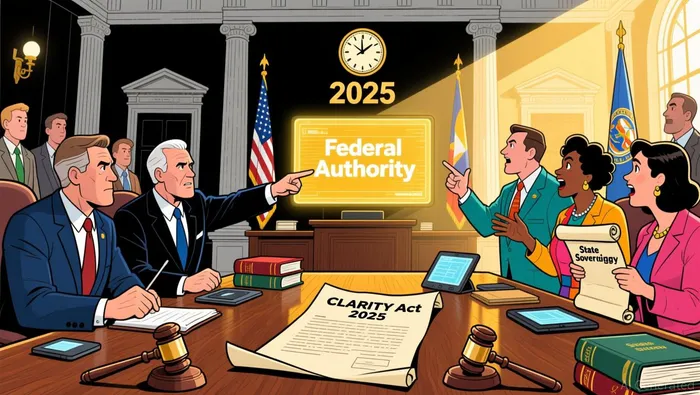
Federal Preemption: A New Balance Between Federal and State Authority
One of the CLARITY Act's most significant provisions is its approach to federal preemption. Unlike previous regulatory efforts, the Act explicitly prevents the preemption of state laws, ensuring that states retain authority to pursue fraud cases involving digital commodities and DeFi activities according to the bill. This is a departure from the SEC's expansive enforcement under the Howey test, which has often left innovators and investors in a legal gray area.
For example, states like New York and California-known for aggressive consumer protection laws-can now independently investigate and prosecute fraudulent DeFi projects without conflicting with federal regulations. This dual-layered enforcement model reduces the risk of regulatory arbitrage while preserving federal oversight of core market functions. However, investors must remain vigilant about state-specific compliance requirements, particularly in jurisdictions with stringent licensing regimes for crypto intermediaries as research shows.
DeFi Regulation: Innovation Meets Accountability
Decentralized finance (DeFi) has long been a thorny issue for regulators, caught between its promise of financial inclusion and its potential for misuse. The CLARITY Act addresses this by granting the CFTC exclusive jurisdiction over digital commodity spot markets, including DeFi platforms that facilitate transactions or governance according to policy trackers. Crucially, activities such as validating transactions or developing blockchain wallets are largely exempt from federal regulation, provided they do not involve centralized management or capital-raising mechanisms as detailed in analysis.
This framework strikes a balance between fostering innovation and enforcing accountability. For instance, DeFi protocols that operate without a central authority-such as automated market makers or decentralized lending platforms-can continue to function with minimal regulatory friction. However, intermediaries like exchanges and brokers must register with the CFTC and comply with anti-money laundering (AML) and know-your-customer (KYC) requirements as outlined in compliance resources. Investors in DeFi projects should prioritize platforms that proactively align with these standards, as compliance will likely become a key differentiator in attracting institutional capital.
Implications for Traditional Finance and Institutional Investors
The CLARITY Act also signals a green light for traditional financial institutions to enter the crypto space. By mandating joint rulemaking between the SEC and CFTC, the Act creates a unified classification system for digital assets, reducing the risk of conflicting regulations according to industry analysis. Banks, for example, can now offer services like trading, custody, and alternative trading systems for digital commodities under a predictable legal framework. This opens the door for a wave of institutional adoption, particularly in asset classes like BitcoinBTC-- and EthereumETH--, which are now clearly defined as digital commodities as confirmed by regulatory updates.
Moreover, the Act's exclusion of stablecoins from its direct jurisdiction-deferred to the separate GENIUS Act-ensures that payment-focused tokens remain accessible for everyday use cases. This separation is vital for investors seeking exposure to both speculative and utility-driven crypto assets without regulatory overlap.
Risks and Opportunities in a Post-CLARITY Landscape
While the CLARITY Act reduces uncertainty, it is not without challenges. The coexistence of federal and state enforcement could lead to fragmented compliance costs for smaller projects. Additionally, the Act's focus on digital commodities leaves investment contract assets (e.g., tokenized equities or real estate) under SEC jurisdiction, creating a hybrid regulatory environment. Investors must carefully assess the tokenomics and governance structures of projects to determine their regulatory exposure.
That said, the Act's bipartisan support and projected September 2025 enactment date suggest a high likelihood of passage as reported by policy trackers. For forward-looking investors, this is a signal to allocate capital toward CFTC-regulated infrastructure, DeFi protocols with robust compliance frameworks, and traditional financial institutions building crypto capabilities.
Conclusion
The CLARITY Act of 2025 is more than a regulatory overhaul-it is a catalyst for the maturation of the U.S. crypto market. By clarifying federal preemption, empowering DeFi innovation, and enabling traditional finance to participate, the Act lays the groundwork for a more inclusive and resilient financial system. For investors, the key takeaway is clear: the era of regulatory ambiguity is ending, and those who adapt to this new paradigm will be best positioned to capitalize on the opportunities ahead.






Comentarios
Aún no hay comentarios