
The CLARITY Act and the Path to U.S. Crypto Regulation: Assessing the Political and Market Implications of Delayed Legislation for Crypto Investors
The U.S. crypto market stands at a crossroads, with the CLARITY Act of 2025 representing both a beacon of regulatory clarity and a source of persistent uncertainty. As the House-passed version of the bill (H.R. 3633) awaits Senate action, the divergence between congressional chambers over definitions, jurisdiction, and compliance obligations has created a fragmented regulatory landscape. For investors, this delay has amplified volatility, complicated capital allocation decisions, and underscored the urgent need for a unified framework.
Political Challenges: A House-Senate Divide
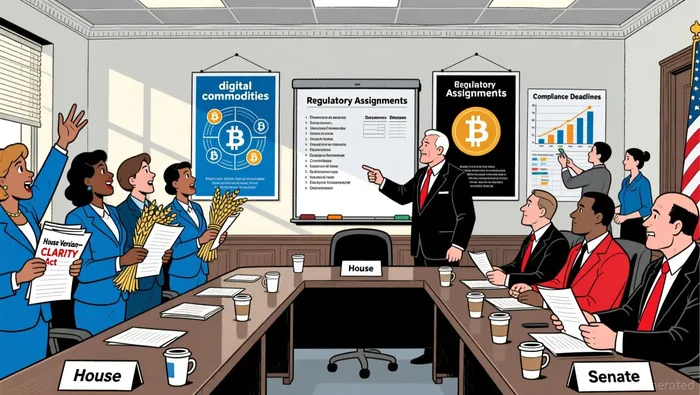
The CLARITY Act, introduced in the House on May 29, 2025, seeks to delineate the SEC and CFTC's roles in regulating digital assets. Under the House version, the CFTC would oversee digital commodities like BitcoinBTC-- and EthereumETH--, defined as assets derived from "mature blockchain systems" not controlled by a single entity. Meanwhile, the SEC would retain authority over investment contracts, determined via the Howey test. However, the Senate's Boozman-Booker draft, released in December 2025, proposes a broader definition of "digital commodities" as any fungible asset recorded on a cryptographically secured public ledger. This broader scope risks excluding tokens tied to non-blockchain systems, creating ambiguity for emerging asset classes.
The Senate draft also introduces stringent compliance requirements, such as mandatory segregation of customer assets and cybersecurity standards for brokers and custodians. Unlike the House bill, it lacks expedited registration processes, which could delay market entry for new participants. These discrepancies highlight a fundamental debate: Should regulation prioritize blockchain-specific assets, or should it adopt a more inclusive, technology-agnostic approach? Without reconciliation, the resulting regulatory patchwork could stifle innovation and deter institutional participation.
Market Implications: Volatility and Investor Caution
The delayed passage of the CLARITY Act has had tangible effects on market dynamics. In late 2025, the CBOE Volatility Index (VIX) surged to 13.5–15.0, reflecting heightened investor anxiety over regulatory outcomes. While the Nasdaq Crypto Index (NCI) fell 1.1% in early December 2025, Bitcoin and Ethereum showed resilience, suggesting that core holders remain optimistic about long-term prospects. However, the lack of a clear timeline for the CLARITY Act has kept institutional investors in a state of cautious anticipation.
Data from Fidelity and SSGA indicates that 86% of institutional investors had exposure to digital assets or planned allocations in 2025. Yet, the absence of a finalized regulatory framework has led to a "wait-and-see" approach. For example, spot Bitcoin ETF inflows, while robust in Q3 2025, slowed in Q4 as investors braced for potential regulatory shifts. This hesitancy is compounded by the Senate's Boozman-Booker draft, which introduces new compliance burdens that could increase operational costs for market participants.
Investor Behavior: Balancing Clarity and Uncertainty
Despite the delays, the broader regulatory environment has seen progress. The July 2025 passage of the GENIUS Act, which established a federal framework for stablecoins, provided a critical boost to investor confidence. By exempting compliant stablecoins from securities classification, the law reduced legal risks for institutions, enabling greater participation in cross-border payments and treasury management. This development, coupled with the Trump administration's pro-crypto stance, has encouraged 80% of reviewed jurisdictions to launch digital asset initiatives by financial institutions.
However, the CLARITY Act's unresolved status has created a paradox: While institutional demand for crypto is rising, regulatory ambiguity continues to dampen large-scale capital flows. A December 2025 report by Benesch Law notes that market participants are "navigating a minefield of conflicting guidelines", with firms forced to reassess token classifications and compliance strategies amid shifting definitions. This uncertainty is particularly acute for decentralized finance (DeFi) projects, which face unclear oversight under both the House and Senate proposals.
The Path Forward: Reconciliation and Global Coordination
The CLARITY Act's success hinges on reconciling the House and Senate versions. Key areas of contention-such as the definition of "digital commodities" and the allocation of CFTC/SEC authority-require bipartisan compromise. The Senate's emphasis on customer protections and cybersecurity standards, while laudable, must be balanced with the House's focus on fostering innovation through streamlined registration.
Internationally, the U.S. and U.K.'s Transatlantic Taskforce for Markets of the Future aims to align cross-border regulations, adding urgency to domestic legislative action. Meanwhile, the EU's MiCA framework and Japan's innovation-friendly policies are setting global benchmarks, pressing the U.S. to finalize its approach. For investors, the resolution of the CLARITY Act will likely determine whether the U.S. remains a leader in crypto innovation or cedes ground to more agile jurisdictions.
Conclusion
The CLARITY Act represents a pivotal moment for U.S. crypto markets. While the House and Senate have made strides in defining regulatory roles, their divergent approaches have prolonged uncertainty, affecting everything from market volatility to institutional adoption. For investors, the path to clarity lies in a reconciled bill that balances innovation with investor protection. Until then, the crypto market will remain a landscape of both opportunity and risk, where regulatory delays continue to shape capital flows and investor sentiment.






Comentarios
Aún no hay comentarios