
The CLARITY Act and the Imminent Regulatory Shift in U.S. Crypto Markets
The U.S. crypto market is on the cusp of a seismic regulatory transformation, driven by the CLARITY Act of 2025. This legislation, formally the Digital Asset Market Clarity Act of 2025, has redefined the jurisdictional divide between the Securities and Exchange Commission (SEC) and the Commodity Futures Trading Commission (CFTC), categorizing digital assets into three distinct classes: digital commodities, investment contract assets, and permitted payment stablecoins according to the bill text. For institutional investors, this shift represents both a risk and an opportunity-a regulatory vacuum is closing, but the transition period has created a unique window for strategic entry.
The CLARITY Act: A New Framework for Digital Assets
The CLARITY Act's core innovation lies in its functional classification of digital assets. Digital commodities, defined as assets intrinsically linked to blockchain systems and deriving value from their operational functionality, fall under CFTC oversight. Investment contract assets, conversely, are subject to SEC regulation if sold or transferred under an investment contract. Permitted payment stablecoins, governed separately under the GENIUS Act, are excluded from the CLARITY Act's primary framework but remain a critical component of the broader regulatory ecosystem.
This tripartite structure resolves years of jurisdictional ambiguity between the SEC and CFTC, enabling clearer compliance pathways for market participants. For example, the Act mandates joint rulemaking to define delisting criteria and ensure consistency, while also introducing exemptions for primary token offerings up to $75 million in a 12-month period. These provisions signal a regulatory environment that balances innovation with investor protection-a critical factor for institutional adoption.
Pre-Legislative Volatility: A Strategic Window for Institutional Entry
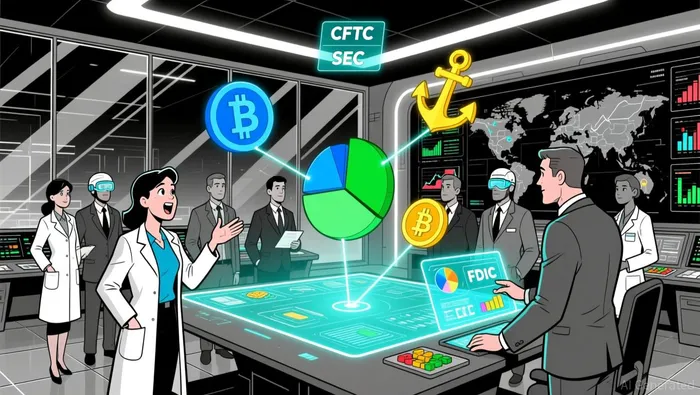
The period leading up to the CLARITY Act's passage in 2025 was marked by heightened volatility, driven by macroeconomic uncertainty and regulatory flux. According to Chainalysis, 80% of jurisdictions reviewed in 2025 saw financial institutions announce digital asset initiatives, reflecting growing institutional confidence. This trend was amplified by the introduction of U.S. spot BitcoinBTC-- and EthereumETH-- ETFs, which recorded net inflows of $22.47 billion and $10.43 billion, respectively, in 2025 alone.
Institutional investors capitalized on this volatility by adopting risk-adjusted allocation strategies, prioritizing liquid tokens like Bitcoin and Ethereum while leveraging tokenized real-world assets (e.g., U.S. Treasuries and commodities) to diversify exposure. The CLARITY Act's pre-legislative phase also saw banks begin to register as digital commodity brokers and dealers, opening new custodial and trading avenues. For example, the Act's certification mechanism allows assets to transition from SEC to CFTC oversight once a blockchain network demonstrates sufficient decentralization-a feature that incentivizes long-term investment in foundational protocols.
Risk Mitigation in a Structured Ecosystem
The CLARITY Act's multi-tiered regulatory framework provides institutional investors with tools to mitigate risk. By clearly defining asset classes and enforcement boundaries, the Act reduces the legal uncertainty that previously deterred institutional participation. For instance, the exclusion of stablecoins from the digital commodity category simplifies risk management for investors using stablecoins as settlement tools. Additionally, the Act's emphasis on AML/KYC controls and customer asset segregation creates a safer operational environment.
The Trump administration's broader policy goals-such as promoting dollar-backed stablecoins and fostering responsible innovation- further align with institutional interests. Leadership changes at the SEC and CFTC, including the appointment of pro-crypto officials, have reinforced this alignment. These developments suggest that the regulatory landscape is not merely stabilizing but actively encouraging institutional participation.
Strategic Entry Points for 2026
As the CLARITY Act moves into its implementation phase in 2026, institutional investors should focus on three key entry points:
1. Digital Commodity Brokers/Dealers: Banks and fintechs registered under the Act will offer custodial services and ATS platforms, providing institutional access to previously fragmented markets.
2. Tokenized Real-World Assets (RWA): The tokenization of U.S. Treasuries and commodities, now supported by clearer regulatory guardrails, offers a low-risk on-ramp for capital deployment.
3. Decentralized Finance (DeFi) Protocols: The Act's certification mechanism creates incentives for early-stage projects to demonstrate decentralization, attracting long-term capital to foundational blockchain infrastructure.
Conclusion
The CLARITY Act marks a pivotal shift in U.S. crypto markets, transforming regulatory uncertainty into a structured framework for growth. For institutional investors, the pre-legislative volatility of 2025 was not a barrier but a catalyst-a period to refine strategies, secure entry points, and align with a regulatory environment that prioritizes innovation. As 2026 unfolds, the focus will shift from legislative drafting to execution, and those who act decisively during this window will position themselves at the forefront of the institutional crypto era.






Comentarios
Aún no hay comentarios