
The CLARITY Act and DeFi Regulation: A Tipping Point for Crypto Markets?
The U.S. crypto landscape is at a crossroads. For years, regulatory ambiguity has stifled innovation, deterred institutional capital, and left investors navigating a minefield of conflicting enforcement actions. The CLARITY Act of 2025, now passed by the House and advancing in the Senate, represents a seismic shift in this dynamic. By codifying a clear framework for digital asset classification and jurisdictional oversight, the Act could catalyze a new era of institutional participation, reshaping investor strategies and DeFi's trajectory.
The CLARITY Act: A Framework for Clarity
The CLARITY Act (H.R. 3633) seeks to resolve the long-standing jurisdictional tug-of-war between the SEC and CFTC by categorizing digital assets into three distinct classes: digital commodities (e.g., BitcoinBTC-- and Ethereum), investment contract assets (subject to the Howey test), and permitted payment stablecoins (governed by the GENIUS Act) according to Arnold & Porter. Digital commodities fall under CFTC oversight, while investment contracts remain under SEC jurisdiction. This tripartite system aims to eliminate regulatory overlap and provide a stable legal foundation for market participants.
As of December 2025, the Act has passed the House (294–134) and is undergoing Senate deliberation, with a markup session on January 15, 2026, marking a critical inflection point. Bipartisan Senate efforts, led by Tim Scott and Cynthia Lummis, have produced a discussion draft addressing key terms like "digital commodity" and tensions between primary market fundraising (SEC) and secondary trading (CFTC) according to LegalWeek. The Act also mandates joint rulemaking by the SEC and CFTC to define delisting criteria and ensure compliance, signaling a commitment to harmonizing regulatory standards.
DeFi in the Crosshairs: Compliance Challenges and Opportunities
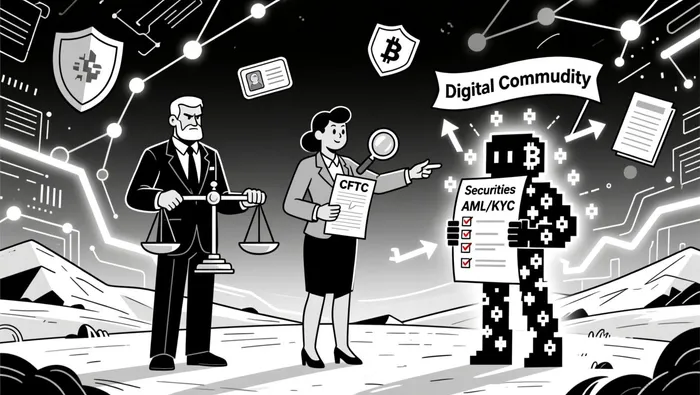
Decentralized finance (DeFi) platforms face unique challenges under the CLARITY Act. While the Act does not explicitly define "decentralized enough" for regulatory purposes, it introduces compliance obligations for digital asset intermediaries, including AML/KYC requirements aligned with the Bank Secrecy Act. This has forced DeFi protocols to reevaluate their operational models. For instance, non-custodial platforms must now navigate a landscape where even software developers and validators could face scrutiny, depending on their role in facilitating transactions.
The Senate's markup session highlighted these tensions, with lawmakers debating how to balance innovation with investor protection. A key focus was on stablecoin-linked rewards and the treatment of DeFi platforms that offer yield-generating services. While the SEC has signaled that most tokens are not securities, the CFTC's expanded jurisdiction over spot markets could create new compliance hurdles for DeFi protocols operating in both primary and secondary markets.
Investor Strategy Shifts: From Speculation to Institutionalization
The CLARITY Act's regulatory clarity has already begun reshaping investor behavior. Institutional allocators, previously hesitant due to regulatory uncertainty, are now increasingly allocating capital to digital assets. According to State Street, the rescission of the SEC's SAB 121 guidance in 2025 removed barriers for banks to offer custody services, enabling a surge in institutional participation. This shift is evident in the growing demand for tokenized assets and stablecoins, which are now being integrated into mainstream portfolios for yield and settlement purposes.
Retail investors, too, are adapting. With clearer legal boundaries, platforms offering regulated digital asset services-such as tokenized money market funds and commodities-are gaining traction. The Trump administration's executive order promoting dollar-backed stablecoins has further accelerated this trend, with jurisdictions like Hong Kong and Japan adopting similar frameworks. As a result, stablecoins now account for over 30% of cross-border payment volumes in emerging markets, where their efficiency and regulatory clarity are driving adoption.
The Tipping Point: Innovation vs. Regulation
The CLARITY Act's passage could mark a tipping point for crypto markets, but its success hinges on the Senate's ability to finalize a version that balances innovation with oversight. If enacted, the Act would enable banks to dominate the digital asset custody and settlement space, leveraging their regulatory expertise to outcompete crypto-native firms. For DeFi, the challenge will be to demonstrate compliance without sacrificing decentralization-a tightrope walk that will define the sector's next phase.
Investors, meanwhile, must navigate a rapidly evolving landscape. The Act's emphasis on token classification and AML compliance will likely drive consolidation in the DeFi space, favoring protocols that can demonstrate robust governance and transparency. As the Senate's markup session in January 2026 unfolds, the market will be watching closely: the outcome could either unlock a new era of institutional-grade crypto adoption or reinforce the status quo of regulatory fragmentation.






Comentarios
Aún no hay comentarios