
Citigroup's Resilient Investment Banking and Market Revenue Growth: Strategic Momentum in a Volatile Macro Environment
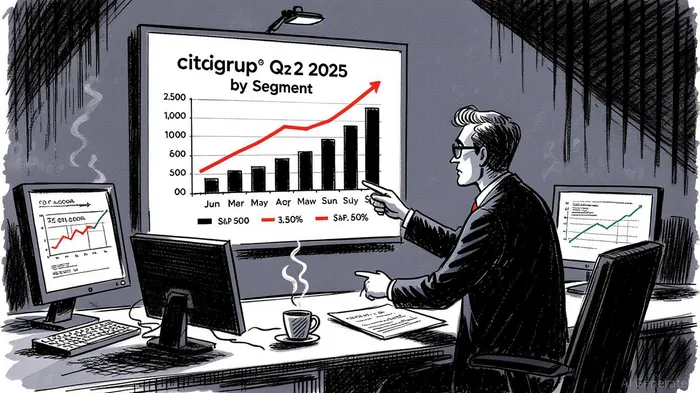
Citigroup's Q2 2025 earnings report has cemented its position as a standout performer in a macroeconomic landscape marked by geopolitical tensions, inflationary pressures, and uneven global growth. The bank's strategic focus on volatility-driven opportunities—coupled with disciplined cost management and capital allocation—has translated into robust revenue growth and earnings upside, outpacing broader industry trends.
Strategic Momentum in Investment Banking and Markets
Citigroup's Investment Banking (IB) segment delivered a 15% year-over-year revenue increase in Q2 2025, driven by a rebound in capital markets activity and a surge in advisory fees from cross-border deals [2]. This growth was underpinned by a 13% rise in investment banking fees, reflecting strong demand for Citigroup's advisory services amid a wave of M&A activity in sectors like technology and energy [4]. The Markets segment, which reported a 16% year-over-year revenue jump to $5.9 billion, benefited from elevated volatility in fixed income and equities trading, with Fixed Income contributing a significant portion of the gains [3].
The bank's ability to capitalize on volatility aligns with CEO Jane Fraser's strategic vision, who emphasized that “volatility is likely to be a feature of the new world order” [1]. This forward-looking approach has enabled CitigroupC-- to outperform peers in volatile markets, as evidenced by its 8.7% Return on Tangible Common Equity (ROTCE) in Q2 2025—a metric that underscores improved capital efficiency and risk-adjusted returns [2].
Competitive Positioning and Operational Discipline
Citigroup's strategic initiatives have not only driven top-line growth but also enhanced operational resilience. The bank's efficiency ratio improved to 61.8% in Q2 2025, down from 63.2% in the prior year, reflecting cost-cutting measures and better resource allocation [4]. This operational leverage, combined with a $20 billion share repurchase program and a $2–$2.5 billion annual savings target by 2026, positions Citigroup to sustain profitability even in a low-growth environment [3].
Comparative analysis with peers further highlights Citigroup's strength. While Goldman SachsGS-- and JPMorganJPM-- reported investment banking revenue growth of 26% and 7% respectively in Q2 2025, Citigroup's 15% increase places it firmly within the industry's top tier [1]. Analysts attribute this to Citigroup's diversified client base and its focus on high-conviction sectors like technology and emerging markets [2].
Earnings Upside and Capital Return
The bank's Q2 2025 results included a 29% year-over-year increase in earnings per share (EPS) to $1.96, surpassing consensus estimates by 22.5% [4]. This earnings upside has been amplified by Citigroup's aggressive capital return strategy, including a $20 billion stock buyback program and a raised full-year revenue guidance to $84 billion [2]. These actions signal confidence in the bank's ability to sustain growth, even as macroeconomic headwinds persist.
Conclusion: A Model of Resilience
Citigroup's Q2 2025 performance demonstrates that strategic agility and operational discipline can drive earnings upside in a challenging macro environment. By leveraging volatility, expanding high-margin services, and prioritizing capital efficiency, the bank has positioned itself as a leader in the post-pandemic financial landscape. For investors, Citigroup's resilient investment banking and markets segments—coupled with its transformative initiatives—offer a compelling case for long-term value creation.





Comentarios
Aún no hay comentarios