
Citigroup's Q3 Earnings Momentum: A Strategic Buy Opportunity in a Resilient Investment Bank
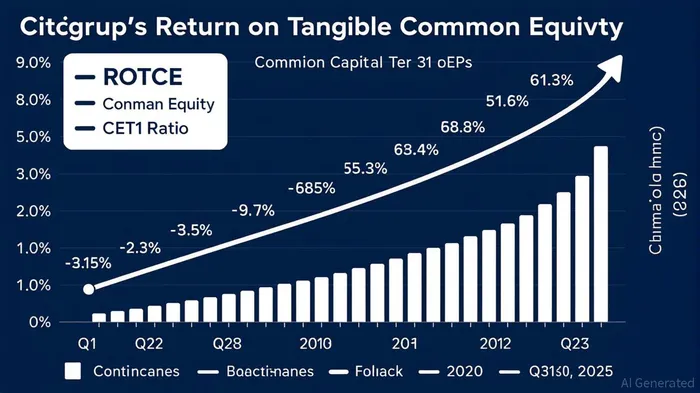
In an era where global markets grapple with inflationary pressures and regulatory scrutiny, Citigroup's strategic execution under CEO Jane Fraser has positioned the bank as a standout performer. With Q3 2025 earnings set to be released on October 14, 2025[1], the investment community is poised to assess whether the bank can sustain its momentum in a high-fee environment. The answer, based on Q2 performance and forward-looking guidance, appears to be a resounding yes.
Capital Efficiency: A Pillar of Resilience
Citigroup's capital efficiency remains a cornerstone of its competitive advantage. As of Q2 2025, the bank maintained a CET1 ratio of 13.5%, comfortably exceeding the regulatory requirement of 12.1% and including a 140-basis-point buffer[2]. This robust capital position has enabled CitiC-- to reduce its Stress Capital Buffer (SCB) requirement from 4.1% to 3.6% following the successful completion of the 2025 Federal Reserve stress test[3]. The flexibility afforded by this reduction allows for more aggressive capital deployment, as evidenced by the $3.1 billion returned to shareholders in Q2 2025 through dividends and share repurchases[4].
The bank's $20 billion multi-year share repurchase program, with $5.75 billion executed year-to-date (Q1–Q2 2025), underscores its commitment to shareholder value[5]. Meanwhile, debt reduction efforts—such as the redemption of €1.75 billion in 2026 notes—further optimize the balance sheet[6]. These actions reflect a disciplined approach to capital management, even as the bank navigates elevated operating expenses and credit costs.
Earnings Resilience in a High-Fee Environment
Citigroup's Q2 2025 results demonstrated its ability to thrive in a fee-driven landscape. Total revenue rose 8% year-over-year to $21.7 billion, driven by double-digit growth in Markets (16%), Banking (12%), and Wealth (20%)[7]. The Markets segment, in particular, benefited from strong client activity in fixed income and equities, while the Services segment saw a 23% ROTCE, fueled by loan and deposit growth[8].
The bank's ROTCE of 8.7% in Q2 2025, though slightly below Q1's 9.1%, remains well above its long-term target of 10–11% for 2026[9]. This resilience is underpinned by a 340-basis-point improvement in the efficiency ratio year-over-year, driven by cost discipline and productivity gains[10]. CFO Mark Mason has signaled mid-single-digit growth in investment banking fees and market revenue for Q3 2025, suggesting continued momentum[11].
Strategic Transformation: Fueling Long-Term Value
Citigroup's strategic initiatives are amplifying its earnings resilience. The expansion of Citi Token Services and AI-driven operational efficiencies are expected to enhance returns, while the bank's focus on high-growth areas like wealth management and digital banking positions it to capture market share[12]. Additionally, the 7.1% dividend increase, raising the payout to $0.60 per share starting in Q3 2025, reflects confidence in sustained profitability[13].
The bank's full-year 2025 revenue guidance of $84.1 billion and ROTCE targets of 10–11% for 2026[14] further validate its trajectory. These goals are achievable given Citigroup's disciplined expense management—Q2 expenses rose only 2% year-over-year to $13.6 billion, with management guiding full-year costs to $53.4 billion[15].
A Strategic Buy Opportunity
With a forward P/E ratio of approximately 9.5x (based on Q2 EPS of $1.96 and a $18.60 share price as of September 2025[16]), CitigroupC-- trades at a discount to its historical average and peers. The bank's strong capital position, resilient earnings, and strategic reinvention make it an attractive candidate for investors seeking exposure to a well-managed global financial institution.
Conclusion
Citigroup's Q3 2025 earnings will be a critical test of its ability to maintain momentum in a challenging macroeconomic climate. However, the bank's capital efficiency, earnings resilience, and strategic clarity suggest that it is well-positioned to deliver value to shareholders. For investors willing to look beyond short-term volatility, Citi represents a compelling long-term opportunity.





Comentarios
Aún no hay comentarios