
Citigroup's MSCI ACWI Target: Navigating Range-Bound Markets and Strategic Opportunities Through 2026
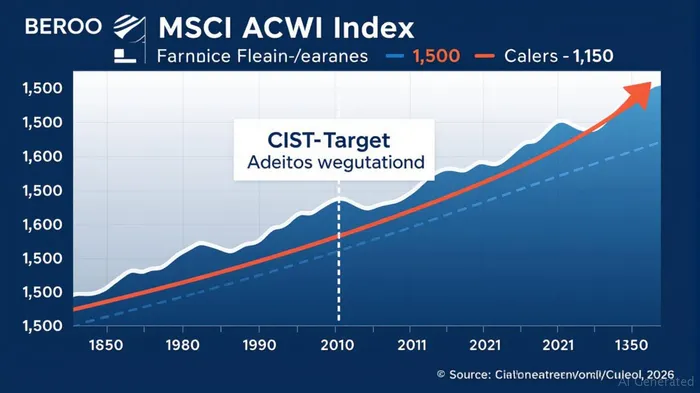
Global equity markets have entered a new phase of cautious optimism, underscored by Citigroup's mid-2026 forecast for the MSCIMSCI-- All Country World Index (ACWI) to reach 1,150—a 5% upside from its recent close of 1,100.213. This target reflects a nuanced outlook where range-bound dynamics of 2024 give way to gradual gains, driven by economic expansion and sector-specific tailwinds. Yet, geopolitical risks and policy uncertainties loom large, demanding strategic positioning to navigate the coming year.
The Case for Range-Bound Markets—and a Gradual Uptick
Citigroup's 2025 Market Outlook report frames the current environment as a transitional period. Through late 2024, global equities remained constrained by inflationary pressures, geopolitical tensions, and central bank hawkishness. However, the firm anticipates a breakout in early 2025, fueled by improving corporate profits and gradual Federal Reserve rate cuts. The U.S. economy, projected to grow 2.4% in 2025, will anchor this recovery, but CitigroupC-- cautions that the path will be uneven.
The Fed's policy stance is critical here. While the central bank has paused rate hikes, Citigroup expects the Fed funds rate to remain elevated at 3.5%-4% through 2025, with cuts likely in late 2026. This extended pause, combined with fiscal stimulus from potential U.S. policy shifts under the incoming Trump administration, creates a backdrop of moderate growth but heightened volatility.
Regional Opportunities: Japan and Europe Lead the Charge
Citigroup identifies Japan and Europe as the primary beneficiaries of this recovery. Both regions have underperformed the U.S. in recent years but now benefit from structural reforms, corporate governance improvements, and undervalued equity markets. In Japan, Prime Minister Kishida's push for deregulation and investment in AI and robotics could unlock productivity gains. Meanwhile, European markets, particularly in Germany and France, are poised to capitalize on energy sector resilience and a rebound in manufacturing.
Investors should consider overweighting regional benchmarks like the Nikkei 225 (^N225) and Euro Stoxx 50 (^STOXX50E), which have lagged the S&P 500 (^GSPC) by over 10% in the past three years.
Sectors to Watch: Robotics, Defense, and Healthcare
The report highlights sectors positioned to thrive in a growth-oriented but politically charged environment:
1. Robotics & Automation: Rising labor costs and the need for efficiency are driving demand for automation solutions. Companies like iRobotIRBT-- (IROBOT) and Stanley BlackSWK-- & Decker (SWK) could benefit, as Citigroup forecasts global robotics spending to hit $200 billion annually by 2026.
2. Defense Contractors: Geopolitical risks, particularly in U.S.-China and U.S.-Russia tensions, will sustain demand for defense tech. BoeingBA-- (BA) and Lockheed MartinLMT-- (LMT) are prime candidates, given their exposure to U.S. military spending.
3. Healthcare Innovations: Aging populations and advancements in biotech are pushing healthcare spending upward. Firms like RegeneronREGN-- (REGN) and UnitedHealth GroupUNH-- (UNH) are well-positioned to capitalize on this trend.
Risks to the Outlook: Inflation, Trade Wars, and Policy Uncertainty
Despite the positive trajectory, Citigroup flags several risks. Inflation, driven by fiscal deficits and potential trade wars, could pressure emerging markets and derail Fed rate cuts. U.S.-China trade disputes remain a wildcard, while domestic political friction under a Trump administration might lead to protectionist policies. Investors should hedge against these risks by diversifying into defensive sectors like utilities and gold (GLD).
Strategic Positioning: A Balanced Approach
To capture the upside while mitigating risks, consider the following:
1. Global Equity Allocation: Shift from U.S.-centric portfolios to a balanced mix of developed international markets.
2. Sector Focus: Prioritize robotics, defense, and healthcare stocks with strong balance sheets and recurring revenue streams.
3. Fixed Income: Embrace credit-sensitive bonds (e.g., corporate debt) as Fed rate cuts reduce default risks.
4. Geopolitical Hedges: Use inverse ETFs (e.g., SCHO) or gold to offset potential volatility from trade disputes.
Conclusion: Prudent Optimism, Strategic Flexibility
Citigroup's 1,150 target for the MSCI ACWI represents a measured view of global markets: growth is possible, but it requires patience and precision. Investors should avoid complacency, instead focusing on regional diversification, sector-specific opportunities, and risk management. As the Fed's policy path unfolds and geopolitical winds shift, agility will be key to capitalizing on this range-bound-to-upside transition.
Stay informed, stay diversified, and stay ahead of the curve.





Comentarios
Aún no hay comentarios