
Citigroup's AI-Driven Transformation and Regional Expansion: A Strategic Path to Surpassing 2025 Revenue Targets
Citigroup's 2025 revenue target of exceeding $84 billion is no longer a distant aspiration but a tangible goal, underpinned by its aggressive AI-driven operational overhaul and strategic divestiture of Banamex. As the bank navigates a rapidly evolving financial landscape, its dual focus on technological innovation and regional restructuring positions it to outperform expectations-and investors should take note.
AI as the Engine of Efficiency
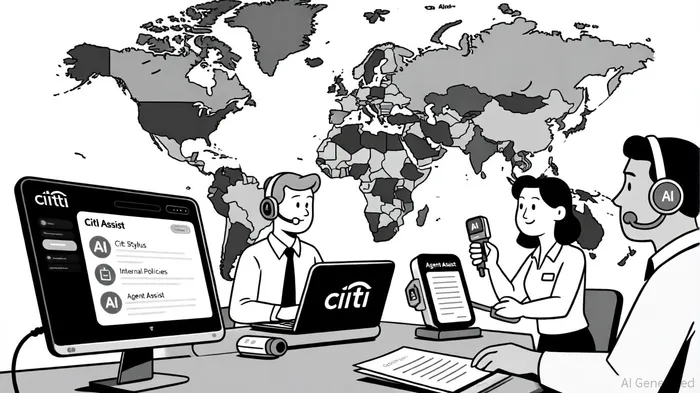
Citigroup's AI transformation has emerged as a cornerstone of its strategy to boost profitability and operational agility. By deploying AI tools to 140,000 employees across eight countries, the bank has automated routine tasks, streamlined data analysis, and enhanced productivity. Tools like Citi Assist (for internal policy navigation), Citi Stylus (document intelligence), and Agent Assist (customer service optimization) have been accessed over 7 million times in 2025 alone, reflecting deep integration into daily workflows[1].
Financially, these initiatives are paying off. The bank anticipates $2–2.5 billion in annualized cost savings by 2026 through AI-driven efficiency gains, while maintaining a 2025 total expense budget of $53.4 billion[3]. CEO Jane Fraser has emphasized that AI and digital assets are "key drivers of growth," with Q3 2025 results already showing a 9% year-over-year revenue increase to $22.09 billion, driven by strong operating leverage across all five business segments[4].
However, Citi's AI ambitions come with stiff competition. While it ranks among the top spenders in the banking sector, its $14.7 billion investment (including $11.8 billion in technology and $2.9 billion in transformation) still trails JPMorgan Chase's $17 billion commitment[1]. Goldman Sachs, meanwhile, leads in AI venture investments and research quality, though Citi's focus on enterprise-scale deployment gives it an edge in operational execution[1].
Banamex: A Strategic Exit and Valuation Catalyst
The bank's progress with Banamex further strengthens its 2025 outlook. CitigroupC-- has sold a 25% stake in its Mexican subsidiary, marking a critical step toward full divestiture and eventual deconsolidation[2]. This move aligns with CEO Fraser's strategy to simplify operations and prioritize high-return businesses. By Q3 2025, the bank had completed the separation of Banamex from its institutional banking operations in Mexico, paving the way for a dual IPO in Mexico City and New York[2].
Yet challenges remain. Banamex's delinquency rate stood at 2.83% as of June 2025, above the 2.13% average for Mexico's seven systemically important banks[4]. The transfer of 26% of its loan portfolio-considered the healthiest portion-during the separation has exacerbated this issue[2]. For the IPO to succeed, Banamex must reduce delinquency rates and improve profitability, particularly in its consumer lending segment, which now accounts for 49.8% of its total portfolio[4].
Analysts suggest that digital transformation and operational improvements-such as enhanced cybersecurity and compliance frameworks-will be critical to unlocking value[2]. If successful, the IPO could generate billions in capital for Citigroup, further accelerating its path to the $84 billion revenue target.
Investor Implications and Competitive Positioning
For investors, Citigroup's dual-track strategy offers both near-term stability and long-term growth potential. The bank's Q3 2025 results-$3.8 billion in net income and an 8% return on tangible common equity (ROTCE)-exceed its 10–11% ROTCE target for 2026[3]. Meanwhile, its efficiency ratio of 64.7% in Q3 2025, though still above the 60% goal, shows measurable progress[4].
Competitively, Citi's AI investments are part of a broader industry trend. A Citigroup report estimates that AI could boost banking industry profits by 9% ($170 billion) by 2028, excluding non-bank financial sectors[1]. While JPMorgan and Goldman Sachs remain formidable rivals, Citi's enterprise-scale AI deployment and disciplined cost-cutting position it to capture market share in a sector increasingly defined by technological agility.
Conclusion: A Compelling Case for Outperformance
Citigroup's AI-driven transformation and strategic exit from Banamex are not just operational necessities-they are catalysts for outperformance in a competitive market. With AI tools embedded in core operations, a clear roadmap for cost savings, and a disciplined approach to regional restructuring, the bank is well-positioned to exceed its 2025 revenue target. For investors, this represents a rare combination of near-term financial discipline and long-term innovation, making CitiC-- a standout in the AI-empowered banking sector.







Comentarios
Aún no hay comentarios