
Citadel Securities: Engineering Market Dominance Through Operational Precision and Technological Mastery
In the high-stakes arena of high-frequency trading (HFT), where milliseconds determine fortunes, Citadel Securities has emerged as a paragon of operational discipline and technological innovation. The firm's ability to execute $652 billion in daily trades while maintaining a 35% share of U.S. retail trading volume is not accidental—it is the result of a meticulously engineered operational framework. At the heart of this framework lie two symbolic pillars: the “5,000 goals” initiative and the “one giant binder” integration. These concepts, rooted in systematic optimization and technological synergy, have enabled Citadel to dominate liquidity provision, reduce latency by 30%, and scale operations across 50+ markets[3].
The “5,000 Goals” Framework: Hyper-Optimization in Action
Citadel's “5,000 goals” strategy is less a metaphor and more a blueprint for relentless operational refinement. This initiative, spearheaded by CTO Josh Woods and COO of Technology Jeff Maurone, focuses on dismantling redundancies in the firm's once “messy” infrastructure[1]. By consolidating systems and adopting a standardized global architecture, Citadel has reduced operational complexity, enabling faster onboarding of new exchanges and asset classes. For instance, the firm's cloud-native infrastructure overhaul—part of this framework—has slashed latency by 30% and boosted throughput by 50%, critical metrics in HFT where speed is synonymous with profit[3].
The “5,000 goals” also emphasize hyper-specialization. Teams are tasked with discrete objectives, such as refining algorithmic execution or expanding into cryptocurrency markets. This division of labor ensures that Citadel's market-making algorithms, which profit from bid-ask spreads, operate with surgical precision. As stated in its product strategy guide, the firm aims to increase its U.S. equities market share from 40% to 50% by 2025, a target underpinned by AI-driven models that adapt in real time to volatility[2].
The “One Giant Binder”: Integration as a Competitive Moat
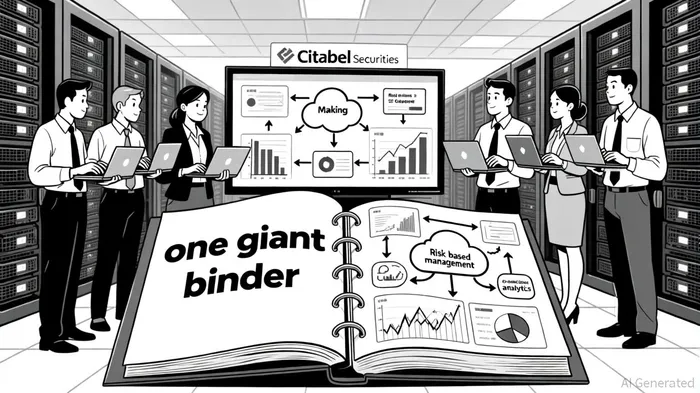
The “one giant binder” metaphor captures Citadel's integration of fragmented systems into a unified, globally scalable infrastructure. This approach, inspired by airline industry efficiency models, ensures that Citadel's trading platforms, risk management systems, and data analytics tools operate in lockstep[3]. For example, the firm's partnership with Google Cloud has created a flexible quantitative research platform, allowing researchers to dynamically scale compute resources and optimize models for execution speed and risk mitigation[4].
This integration extends to Citadel's payment for order flow (PFOF) arrangements with brokers like RobinhoodHOOD--. By routing retail orders through its systems, Citadel gains privileged access to real-time data, enabling it to position itself ahead of market moves. According to a report by Trade Ideas, this practice has amplified Citadel's influence, as it processes 40% of U.S. retail trading volume[2]. The firm's dominance in this space is further reinforced by its AI-driven market-making strategies, which refine liquidity provision using machine learning[5].
Financial Performance: A Testament to Operational Excellence
Citadel's operational rigor has translated into staggering financial results. In Q1 2025, the firm reported a 70% year-over-year surge in profits, reaching $1.7 billion, driven by a 45% increase in net trading revenue to $3.4 billion[5]. This performance underscores the profitability of its HFT model, particularly during periods of heightened volatility, such as the Trump-era trade policy shifts in 2025[5].
The firm's expansion into cryptocurrencies and fixed income markets also highlights its strategic foresight. With plans to capture 15% of the crypto market within two years and expand into European government bonds, Citadel is leveraging its technological edge to diversify revenue streams[3].
Future Prospects: Sustaining the Edge
Citadel's investment-grade execution efficiency is not static. The firm continues to innovate, adopting cutting-edge technologies like C++26 for faster code compilation and quantum computing research for next-generation algorithms[1]. These advancements, coupled with its global expansion into Asia-Pacific and EMEA, position Citadel to maintain its leadership in a rapidly evolving market.
Conclusion
Citadel Securities' dominance in HFT is a masterclass in operational scalability and technological discipline. By embedding systematic optimization into its DNA through the “5,000 goals” and “one giant binder” frameworks, the firm has created a self-reinforcing cycle of efficiency, profitability, and market share growth. For investors, this operational alchemy offers a compelling case: a company that not only adapts to market chaos but thrives within it.







Comentarios
Aún no hay comentarios