
Circle's Strategic Position Amid Tether's Downgrade: A New Era for USDC and Solana?
The stablecoin market is undergoing a seismic shift as Tether's recent S&P Global downgrade to "weak" has exposed vulnerabilities in its reserve structure, triggering a reevaluation of risk and trust in the sector. This development, coupled with Circle's aggressive expansion of USDCUSDC-- and Solana's infrastructure-driven growth, is reshaping the competitive landscape. For investors, the implications are clear: transparency, regulatory alignment, and blockchain scalability are now critical factors in assessing stablecoin-adjacent assets.
Tether's Downgrade: A Wake-Up Call for the Stablecoin Market
According to a Bloomberg report, S&P Global Ratings downgraded Tether's USDTUSDT-- to the lowest rating of "5 (weak)" in November 2025, citing a 24% allocation of high-risk assets in its reserves-including BitcoinBTC-- (5.6% of USDT in circulation), gold, secured loans, and corporate bonds-as well as persistent gaps in disclosure about custodians and reserve management. The agency warned that a decline in the value of these assets could push USDT below its 3.9% overcollateralization margin, risking undercollateralization. While TetherUSDT-- CEO Paolo Ardoino dismissed the downgrade as a "neutral" rating and defended the company's $12.9 billion gold reserves, the downgrade has eroded confidence among institutional investors and regulators, accelerating a shift toward alternatives with clearer risk profiles.
Circle's USDC: Capitalizing on Trust and Transparency
Circle's USDC has emerged as a beneficiary of this sentiment shift. JPMorgan data indicates that USDC's market capitalization grew by 72% year-to-date in 2025, reaching $74 billion, outpacing Tether's 32% growth. This surge is driven by USDC's transparent reserve management, regular audits, and compliance with regulatory frameworks like the EU's Markets in Crypto-Assets (MiCA) regulation. Circle's strategic minting of $1.25 billion in USDC on SolanaSOL-- in early 2025 further underscores its focus on scalability and institutional adoption. By August 2025, total USDC issuance on Solana had reached $24 billion, tripling the network's stablecoin supply to $11.4 billion since July 2024.
Solana's Role: Scaling USDC's Infrastructure Edge
Solana's partnership with CircleCRCL-- has been pivotal in amplifying USDC's utility. 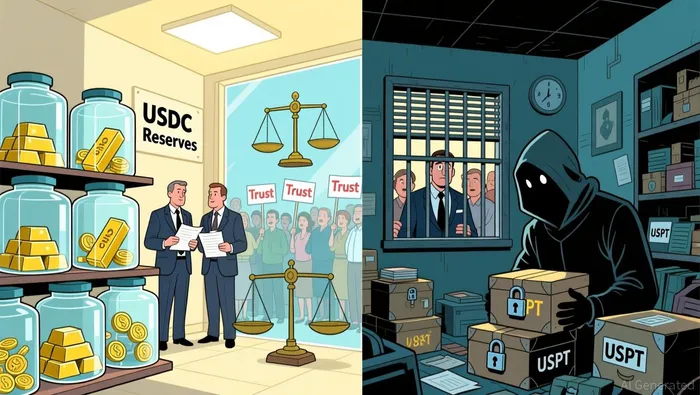 The network's Cross-Chain Transfer Protocol (CCTP) enables secure, non-custodial USDC transfers between blockchains, while its capacity for 50,000 transactions per second supports high-throughput DeFi and payment applications. As Coinspeaker noted, USDC's market dominance on Solana rose from 20% to 25.5% in early 2025, directly challenging Tether's dominance. This growth is further fueled by institutional partnerships, including Trump-backed initiatives and collaborations with payment processors like Visa and Stripe. Solana's low-cost infrastructure has also attracted retail users, with large Bitcoin outflows from centralized exchanges redirecting activity to onchain trading layers.
Investor Sentiment: A Shift Toward Compliance and Resilience
The downgrade has prompted a broader reevaluation of stablecoin risk. Investors are increasingly favoring USDC and Binance USD over USDT, prioritizing transparency and regulatory alignment. Tether's launch of USAT, a U.S.-compliant stablecoin, signals its intent to compete in this space, but USDC's first-mover advantage in compliance and its entrenched position on Solana give Circle a significant edge. For now, USDT remains the largest stablecoin by market cap ($185 billion), but its share of the market has declined as USDC's supply grew by $17.25 billion collectively with Tether post-October 2024 flash crash.
Conclusion: Re-Evaluating Exposure to Stablecoin-Adjacent Assets
The Tether downgrade has exposed the fragility of opaque reserve models, creating a tailwind for USDC and Solana's infrastructure-driven approach. For investors, this represents an opportunity to rebalance exposure toward assets with clearer governance and regulatory alignment. Circle's strategic partnerships, combined with Solana's scalability, position USDC as a long-term contender in the stablecoin race. However, risks remain, including Tether's potential counteroffensives and macroeconomic volatility. Those who act now may find themselves well-positioned as the market consolidates around transparency and trust.







Comentarios
Aún no hay comentarios