
Circle's Strategic Position in the Post-Rate Cut Era: Digital Currency Resilience and Payment Innovation
As central banks globally pivot toward accommodative monetary policies post-2025 rate cuts, the financial landscape is undergoing a seismic shift. Traditional payment systems, long constrained by inefficiencies and high costs, now face intensified competition from digital currency solutions. In this evolving environment, CircleCRCL-- Internet Financial has emerged as a pivotal player, leveraging strategic partnerships and product innovations to solidify its position at the intersection of stablecoin adoption and institutional-grade payment infrastructure.
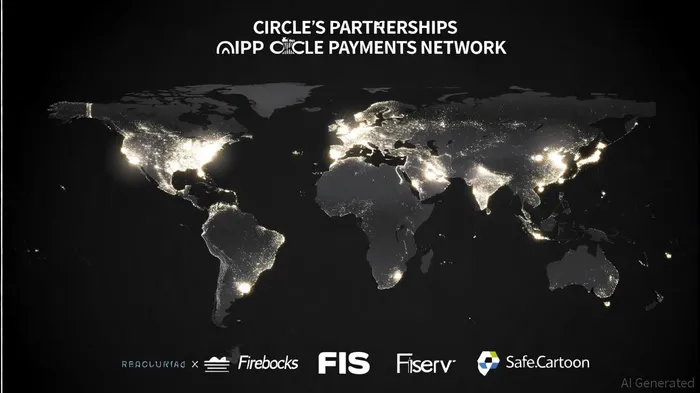
Strategic Partnerships: Building a Resilient Ecosystem
Circle's 2025 strategic initiatives underscore its commitment to addressing the limitations of legacy systems while capitalizing on the post-rate cut era's demand for faster, cheaper, and programmable money. A cornerstone of this strategy is its collaboration with Fireblocks, which integrates Circle's stablecoin network with Fireblocks' institutional custody and tokenization infrastructure. This partnership enables financial institutions to execute secure cross-border treasury operations and tokenization settlements, addressing the growing need for regulated digital assets in institutional settings [1].
Similarly, Circle's alliance with FIS has unlocked real-time stablecoin money movementMOVE-- for financial institutions. By embedding USDC-the world's largest regulated stablecoin-into FIS' Money Movement Hub, the collaboration provides scalable fraud detection and instant settlement capabilities, reducing reliance on traditional correspondent banking networks [2]. Meanwhile, the partnership with Fiserv extends Circle's reach into the digital banking ecosystem, combining Fiserv's payment infrastructure with Circle's stablecoin platform to enhance global merchant and consumer payment experiences [3].
Perhaps most notably, Circle's collaboration with Safe positions USDCUSDC-- as the core stablecoin for institutional onchain capital management. With $2.5 billion in USDC already secured in Safe smart accounts, the partnership streamlines treasury operations and taps into DeFi liquidity pools, leveraging Safe's programmable multi-signature technology to process nearly 4% of all EthereumETH-- transactions [4]. These alliances collectively reinforce Circle's ability to meet institutional demand for secure, regulated digital assets in a post-rate cut environment where liquidity and efficiency are paramount.
The Circle Payments Network: A Paradigm Shift in Cross-Border Payments
Circle's most transformative initiative in 2025 is the launch of the Circle Payments Network (CPN), a global infrastructure designed to revolutionize cross-border money movement. Traditional systems, as noted by the World Bank, often incur fees exceeding 6% and take over a day to settle, disproportionately affecting emerging markets [5]. CPN addresses these inefficiencies by enabling real-time, low-cost transactions using regulated stablecoins like USDC and EURC.
The network's modular API architecture allows third-party developers to build advanced financial applications, while its governance framework ensures compliance with AML/CFT protocols and cybersecurity standards. Major banks, including Banco Santander, Deutsche Bank, and Standard Chartered, have endorsed CPN as a "game changer" for cross-border transactions, emphasizing its potential to reduce operational friction and expand financial inclusion [6]. Design partners like Alfred Pay and Flutterwave further enhance CPN's scalability, targeting use cases such as remittances, payroll, and capital markets settlements [7].
Digital Currency Resilience in a Shifting Monetary Policy Landscape
The post-rate cut era has amplified demand for assets that retain value and facilitate seamless transactions amid low-interest environments. Circle's stablecoins, particularly USDC, have demonstrated resilience by maintaining a 100% reserve-backed structure, offering institutional and retail users a hedge against volatility while preserving liquidity. According to a report by Marketchameleon, Safe's Q1 2025 transaction volumes across its smart accounts reached $189.6 billion, driven by DeFi and institutional activity-a testament to the growing adoption of regulated stablecoins [8].
Moreover, CPN's integration with global financial advisors and design partners ensures compliance with evolving regulatory frameworks, a critical factor in the post-rate cut era where monetary policy uncertainty persists. By aligning with banks and fintechs, Circle is notNOT-- only future-proofing its infrastructure but also positioning itself as a bridge between traditional finance and the digital economy.
Implications for Investors
For investors, Circle's strategic positioning offers a compelling case. The company's partnerships with Fireblocks, FISFIS--, Fiserv, and Safe, combined with the launch of CPN, create a flywheel effect: institutional adoption drives network effects, which in turn attract more partners and developers. This ecosystem is poised to benefit from the post-rate cut environment, where demand for efficient, low-cost payment solutions and programmable capital is surging.
Conclusion
Circle's 2025 initiatives reflect a forward-looking strategy that aligns with the structural shifts in global finance. By addressing the limitations of traditional systems through stablecoin innovation and institutional-grade infrastructure, the company is not only enhancing digital currency resilience but also redefining the future of money movement. As central banks navigate the post-rate cut landscape, Circle's ecosystem-anchored by strategic partnerships and cutting-edge technology-positions it as a key beneficiary of the ongoing digital transformation.





Comentarios
Aún no hay comentarios