
Circle's Strategic Acquisition of Interop Labs: A Game Changer for Cross-Chain Interoperability and USDC Dominance
In the rapidly evolving stablecoin ecosystem, infrastructure has emerged as the defining battleground for competitive dominance. As global payments systems increasingly adopt tokenized value transfer, the ability to seamlessly connect disparate blockchain networks has become a critical differentiator. Circle's recent acquisition of Interop Labs-a core contributor to the AxelarAXL-- Network-positions the stablecoin issuer to cement its leadership in cross-chain interoperability while accelerating USDC's ascent as the de facto standard for institutional-grade digital assets.
Strategic Rationale: Bridging the Blockchain Fragmentation Gap
Circle's acquisition of Interop Labs' team and intellectual property is a calculated move to address one of the most persistent challenges in blockchain adoption: fragmentation. By integrating Interop Labs' expertise in secure cross-chain messaging and token transfer, CircleCRCL-- aims to embed interoperability directly into its Arc blockchain and Cross-Chain Transfer Protocol (CCTP) according to a report. This acquisition allows Circle to reduce reliance on third-party infrastructure, a strategic imperative as stablecoin usage expands across EthereumETH--, SolanaSOL--, AvalancheAVAX--, and other networks according to industry analysis.
The Axelar Network, while retaining its open-source governance under Common Prefix, will now serve as a foundational component of Circle's infrastructure. 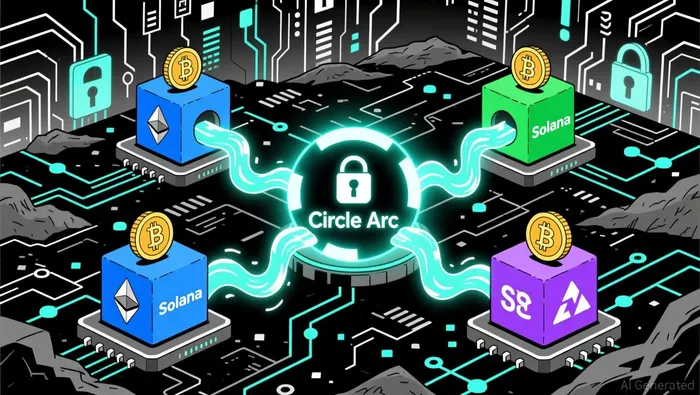 This dual approach-leveraging open-source innovation while consolidating in-house capabilities-mirrors broader industry trends where stablecoin issuers prioritize control over settlement layers to ensure scalability and security according to a market report. Nikhil Chandhok, Circle's Chief Product and Technology Officer, emphasized the goal of "making blockchain connectivity seamless," a vision aligned with the company's roadmap to position Arc as the "hub for multichain internet finance" as stated in the official announcement.
USDC's Infrastructure-Driven Edge
The acquisition directly enhances USDC's market position by addressing two key pain points: user experience and institutional adoption. By enabling frictionless cross-chain movement of USDCUSDC--, Circle reduces the technical barriers that have historically hindered stablecoin utility. This is particularly critical as institutional players demand interoperable solutions for treasury management, DeFi integration, and cross-border payments according to a recent report.
Data from Circle's Q3 2025 earnings report underscores the growing institutional traction for USDC. With $73.7 billion in circulation-a 108% year-over-year increase-and a 29% share of stablecoin volume, USDC's infrastructure now includes the Circle Payments Network (CPN), which connects 29 financial institutions across eight countries according to the earnings release. Partnerships with FIS, Visa, and Deutsche Börse further amplify USDC's reach, embedding it into traditional finance's money movement and capital markets infrastructure according to a partnership announcement.
Regulatory Tailwinds and Infrastructure Competition
The U.S. regulatory landscape has shifted dramatically in 2025, with the GENIUS Act mandating 1:1 asset backing for stablecoins and banning rehypothecation. This clarity has bolstered institutional confidence, with 86% of firms reporting stablecoin-ready systems according to a market analysis. Circle's compliance-first approach, combined with its infrastructure investments, positions it to outpace competitors like TetherUSDT--, whose USDT, while dominant in market cap ($175 billion as of Q3 2025), faces scrutiny over transparency according to a market intelligence report.
Infrastructure is now the new frontier of competition. As noted in a Fireblocks report, the next wave of dominance will belong to issuers with robust operational and cybersecurity maturity, capable of managing 200–500 institutional stablecoins in parallel according to industry insights. Circle's Arc blockchain, already attracting over 100 institutional participants, is designed to meet these demands, offering programmable smart contracts and tokenized financial systems according to a CEO statement.
The Path to Dominance: From Token to Ecosystem
Circle's vision extends beyond USDC's token utility. By building an "Economic OS" for the internet-enabling programmable value transfer-Circle aligns with broader fintech trends toward capital efficiency and real-time settlements. The potential launch of a native token on the Arc network could further align stakeholder incentives, creating a flywheel effect for adoption according to a financial analysis.
However, challenges remain. USDC's volatility in 2025, driven by regulatory headwinds in Europe, highlights the risks of navigating a fragmented global framework. Yet, the acquisition of Interop Labs signals a long-term commitment to infrastructure resilience, a trait that will likely distinguish Circle in a market where trust and scalability are paramount according to market analysis.
Conclusion
Circle's acquisition of Interop Labs is not merely a technical upgrade-it is a strategic masterstroke in the race to define the future of global payments. By consolidating cross-chain infrastructure, aligning with regulatory clarity, and expanding institutional partnerships, Circle is positioning USDC as the backbone of a multichain financial ecosystem. As stablecoins transition from crypto curiosities to fintech cornerstones, the company's infrastructure-driven approach may well determine the next era of digital asset dominance.





Comentarios
Aún no hay comentarios