
Circle’s Native USDC and CCTP V2 Integration on Hyperliquid: A Catalyst for Scalable DeFi Infrastructure
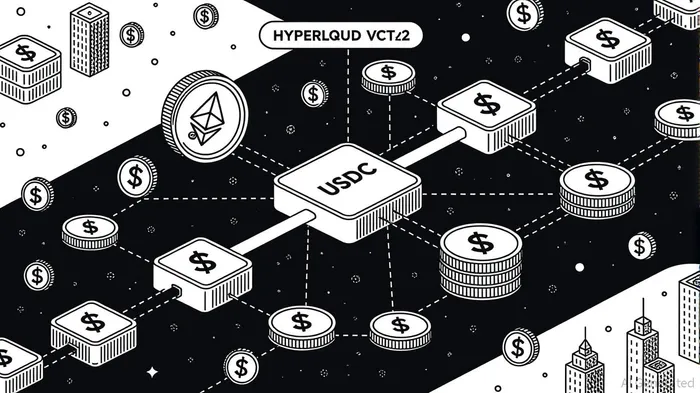
The integration of Circle’s native USDCUSDC-- and Cross-Chain Transfer Protocol (CCTP) V2 on Hyperliquid marks a pivotal advancement in decentralized finance (DeFi). By eliminating reliance on third-party bridges and enabling trust-minimized cross-chain transfers, this collaboration addresses critical pain points in liquidity, security, and scalability. For investors, the implications are profound: Hyperliquid’s architecture, combined with institutional-grade USDC infrastructure, positions the platform as a strategic nexus for on-chain finance flows, potentially driving exponential growth in trading volume, token utility, and institutional adoption.
The Bridge Risk Conundrum and CCTP V2’s Solution
Traditional cross-chain transfers rely on intermediaries or liquidity pools, exposing users to counterparty risk and smart contract vulnerabilities. According to a report by Coinedition, Circle’s CCTP V2 mitigates these risks by enabling native USDC to teleport between blockchains via a “burn-and-mint” process, bypassing the need for wrapped tokens or centralized bridges [1]. This mechanism ensures 1:1 capital efficiency, as assets are not locked in pools or custodied by third parties. For platforms like Hyperliquid, which handles $7.7 million in daily trading fees, the reduction of friction in cross-chain liquidity is a game-changer [4].
The significance of this innovation is underscored by the limitations of bridged stablecoins like USDC.e. As outlined in a Medium analysis, these tokens lack direct oversight from CircleCRCL--, creating compliance and regulatory gaps [2]. By contrast, native USDC on Hyperliquid—deployed via HyperEVM—retains full regulatory compliance and institutional access through Circle Mint, a feature critical for attracting institutional capital [1]. This alignment with compliance standards not only reduces operational risk but also enhances Hyperliquid’s appeal to institutional investors seeking transparency in DeFi.
Hyperliquid’s Dual-Layer Architecture: A Foundation for Scalability
Hyperliquid’s integration of native USDC and CCTP V2 is underpinned by its dual-layer architecture: HyperCore, a high-speed order book decentralized exchange (DEX), and HyperEVM, an Ethereum-compatible smart contract platform. This design enables seamless liquidity sharing between on-chain applications and derivatives trading, a rarity in the DeFi space. Data from Yellow.com reveals that Hyperliquid has captured 70% of USDC on the Arbitrum network, with assets under management (AUM) surging from $4 billion to $5.5 billion in a single month [4]. Such growth is a testament to the platform’s ability to aggregate liquidity across chains while maintaining low latency and high throughput.
The HyperBFT consensus mechanism further amplifies this advantage by enabling real-time smart contract execution and order book updates. For institutional players, this translates to reduced slippage and faster execution, critical factors in derivatives trading. As stated by Circle in its blog, the deployment of native USDC on HyperEVM allows users to directly deposit the stablecoin into HyperCore for trading or utilize it in decentralized applications (dApps) for stable settlement [1]. This integration not only enhances user experience but also creates a flywheel effect: deeper liquidity attracts more traders, which in turn drives higher fees and token utility for HYPE, Hyperliquid’s native token.
Institutional Adoption and Investor Returns
The strategic alignment between Circle and Hyperliquid is not merely technical—it is economic. By offering a secure, compliant, and efficient cross-chain infrastructure, Hyperliquid is positioning itself as a gateway for institutional capital into DeFi. According to Mitrade, Circle’s broader partnerships with chains like World Chain and XDC Network reflect a deliberate effort to expand native USDC’s reach, further solidifying its dominance in the stablecoin market [3]. For Hyperliquid, this means access to a broader pool of liquidity providers and institutional traders, who are increasingly seeking alternatives to centralized exchanges.
Investor returns are already showing signs of momentum. As noted in a MEXC analysis, the implementation of native USDC and CCTP V2 on Hyperliquid has contributed to a 3% price increase in HYPE, the platform’s governance token [3]. This trend is likely to accelerate as the platform’s AUM and trading volume grow. With Hyperliquid’s daily fees surpassing those of major blockchain networks [4], the economic model is robust, and the integration of CCTP V2 could act as a catalyst for further adoption.
Conclusion: A Strategic Hub for the Future of DeFi
Circle’s native USDC and CCTP V2 integration on Hyperliquid is more than a technical upgrade—it is a strategic repositioning of the platform as a cross-chain hub for institutional and on-chain finance. By eliminating bridge risk, enhancing capital efficiency, and aligning with regulatory standards, Hyperliquid is addressing the core challenges that have hindered DeFi’s mass adoption. For investors, the combination of institutional-grade liquidity, scalable infrastructure, and a growing user base presents a compelling case for long-term value creation. As the DeFi ecosystem continues to evolve, Hyperliquid’s ability to bridge the gap between speed, security, and compliance may well define its trajectory—and that of the broader market.
**Source:[1] Circle to Launch Its Native USDC Stablecoin on Hyperliquid [https://coinedition.com/hyperliquid-integrates-circles-usdc-and-cctp-v2-to-boost-defi-ecosystem/][2] USDC.e: Bridged USD Coin in Multi-Chain Ecosystems [https://medium.com/@gwrx2005/usdc-e-bridged-usd-coin-in-multi-chain-ecosystems-38cb8850a528][3] Circle initiates several partnerships to integrate its USDC [https://www.mitrade.com/insights/news/live-news/article-3-1003355-20250801][4] Hyperliquid Sets Record $29B Trading Volume as HYPE ... [https://yellow.com/news/hyperliquid-sets-record-dollar29b-trading-volume-as-hype-token-surges-to-near-all-time-high-of-dollar49]





Comentarios
Aún no hay comentarios