
Circle's Expanding Tokenized Asset Strategy: Risks and Opportunities in a Fragmented Ecosystem
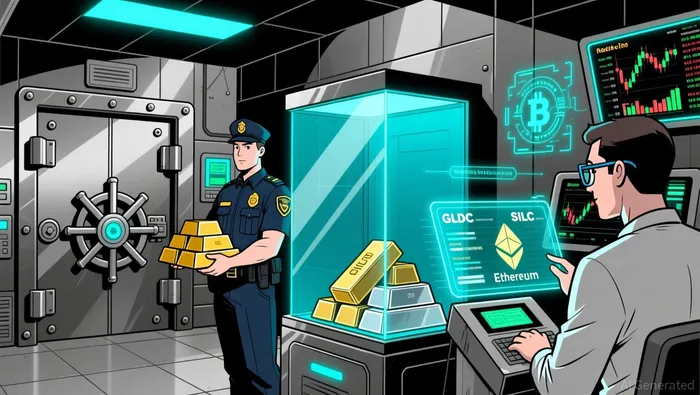
Circle's recent foray into tokenized precious metals-gold (GLDC) and silver (SILC)-marks a significant evolution in its broader vision for USDCUSDC-- as a universal settlement layerLAYER--. Launched via the newly announced platform CircleMetals.com, the initiative allows users to swap USDC for GLDC or SILC at live market rates, leveraging liquidity from COMEX reference markets according to the announcement. While the December 24th announcement provided official confirmation of these tokens, the journey from unverified speculation to reality reveals critical insights into the risks and opportunities inherent in tokenizing real-world assets (RWAs).
The Promise of Tokenized Precious Metals
Tokenization of gold and silver offers transformative potential. By enabling fractional ownership and 24/7 trading on blockchain platforms, GLDC and SILC democratize access to traditionally illiquid assets as research shows. For instance, a single gram of gold can now be represented as a programmable token on EthereumETH--, allowing investors to trade, lend, or collateralize it with unprecedented efficiency. This aligns with Ethereum's ongoing upgrades, including Layer 2 solutions that reduce gas costs and improve transaction throughput according to industry analysis, making tokenized assets more accessible to a global audience.
Circle's approach also emphasizes transparency. Each GLDC or SILC token is backed by physical reserves, with transactions recorded on an immutable ledger. This contrasts sharply with opaque traditional systems, where verifying the authenticity of physical metals often requires intermediaries as noted in research. For developers, the programmability of these tokens opens new possibilities for DeFi integrations, such as using GLDC as collateral for stablecoin loans or creating synthetic exposure to precious metals via derivatives.
Unverified Reports and the Shadow of Skepticism
Prior to the official launch, rumors about GLDC and SILC circulated widely in digital asset circles according to community reports. A standalone website, circlemetals.com, emerged as a focal point for speculation, though it was not linked to Circle's official domains or regulatory filings as reported. This ambiguity highlights a recurring challenge in the RWA space: distinguishing between genuine innovation and vaporware. While Circle's December announcement validated the project, the initial lack of transparency raises questions about due diligence. Investors must ask: How can they verify the authenticity of tokenized assets before official confirmation?
The answer lies in robust custodial frameworks. For GLDC and SILC to gain trust, CircleCRCL-- must demonstrate that its physical reserves are securely stored and audited by third parties. This is no small task. Tokenized metals require not only technical infrastructure but also operational rigor to ensure that redemption processes are reliable and that tokens correspond to real-world assets as research shows. Without this, the risk of "tokenized alchemy"-where digital representations diverge from physical reality-remains high.
Regulatory and Operational Risks
The fragmented regulatory landscape poses another hurdle. While USDC operates under a relatively clear compliance framework, tokenized precious metals introduce new complexities. For example, cross-border trading of GLDC and SILC may trigger jurisdictional conflicts, as different countries impose varying rules on precious metals ownership and taxation. A report by the International Monetary Fund (IMF) notes that harmonizing these standards is a "long-term challenge" for global markets as noted in the report.
Moreover, compliance with KYC and AML regulations becomes more intricate in decentralized environments. Unlike traditional exchanges, where identity verification is centralized, blockchain-based platforms must balance privacy with regulatory obligations. Circle's reliance on Ethereum's public ledger offers some transparency, but it also raises concerns about data privacy and the potential for misuse by bad actors as industry analysis indicates.
Operational risks further complicate the equation. Physical custody of gold and silver requires trusted partners, such as vaults and logistics providers, to ensure assets are not lost or stolen. A single breach could erode confidence in the entire tokenized system. Additionally, market volatility-both in the underlying metals and the crypto ecosystem-could strain liquidity. During periods of financial stress, tokenized metals may underperform compared to physical gold or BitcoinBTC--, as historical data shows.
Broader Implications for the Tokenized Asset Ecosystem
Circle's move underscores a larger trend: the convergence of traditional finance and blockchain. By anchoring USDC to real-world assets like gold and silver, Circle aims to bridge the gap between fiat-backed stablecoins and tangible value. However, this strategy hinges on solving the "last-mile problem"-ensuring that tokenized assets are as reliable as their physical counterparts.
For Ethereum, the success of GLDC and SILC could reinforce its position as the dominant settlement layer for RWAs. The network's ongoing upgrades, including Ethereum 2.0 and rollup scaling solutions, position it to handle the increased transaction volume from tokenized assets according to industry analysis. Yet, competition looms. Other blockchains, such as SolanaSOL-- and AvalancheAVAX--, are also vying for a share of the RWA market, potentially fragmenting the ecosystem further.
Conclusion: Balancing Innovation and Caution
Circle's tokenized gold and silver represent a bold step forward, but they also expose the fragility of the RWA ecosystem. While the benefits of liquidity, transparency, and programmability are undeniable, the risks-authenticity, regulatory uncertainty, and operational complexity-cannot be ignored. Investors must approach these assets with a critical eye, demanding rigorous audits and clear governance structures.
For now, GLDC and SILC serve as a litmus test for the broader tokenization movementMOVE--. If Circle can navigate the challenges ahead, it may pave the way for a new era of asset-backed digital finance. But in a fragmented and rapidly evolving market, the line between innovation and instability is razor-thin.





Comentarios
Aún no hay comentarios