
Circle's CRCL Stock: A 2026 Hold Amid Regulatory Uncertainty and Strategic Transformation
Circle's CRCLCRCL-- stock has faced a turbulent 2025, marked by a 59% price plunge despite robust financial performance and strategic expansion. As the company navigates a rapidly evolving regulatory landscape and accelerates its transformation into a financial infrastructure platform, investors must weigh the long-term potential of its platform diversification and USDCUSDC-- growth against persistent compliance risks. This analysis argues that CRCL remains a cautious hold for 2026, supported by its market-leading stablecoin position and institutional-grade blockchain initiatives, but tempered by systemic regulatory uncertainties.
Strategic Diversification: Arc and CPN as Growth Catalysts
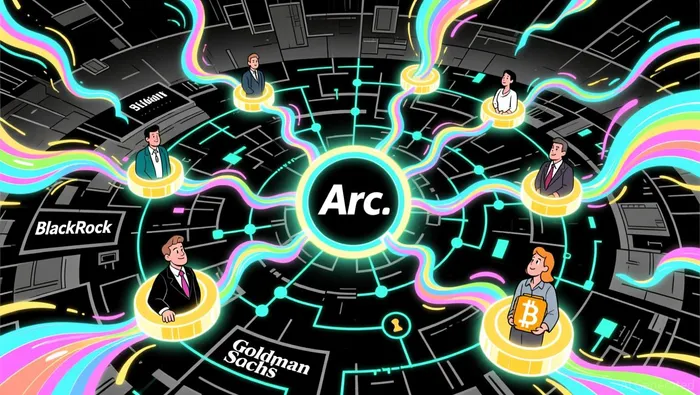
Circle's strategic pivot beyond USDC into enterprise-grade blockchain infrastructure is a critical long-term play. The Arc initiative, a Layer-1 blockchain designed as an "economic operating system for the internet," has gained momentum with a public testnet launched in Q3 2025, attracting over 100 institutional participants, including BlackRock and Goldman Sachs according to Q3 2025 presentation. The planned 2026 mainnet rollout, coupled with potential governance and incentive mechanisms via a native token, signals Circle's ambition to capture a broader slice of the institutional blockchain market.
Simultaneously, the CircleCRCL-- Payments Network (CPN) is emerging as a cross-border payment backbone. With 29 enrolled financial institutions and a pipeline of 500 additional entities, CPN's annualized transaction volume reached $3.4 billion in Q3 2025. This growth underscores Circle's ability to monetize its stablecoin ecosystem by offering infrastructure services, a strategy that could diversify revenue streams beyond reserve income.
USDC's Dominance and Growth Trajectory
USDC remains the cornerstone of Circle's value proposition. As of Q3 2025, USDC circulation hit $73.7 billion, doubling year-over-year, while on-chain transaction volume surged to $9.6 trillion. The stablecoin now commands 29% of the market by circulation and 40% of stablecoin transactions, solidifying its role as a de facto standard in DeFi, payments, and institutional capital markets.
Circle's multi-year target of 40% compound annual growth in USDC circulation appears achievable, supported by a 77% year-over-year increase in meaningful wallet addresses to 6.3 million. Non-reserve revenue, driven by services like CPN and Arc, also grew 52.1x year-over-year to $29 million in Q3 2025, highlighting the company's progress in monetizing its ecosystem.
Regulatory Risks: A Double-Edged Sword
The 2025 passage of the U.S. GENIUS Act introduced both clarity and uncertainty for Circle. While the legislation affirmed stablecoins like USDC as non-securities and non-national currencies, it also imposed stricter reserve requirements, mandating monthly financial disclosures and limiting permissible reserves to specific assets-including uninsured bank deposits. This creates a paradox: Circle's reliance on such deposits exposes USDC to liquidity risks during financial stress, as seen in the 2023 Silicon Valley Bank collapse and a 2025 depegging event triggered by U.S.-China trade tensions.
Moreover, the rise of DeFi lending platforms has amplified systemic risks. Retail investors lending USDC for yield generate leveraged positions that can destabilize during market downturns, a vulnerability regulators are increasingly scrutinizing. While Circle's conditional approval for a national trust bank charter from the OCC bolsters institutional confidence, the high costs of compliance and Arc development have already pressured margins, contributing to the stock's 59% decline in 2025.
Balancing the Equation: A Cautious Hold for 2026
Circle's strategic initiatives-Arc, CPN, and USDC's institutional adoption-position it as a leader in the digital financial infrastructure race. The company's 2025 revenue surge to $740 million, driven by reserve income and cross-border payments, demonstrates its ability to scale. However, regulatory tailwinds are offset by headwinds: the GENIUS Act's implementation ambiguities, redemption risks, and the inherent volatility of DeFi lending create a high-risk environment.
For CRCL to justify a 2026 hold, investors must accept that regulatory clarity will likely lag behind technological adoption. Circle's conditional bank charter and partnerships with entities like Intercontinental Exchange suggest it is proactively addressing compliance challenges. Yet, the stock's valuation remains sensitive to macroeconomic shifts and regulatory sentiment, as evidenced by its 4.5% pre-market drop in Q3 2025 despite strong earnings.
Conclusion
Circle's CRCL stock embodies the duality of innovation and risk in the crypto-adjacent sector. While its platform diversification and USDC's market dominance offer compelling long-term upside, the regulatory environment remains a wildcard. A cautious hold is warranted for 2026, contingent on the successful launch of Arc, sustained USDC growth, and the company's ability to navigate evolving compliance demands without sacrificing scalability. Investors should monitor the interplay between institutional adoption and regulatory outcomes, as these factors will ultimately determine CRCL's trajectory in the coming year.







Comentarios
Aún no hay comentarios