
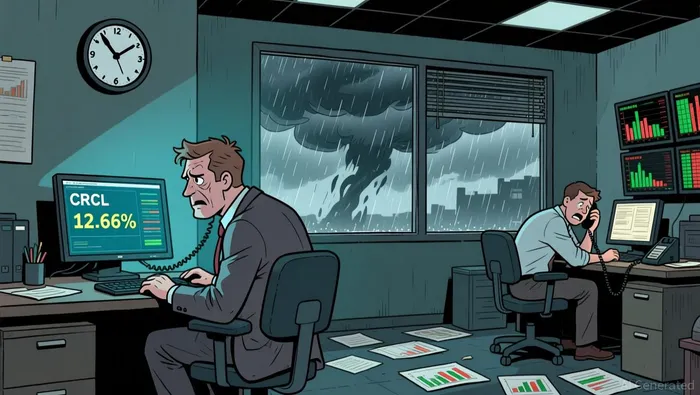
Circle CRCL Plunges 12.66% to 2025 Low on Earnings Skepticism
The share price fell to its lowest level since June 2025 today, with an intraday decline of 12.66%. CircleCRCL-- (CRCL) has now lost 17.10% over two trading days, marking a significant reversal from its post-IPO surge earlier this year.
Despite reporting robust Q3 2025 results—including a 66% year-over-year revenue increase to $740 million and a 202% jump in net income to $214 million—the stock plummeted 9.3% after earnings. The disconnect between financial performance and market reaction highlights investor skepticism about Circle’s ability to sustain profitability amid rising non-cash expenses, such as IPO-related costs and fair-value adjustments. The company also reported a $4.48-per-share net loss in Q2 2025, underscoring earnings volatility.
Circle’s USDCUSDC-- stablecoin saw record adoption, with circulation surging 108% to $73.7 billion and a 680% increase in on-chain transaction volume to $9.6 trillion. Strategic partnerships with Deutsche Börse, Visa, and Kraken have expanded its institutional footprint, while the Arc public testnet attracted over 100 firms. However, competition from TetherUSDT-- and regulatory scrutiny of stablecoins pose risks to its market share and innovation momentumMMT--.
Analyst sentiment remains divided, with J.P. Morgan maintaining a “Sell” rating due to overvaluation concerns, while Monness Crespi Hardt and Wells Fargo initiated “Buy” ratings. The stock has retreated 8.7% year-to-date after a 235% post-IPO rally in June, reflecting ongoing debates about its valuation and long-term growth potential. Institutional backing, including Renaissance Capital’s $6.79 million stake in September, signals cautious optimism, but operational challenges and regulatory uncertainties persist.
Circle’s path forward hinges on balancing rapid growth with profitability, navigating a complex regulatory landscape, and differentiating itself in a crowded stablecoin market. With USDC’s market share now at 29%, the company’s ability to sustain adoption and execute on strategic initiatives will be critical in determining whether its recent selloff represents a buying opportunity or a warning sign of deeper structural risks.







Comentarios
Aún no hay comentarios