
Circle's 14% Stock Surge and the Implications for Stablecoin and DeFi Markets
The 14% surge in Circle's stock during Q3 2025 reflects a confluence of strategic, regulatory, and market-driven catalysts that position the company at the intersection of stablecoin innovation and decentralized finance (DeFi). To assess the sustainability of this rally, it is critical to dissect the underlying fundamentals, macroeconomic context, and evolving regulatory landscape shaping Circle's trajectory.
Fundamentals: Regulatory Clarity and Infrastructure Innovation
Circle's stock performance has been anchored by its ability to navigate regulatory uncertainty—a persistent headwind for the crypto sector. The enactment of the GENIUS Act in June 2025, which established a federal framework for payment stablecoins, marked a turning point. By providing legal clarity for USDCUSDC-- operations, the act solidified Circle's position as the leading regulated stablecoin issuer, reducing counterparty risk and attracting institutional adoption .
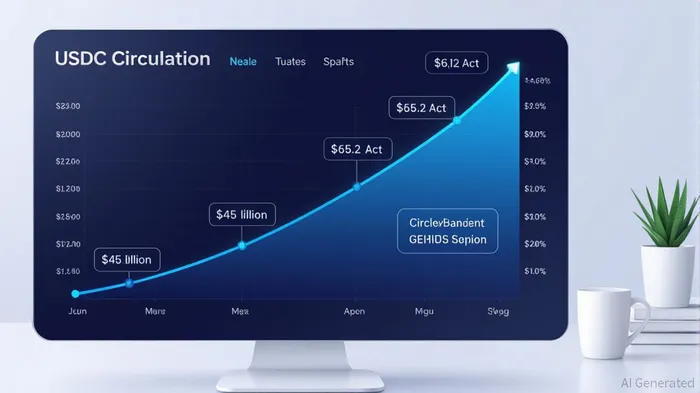
Simultaneously, Circle's Circle Payments Network (CPN), launched in May 2025, expanded the utility of USDC by enabling cross-border transactions for financial institutionsFISI--. This infrastructure innovation not only diversified revenue streams but also demonstrated the scalability of stablecoin-based payments. Complementing this, strategic partnerships with entities like Binance, FIS, and OKX further integrated USDC into both crypto-native and traditional financial ecosystems, driving circulation to $65.2 billion by August 2025 .
Financial metrics reinforce this narrative: Circle's Adjusted EBITDA surged 52% year-over-year to $126 million in Q2 2025, reflecting improved operational efficiency and pricing power in its payment and custody services . These fundamentals suggest a self-reinforcing cycle of adoption, regulation, and profitability.
DeFi Integration: Building the Infrastructure of the Future
Circle's foray into DeFi has been equally transformative. The Circle Gateway, a cross-chain solution for USDC, and the launch of Arc, an open Layer-1 blockchain tailored for stablecoin finance, underscore the company's commitment to interoperability and capital efficiency. By enabling seamless liquidity across EthereumETH--, AlgorandALGO--, and other blockchains, CircleCRCL-- has positioned USDC as a cornerstone of DeFi protocols, from lending platforms to decentralized exchanges .
This infrastructure-driven approach aligns with broader trends in DeFi, where stablecoins serve as the “base currency” for yield generation and risk management. As of August 2025, USDC's DeFi exposure accounted for over 30% of its total circulation, a figure that is expected to grow with the maturation of Arc's ecosystem .
Macro Drivers: Uncertainty and Opportunity
While Circle's fundamentals are robust, macroeconomic headwinds persist. Global growth is projected to slow to 2.3% in 2025 amid geopolitical instability, AI-driven labor shifts, and U.S. tariff policies . These factors introduce volatility into capital allocation decisions, particularly for high-growth tech stocks. However, Circle's focus on regulated, utility-driven stablecoins insulates it from some of the speculative pressures affecting the broader crypto market.
Notably, the absence of concrete data on 2025 interest rates and inflation complicates long-term projections. If central banks maintain accommodative policies to offset global slowdowns, stablecoin demand—particularly in cross-border remittances and DeFi—could remain resilient. Conversely, a tightening cycle might dampen speculative activity in DeFi, though Circle's institutional-grade offerings are less sensitive to such shifts.
Market Sentiment: Confidence in Regulatory Alignment
Investor sentiment has been buoyed by Circle's proactive engagement with regulators. The GENIUS Act not only reduced legal ambiguity but also signaled a broader acceptance of stablecoins as a legitimate financial asset class. This alignment with regulatory priorities has attracted a new cohort of institutional investors, including asset managers and fintech firms seeking exposure to the “crypto infrastructure” narrative.
However, skepticism remains. Critics argue that the sustainability of Circle's rally depends on continued regulatory support and the absence of systemic risks in the stablecoin sector. While the company's 100% reserve-backed model mitigates some concerns, macroeconomic shocks—such as a sudden liquidity crunch—could test its resilience.
Conclusion: A Sustainable Rally?
Circle's 14% stock surge is underpinned by a unique combination of regulatory tailwinds, infrastructure innovation, and strategic partnerships. The company's ability to bridge traditional finance and DeFi, coupled with a growing institutional user base, suggests that the rally has legs. However, macroeconomic uncertainties and the lack of granular data on interest rates and inflation necessitate a cautious outlook.
For investors, the key question is whether Circle can maintain its first-mover advantage in a rapidly evolving landscape. If the company continues to expand its cross-border payment network and solidify Arc's role in DeFi, the current valuation appears justified. Conversely, regulatory reversals or macroeconomic shocks could temper growth. In the near term, the sustainability of the rally hinges on Circle's execution against its ambitious infrastructure roadmap and the broader adoption of USDC as a global payment standard.
Source:
[1] In charts: 7 global shifts defining 2025 so far, [https://www.weforum.org/stories/2025/08/inflection-points-7-global-shifts-defining-2025-so-far-in-charts/]
[6] Circle Reports Second Quarter 2025 Results [https://www.circle.com/pressroom/circle-reports-second-quarter-2025-results]





Comentarios
Aún no hay comentarios