
Choosing Between VCLT and TLT for Long-Term Bond Exposure
In an environment where bond yields remain stubbornly low, investors seeking long-term fixed-income exposure face a critical decision: balancing cost efficiency, yield potential, and risk. Two prominent exchange-traded funds (ETFs) in this space-Vanguard Long-Term Corporate Bond ETF (VCLT) and iShares 20+ Year Treasury Bond ETF (TLT)-offer distinct trade-offs. This analysis examines their expense ratios, yield profiles, and duration characteristics to help investors navigate these choices.
Cost Efficiency: The Vanguard Advantage
Cost efficiency remains a cornerstone of long-term investment success, particularly in low-yield markets where small differences in expense ratios compound over time. VCLTVCLT--, with an expense ratio of 0.03%, starkly outperforms TLT's 0.15%. This 0.12% gap reflects Vanguard's institutional-scale cost structure, which prioritizes minimizing fees for passive investors. For a $100,000 portfolio, this difference translates to $120 in annual savings-a material advantage over decades. TLTTLT--, while still relatively low-cost, carries higher operational expenses, partly due to its focus on longer-dated Treasuries, which require more active management to maintain duration alignment.
Yield Analysis: Corporate Bonds Outperform Treasuries
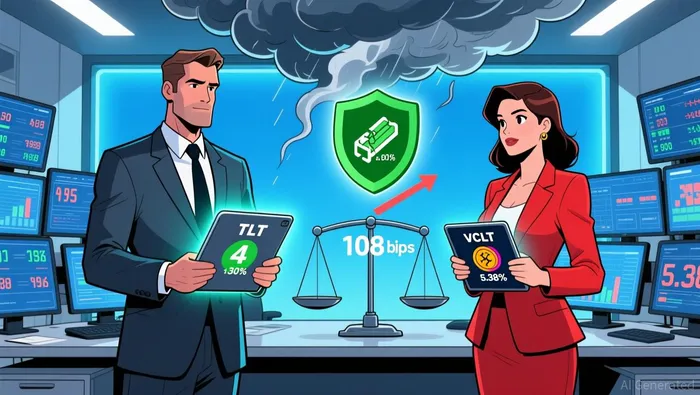 Yield differentials between VCLT and TLT have widened in 2025, with VCLT offering a 5.38% annual dividend yield compared to TLT's 4.30% according to data. This 108-basis-point spread is near a decade low, reflecting persistent suppression of Treasury yields by central bank policies and a flight to quality in corporate bonds. For income-focused investors, VCLT's higher yield is compelling, especially in a low-yield environment where incremental returns are hard to come by. However, this premium comes with caveats: corporate bonds carry credit risk, and VCLT's portfolio includes issuers with varying credit profiles, unlike TLT's government-backed Treasuries.
Risk Considerations: Duration, Credit, and Liquidity
Duration-a measure of interest rate sensitivity-distinguishes the two funds. TLT is designed to track U.S. Treasury bonds with maturities exceeding 20 years, resulting in a longer duration and greater price volatility during rate hikes. VCLT, by contrast, holds corporate bonds with maturities spanning 10 to 25 years, offering a shorter average duration and potentially reduced sensitivity to rate changes. This structural difference makes TLT more volatile in rising-rate environments but could enhance capital preservation during rate declines.
Credit risk further differentiates the two. While Treasuries are free from default risk, VCLT's corporate bonds expose investors to issuer-specific risks. However, the fund's diversified portfolio-weighted toward investment-grade issuers-mitigates this concern. A third factor is liquidity: TLT's $48.7 billion in assets under management dwarfs VCLT's, offering deeper liquidity and tighter bid-ask spreads, which is advantageous for frequent traders or large institutional investors.
Conclusion: Weighing Trade-Offs in a Low-Yield World
The choice between VCLT and TLT ultimately hinges on investor priorities. For those prioritizing cost efficiency and yield, VCLT's low expense ratio and higher dividend yield make it an attractive option, particularly for long-term, buy-and-hold strategies. Its shorter duration and diversified corporate bond exposure also offer a balanced risk profile. Conversely, TLT appeals to investors valuing liquidity, simplicity, and the safety of government-backed securities, despite its higher costs and lower yield.
In a low-yield environment, where maximizing returns while managing risk is paramount, VCLT's combination of low fees and robust yield appears more aligned with long-term wealth accumulation. However, investors must weigh the added credit risk and ensure it aligns with their risk tolerance. As always, diversification and alignment with broader portfolio goals remain critical.







Comentarios
Aún no hay comentarios