
Choosing Between IonQ and Rigetti Computing in 2026: A Quantum Leap in Innovation or a Risky Bet?
The quantum computing sector in 2026 remains a high-stakes arena, where technological differentiation, regulatory tailwinds, and market execution define the trajectory of companies like IonQIONQ-- and Rigetti ComputingRGTI--. As investors weigh the risks and rewards of these two pioneers, the stakes are amplified by the sector's inherent volatility and the race to achieve commercial quantum advantage. This analysis examines their contrasting approaches through the lenses of technology, market positioning, and regulatory traction, offering a framework for assessing which company is better positioned to deliver long-term value.
Technological Differentiation: Trapped-Ion Precision vs. Superconducting Scalability
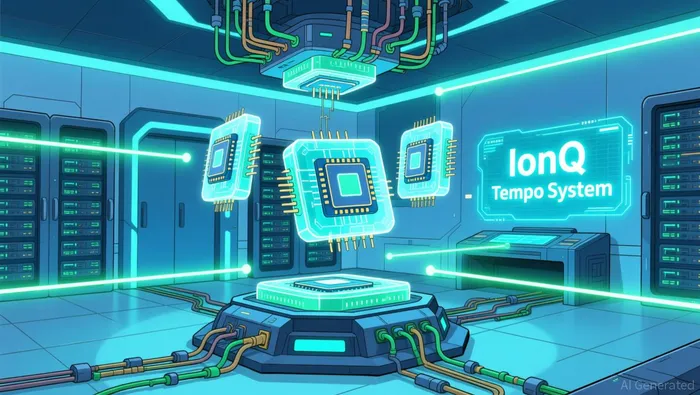
IonQ's trapped-ion architecture has emerged as a standout in 2026, with its two-qubit gate fidelity surpassing 99.99% in October 2025. This level of precision reduces error-correction overhead, a critical factor for achieving practical quantum advantage. By operating at room temperature, IonQ also avoids the cryogenic infrastructure costs that plague superconducting qubit systems. Its Tempo system, deployed three months ahead of schedule, boasts an algorithmic qubit score of 64, underscoring its ability to translate lab breakthroughs into scalable hardware.
Rigetti Computing, by contrast, relies on superconducting qubits, which offer faster gate speeds but require extreme cooling and face fidelity challenges. While Rigetti aims to deploy a 150+ qubit system with 99.7% fidelity by year-end 2026, its roadmap has been marred by delays. A key differentiator for RigettiRGTI-- is its modular chiplet strategy, which allows linking multiple dies to scale systems. However, this approach demands overcoming technical hurdles in coherence and error rates.
The scalability debate hinges on trade-offs: IonQ's trapped-ion technology excels in fidelity and environmental practicality but lags in gate speed, while Rigetti's superconducting qubits offer faster operations but grapple with cryogenic complexity. Innovations like time-division multiplexing (TDM) in trapped-ion systems, which reduce wiring complexity by 100-fold, suggest IonQ is making strides in addressing scalability concerns.
Market Positioning: Revenue Growth vs. Strategic Resilience
IonQ's commercial momentum in 2026 is undeniable. Third-quarter revenues surged 222% year-over-year to $39.9 million, far outpacing its previous guidance and reflecting strong demand for its cloud-based quantum services. Strategic partnerships with enterprises and government contracts-bolstered by its inclusion in DARPA's Quantum Benchmarking Initiative-have solidified its market position. With no debt and $3.5 billion in cash, IonQ has the financial flexibility to invest aggressively in R&D and customer acquisition.
Rigetti's market progress, however, appears more precarious. Despite a robust $600 million cash reserve, its third-quarter revenues declined 18% year-over-year in 2025, signaling challenges in converting R&D into recurring revenue. Exclusion from DARPA's Stage B benchmarking initiative-a program designed to validate utility-scale quantum computing-has further complicated its path to commercialization. While Rigetti's modular architecture and industry partnerships (e.g., with AWS and startups) provide a foundation for growth, its execution risks remain pronounced.
Regulatory Traction: Federal Funding as a Double-Edged Sword
Both companies benefit from a regulatory environment primed to accelerate quantum innovation. The U.S. Department of Energy's $625 million renewal of the National Quantum Initiative in November 2025 and the Federal Reserve's rate cuts have eased capital constraints for deep-tech firms. IonQ's inclusion in DARPA's QBI program and Rigetti's participation in the DOE's Quantum Leadership Act highlight their alignment with federal priorities.
Yet regulatory support is not a guarantee of success. The reauthorization of the National Quantum Initiative for 2025–2029, with competing House and Senate bills proposing increased funding, introduces uncertainty in funding allocation. For IonQ, this means leveraging its technological edge to secure a larger share of government contracts; for Rigetti, it requires demonstrating that its superconducting qubit roadmap justifies continued investment despite delays.
Scalability Risks and Industry Adoption: A Tale of Two Timelines
While IonQ's trapped-ion approach is lauded for its fidelity, scalability risks persist. The complexity of wiring and control in large-scale systems remains a hurdle, though innovations like photonic interconnects and TDM are mitigating these challenges. Analysts project IonQ could achieve a 20,000-fold increase in computing power by 2030, a timeline that assumes sustained R&D breakthroughs.
Rigetti's superconducting qubits face different scalability risks, particularly in maintaining coherence across modular systems. However, its chiplet strategy and strong cash position provide flexibility to iterate on designs. The company's focus on enterprise partnerships and cloud integration suggests a pragmatic approach to commercialization, even if its technical execution lags.
Conclusion: A Quantum Leap or a Risky Bet?
Investors must weigh IonQ's technological leadership and revenue growth against its scalability challenges and Rigetti's modular strategy and financial resilience. IonQ's trapped-ion architecture, bolstered by high fidelity and federal backing, positions it as a safer long-term bet for those prioritizing innovation and commercialization speed. Rigetti, while technically ambitious, remains a riskier proposition due to its execution delays and revenue volatility.
In a sector where the first to achieve quantum advantage could dominate, IonQ's current trajectory-marked by outperforming revenue growth and a robust cash position-makes it the more compelling investment in 2026. However, Rigetti's modular approach and industry partnerships warrant continued scrutiny, particularly if it secures breakthroughs in error correction or wins key government contracts.





Comentarios
Aún no hay comentarios