
Chipotle's Strategic Reforms: A Path to Reviving Growth in 2026
In the shadow of a slowing economy and shifting consumer behavior, ChipotleCMG-- Mexican Grill has embarked on a recalibration of its strategy, betting that operational discipline and digital innovation can rekindle its growth trajectory. The company's third-quarter 2025 results, while showing resilience in revenue growth, underscored the fragility of its current model. With a 7.5% year-over-year revenue increase to $3.0 billion driven by 84 new restaurant openings and a 0.3% rise in comparable sales, Chipotle has not yet fully shaken off the drag of macroeconomic headwinds. Yet, as the company eyes 2026, its strategic initiatives-ranging from pricing adjustments to kitchen automation suggest a calculated pivot toward long-term value creation.
Pricing Strategy: Balancing Affordability and Profitability
Chipotle's pricing strategy has long been a double-edged sword. While its value menu has historically attracted budget-conscious consumers, rising input costs and inflation have forced a delicate balancing act. In Q3 2025, the company faced a decline in transactions, particularly among low- and middle-income households and its core 25-to-35 demographic, a trend attributed to broader economic pressures. To counter this, Chipotle has introduced targeted menu innovations, such as the Red Chimichurri sauce, to enhance perceived value without triggering price sensitivity. According to a report by Seeking Alpha, these efforts are part of a broader push to "differentiate offerings while maintaining affordability," a critical test in an era where consumers are increasingly price-averse.
Digital Upgrades: The Engine of Modernization
Digital transformation remains a cornerstone of Chipotle's growth narrative. In Q3 2025, digital sales accounted for 36.7% of total revenue, a figure that reflects the company's aggressive investment in mobile ordering, delivery, and loyalty programs.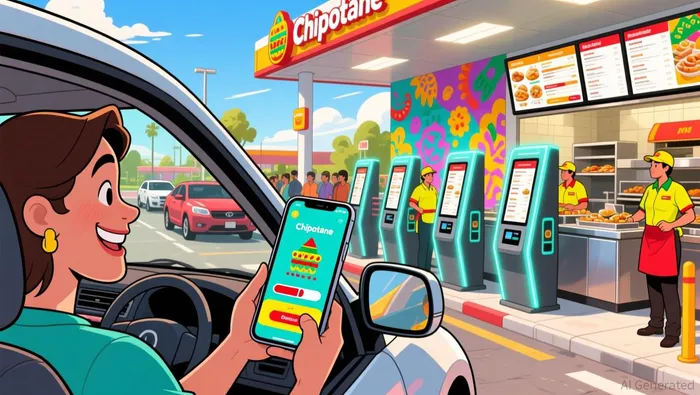 The expansion of "Chipotlanes"-drive-thru-only units designed to streamline service-has further amplified this digital push. Of the 84 new units opened in the quarter, 64 were Chipotlanes, a format that not only reduces labor costs but also accelerates order fulfillment, a key differentiator in a competitive quick-service landscape. As stated by management in its earnings call, these units are "strategically positioned to capture traffic in high-traffic areas" while reducing overhead, a hybrid model that could redefine efficiency in the fast-casual sector.
Unit Expansion: Scaling with Precision
Chipotle's 2026 unit growth ambitions-targeting 350 to 370 new locations-represent a bold bet on market saturation. The company's focus on Chipotlanes, which require lower capital expenditures than traditional units, allows for rapid expansion without overextending financial resources. This approach aligns with a broader industry trend toward "light-unit" formats, where density and convenience outweigh traditional dine-in footprints. However, the success of this strategy hinges on execution: opening too many units in a short period could dilute brand equity, while insufficient growth would leave market share on the table. For now, the math appears to check out. With 30.0% of revenue tied to food, beverage, and packaging costs, the company's unit economics remain vulnerable to commodity swings, but the HEAT equipment rollout-a $150 million investment aims to mitigate labor and waste costs by streamlining kitchen operations.
Navigating Cost Pressures and Consumer Shifts
Despite these strides, Chipotle cannot ignore the weight of external forces. Tariffs on Mexican imports and surging beef prices continue to erode margins, a challenge shared by peers like McDonald's and Taco Bell. Yet, the company's strategic playbook-combining menu innovation, digital engagement, and operational efficiency-positions it to absorb these shocks better than its competitors. As noted in a Fintool analysis, the HEAT rollout is expected to improve throughput by 15-20%, a critical lever for maintaining service speed amid labor shortages.
The Road Ahead: Execution as the Ultimate Test
Chipotle's 2026 roadmap is ambitious but not without risks. The company must prove that its pricing adjustments do not alienate its core customer base, that its digital tools translate into sustained engagement, and that its unit expansion does not become a liability. Yet, for investors willing to look beyond near-term volatility, the pieces are falling into place. The combination of a 36.7% digital sales contribution, a 7.5% revenue growth rate, and a capital-efficient unit model suggests a business that is not just surviving but recalibrating for a new era of fast-casual dining.
In the end, Chipotle's story is one of adaptation. Whether it can execute its reforms with the precision required to outpace rivals and outmaneuver macroeconomic headwinds will determine if its 2026 ambitions are more than just a hopeful forecast.







Comentarios
Aún no hay comentarios