
Chipotle's High-Efficiency Equipment Package (HEAP): A Catalyst for Revitalizing Unit Economics in a Competitive Market?
Chipotle Mexican Grill's High-Efficiency Equipment Package (HEAP) represents a bold strategic pivot aimed at addressing the dual challenges of operational inefficiency and margin compression in a crowded fast-casual market. As the company navigates a landscape where competitors like McDonald's and Starbucks are recalibrating their strategies, Chipotle's investment in kitchen technology and throughput optimization could prove pivotal in sustaining its unit economics and long-term value creation.
Operational Efficiency: The HEAPlifting Effect
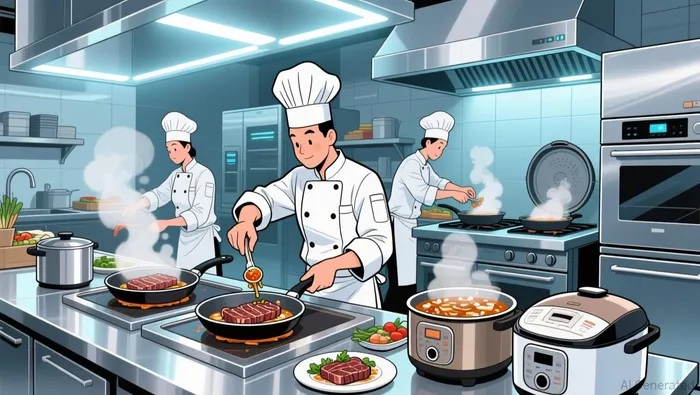
HEAP, introduced in 2025, centers on upgrading kitchen equipment to streamline food preparation and enhance labor productivity. Key components include dual-sided planchas, three-pan rice cookers, and higher-capacity fryers, all designed to reduce cook times and improve line flow according to Nasdaq. By the third quarter of 2025, the initiative had been deployed in 175 restaurants, with early results showing measurable gains in labor efficiency, culinary consistency, and guest satisfaction according to Nasdaq. These improvements are critical for a brand that relies on speed and customization to differentiate itself from rivals.
The rollout aligns with Chipotle's broader five-pillar strategy, which emphasizes operational execution as a cornerstone of growth according to Nasdaq. For instance, the dual-sided planchas enable cooks to prepare multiple items simultaneously, reducing bottlenecks during peak hours. Similarly, the three-pan rice cookers standardize portioning, minimizing waste and ensuring menu consistency-a factor that directly impacts customer retention. According to a report by Nasdaq, these upgrades are expected to support higher throughput, allowing restaurants to handle increased order volumes without proportionally scaling labor costs according to Nasdaq.
Financial Implications: Yield Savings and Margin Resilience
While specific cost savings or ROI figures for HEAP remain undisclosed, the initiative's potential to bolster unit economics is evident. Chipotle's Q3 2025 earnings report noted a 24.5% restaurant-level operating margin, a figure that underscores the company's ability to maintain profitability despite macroeconomic headwinds according to AOL. Management attributes this resilience to yield savings from operational improvements like HEAP, which reduce food waste and labor expenses according to Nasdaq.
Comparative analysis with competitors further highlights Chipotle's strategic edge. McDonald's, for example, leverages its integrated real estate model and value-driven promotions (e.g., $5 Meal Deals) to sustain margins of 45-47% according to KoalaGains. Starbucks, meanwhile, is refocusing on store-level service and cost control under its "Back to Starbucks" turnaround plan according to Nasdaq. Chipotle's approach, however, is distinct: by investing in kitchen efficiency, it aims to create a scalable operational model that supports both throughput and margin expansion without relying on price cuts or real estate arbitrage according to Nasdaq.
Competitive Positioning: Throughput as a Differentiator
In a market where transaction growth has stagnated for Chipotle-Q3 2025 saw a 0.8% decline in transactions-throughput improvements are critical for offsetting volume losses according to Chipotle's newsroom. The company's CEO, Scott Boatwright, has emphasized that HEAP complements digital initiatives, such as its Chipotlanes (drive-thru lanes with dedicated digital ordering), which accounted for 36.7% of Q3 2025 revenue according to MarketBeat. By enabling faster order fulfillment, HEAP enhances the customer experience for digital orders, a segment that is increasingly vital for fast-casual brands.
Moreover, the three-year rollout timeline positions ChipotleCMG-- to capitalize on its aggressive expansion plans. The company aims to open 315–345 new company-owned restaurants in 2025, with over 80% featuring Chipotlanes according to DCF Modeling. Integrating HEAP into these new locations could accelerate the realization of throughput gains, creating a compounding effect on unit economics.
Long-Term Value Creation: Structural vs. Cyclical Gains
Critics may argue that HEAP's benefits are long-term and not yet reflected in short-term financial metrics. However, the initiative's structural nature-focused on equipment, labor, and process optimization-suggests it is designed to withstand cyclical pressures. For example, while labor costs rose to 25.2% of revenue in Q3 2025 due to wage inflation according to Chipotle's IR, HEAP's labor efficiency gains could mitigate future cost spikes.
Additionally, the program aligns with Chipotle's emphasis on menu innovation and digital engagement. By reducing operational friction, the company can allocate more resources to testing new menu items and enhancing its app-driven loyalty program, both of which are key to regaining transaction growth according to Chipotle's newsroom.
Conclusion: A Strategic Bet on Operational Excellence
Chipotle's High-Efficiency Equipment Package is more than a cost-cutting measure-it is a calculated investment in operational excellence. By addressing throughput constraints and labor inefficiencies, HEAP positions the company to defend its unit economics in a competitive market where margins are under pressure. While the absence of hard ROI figures introduces some uncertainty, the early results and management's long-term vision suggest that the initiative could be a catalyst for sustainable value creation. For investors, the key will be monitoring how throughput improvements translate into margin expansion and whether Chipotle can leverage this operational edge to outperform rivals in the years ahead.





Comentarios
Aún no hay comentarios