
US-China Trade Truce: Navigating Supply Chain Shifts and Investment Opportunities in a Fragile Global Order
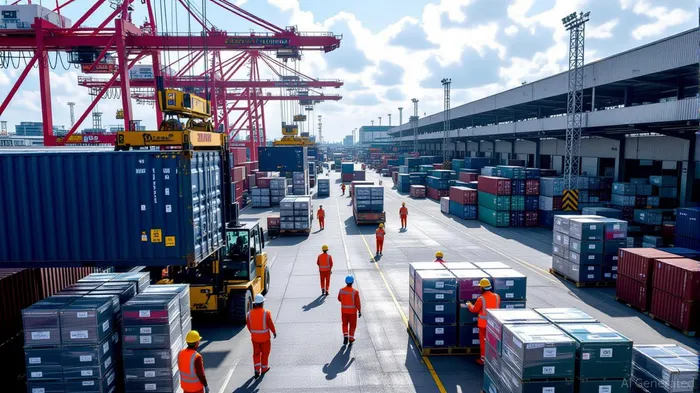
The U.S.-China trade truce, extended until November 10, 2025, has created a fragile but critical window for global supply chains to recalibrate. While the 30% U.S. tariff on Chinese goods and 10% Chinese tariff on U.S. imports avoid immediate chaos, the underlying tensions remain unresolved. For investors, this period demands a dual focus: capitalizing on near-term stability in sectors like logistics and renewables while hedging against the long-term risks of a potential trade war.
The Winners: Sectors Benefiting from Supply Chain Diversification
The truce has accelerated nearshoring and onshoring trends, with Vietnam, India, and Mexico emerging as key beneficiaries. For instance, Vietnam's garment industry grew 12% year-to-date in 2025, while India's electronics sector attracted record foreign direct investment (FDI). Logistics firms such as A.P. Møller – Mærsk (MAERSK-B) and Flex (FLEX) are seeing surges in demand for automation and real-time supply chain visibility tools.
Renewable energy is another sector poised to thrive. The resumption of Chinese rare-earth exports has stabilized supply chains for electric vehicle (EV) motors and wind turbines, benefiting companies like Tesla (TSLA) and MP Materials (MP). The Inflation Reduction Act (IRA) further amplifies opportunities, with tax credits driving demand for domestic infrastructure and clean energy projects. ETFs like the iShares Global Clean Energy ETF (ICLN) have gained 8% in 2025, outperforming broader markets.
The Vulnerable: Sectors at Risk of Trade War Escalation
Semiconductors remain a flashpoint. U.S. export controls on advanced chips and Chinese restrictions on rare-earth minerals have created bottlenecks for firms like NVIDIA (NVDA) and AMD (AMD). While the truce prevents immediate tariff hikes, the Trump administration's proposed 40% tariff on transshipped goods could disrupt global supply chains. The VanEck Semiconductor ETF (SMH) has shown volatility, rebounding 18% in July 2025 after a 30% slump in April.
Agriculture is another high-stakes sector. U.S. soybean exports to China are sensitive to tariff fluctuations. Trump's demand for China to “quadruple” soybean orders could trigger retaliatory tariffs if unmet, threatening small farms and shifting demand to agribusiness giants like Cargill.
Strategic Investment Playbook
- Nearshoring Enablers: Prioritize logistics providers (e.g., Prologis (PLD), Americold (COLD)) and infrastructure developers with exposure to IRA-driven projects. These firms benefit from “just-in-case” inventory models and port expansions.
- Renewable Energy and Rare Earths: Invest in companies with domestic supply chain resilience, such as MP Materials (MP) and Li-Cycle (LTHM), or ETFs like REMX (Rare Earth & Strategic Metals ETF), which has outperformed the S&P 500 by 12% in 2025.
- Hedging Against Volatility: Allocate to safe-haven assets like gold (e.g., SPDR Gold Shares ETF (GLD)) and diversified ETFs (e.g., ICLN) to mitigate risks from trade-related disruptions.
The Path Forward: Diplomacy or Deterioration?
The November 2025 deadline looms as a pivotal moment. A Trump-Xi summit, likely at the APEC meeting in October, could determine whether the truce evolves into a broader agreement or collapses into a trade war. Investors should monitor key indicators:
- U.S. soybean import data to gauge agricultural trade sentiment.
- China's rare-earth exports as a barometer of diplomatic leverage.
- Secondary tariffs on transshipped goods, which could complicate supply chains further.
Conclusion
The U.S.-China trade truce offers a temporary reprieve but masks deeper structural risks. For investors, the key is to balance short-term gains in nearshoring and renewables with long-term hedging against geopolitical uncertainty. By strategically positioning in resilient sectors and diversifying portfolios, investors can navigate the evolving landscape of global trade tensions and emerge stronger in a post-truce world.





Comentarios
Aún no hay comentarios