
U.S.-China Trade Tensions and the Rise of Resilient Manufacturing: Sector-Specific Opportunities in Nearshoring
The U.S.-China trade war, now in its seventh year, has catalyzed a seismic shift in global manufacturing. As tariffs, geopolitical risks, and supply chain disruptions intensify, companies are reengineering their operations to prioritize resilience over cost efficiency. This transformation is most evident in the surge of nearshoring and onshoring investments, particularly in North America. For investors, the evolving landscape presents sector-specific opportunities in industries such as automotive, electronics, semiconductors, and clean energy-each shaped by policy incentives, trade agreements, and corporate strategy.
Automotive: A Case Study in Resilience
The automotive sector has emerged as the poster child for nearshoring. According to a Forbes report, over $400 billion in advanced manufacturing investments are expected by 2030, with the U.S. automotive industry leading the charge. Tesla's decision to build a factory in Mexico-just 140 miles from the U.S. border-exemplifies this trend. The facility leverages the U.S.-Mexico-Canada Agreement (USMCA) to minimize tariffs while reducing lead times and logistical costs, the Forbes report notes.
Mexico's role as a nearshoring hub is further solidified by its 15.4% share of U.S. trade in 2025, surpassing China for the first time, according to a DP World report. This shift is driven by USMCA's duty-free access to the U.S. market and Mexico's ability to serve as a bridge for Asian components. For instance, while China still supplies critical parts to Mexico, the latter's proximity to the U.S. allows for faster reconfiguration in response to disruptions, a Bain report finds.
Electronics and Advanced Manufacturing: Diversification Over Dependency
Beyond automotive, the electronics sector is witnessing a strategic pivot. Companies are diversifying suppliers to mitigate risks from China's dominance in component manufacturing. Mexico's electronics industry, bolstered by U.S. investments, has become a key player. A Brookings report notes that Mexican electronics exports to the U.S. grew substantially between 2017 and 2022, driven by lower labor costs and streamlined trade procedures under USMCA.
However, challenges persist. Infrastructure bottlenecks and rising labor costs in North America remain hurdles. Yet, the Biden administration's "China+1" strategy-encouraging firms to split production between China and "friendly" nations-has reinforced Mexico's appeal, the Brookings report argues. For investors, this sector offers opportunities in automation, logistics, and supply chain software that enhance agility.
Semiconductors and Clean Energy: Policy-Driven Gains
The Inflation Reduction Act (IRA) and CHIPS Act have injected new momentum into U.S. manufacturing. These policies provide tax credits and grants for domestic production of semiconductors and clean energy technologies, incentivizing firms to nearshore or reshore operations, a Bain report notes. For example, Intel and AMD have announced multi-billion-dollar investments in U.S. chip fabrication plants, while companies like First Solar are expanding solar panel manufacturing, according to Bain.
The clean energy sector, in particular, is poised for growth. With the U.S. aiming to reduce carbon emissions by 50% by 2030, demand for locally produced wind turbines, batteries, and solar panels is surging. Mexico's renewable energy sector is also attracting attention, with its abundant natural resources and proximity to U.S. markets, the DP World report observes.
Challenges and the Road Ahead
Despite the optimism, nearshoring is not without risks. Infrastructure gaps, particularly in Mexico's transportation networks, could delay projects. Additionally, the high capital costs of reshoring and the potential renegotiation of USMCA pose uncertainties, the Forbes report warns. For investors, due diligence must account for these factors while balancing long-term resilience with short-term profitability.
Conclusion
The U.S.-China trade tensions have accelerated a global reordering of supply chains, with nearshoring and resilient manufacturing at the forefront. For investors, the key lies in identifying sectors where policy, geography, and corporate strategy align. The automotive, electronics, semiconductor, and clean energy industries offer compelling opportunities, but success will depend on navigating the complex interplay of tariffs, trade agreements, and geopolitical dynamics. As the world moves toward a more fragmented but resilient economic order, those who adapt will thrive.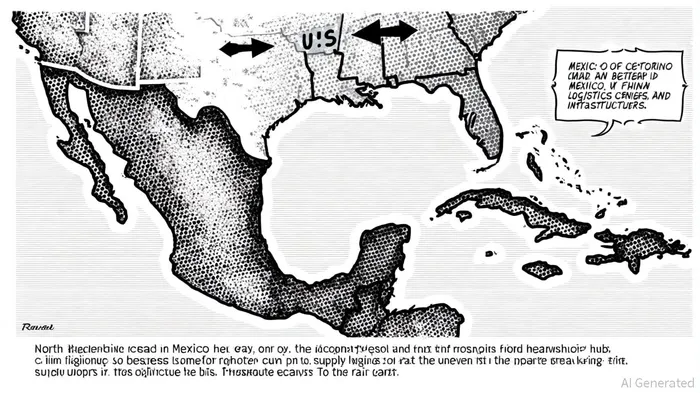





Comentarios
Aún no hay comentarios