
China-U.S. Trade Tensions Reshape Global Shipping and Supply Chains: Strategic Investment Opportunities Emerge
The U.S.-China trade war, now in its third year, has evolved from a tariff-driven conflict into a broader economic and strategic rivalry. By 2025, the imposition of steep port fees, supply chain diversification, and geopolitical maneuvering have created a fragmented global trade landscape. Yet, for investors, these disruptions have also unlocked opportunities in diversified logistics and defense-linked technology sectors.
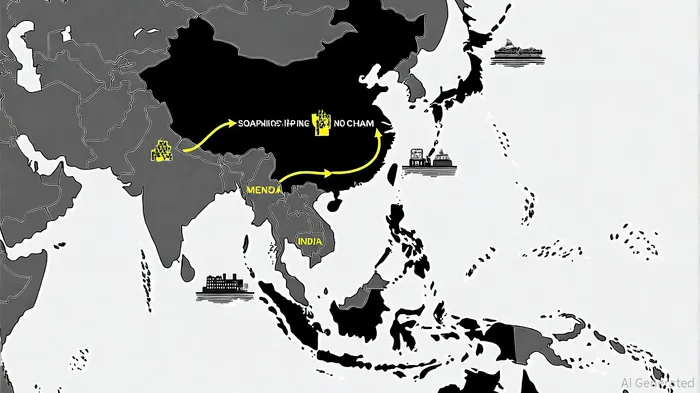
The Fracturing of Global Shipping Routes
The U.S. and China have weaponized maritime infrastructure to escalate tensions. In 2025, the U.S. introduced port fees of up to $140 per net ton on Chinese-operated bulk carriers and $250 per container on Chinese container ships, with full implementation slated for 2028, according to a Politico report. China retaliated with reciprocal fees, targeting U.S. equity shareholdings in vessels docking at its ports, as noted in a Bloomberg report. These measures have disrupted traditional trade flows: major shipping lines have suspended six weekly routes between China and the U.S., canceling 1.3 million containers annually, according to a Glottis analysis.
The fallout is evident in rerouted cargo. Chinese exporters have shifted $10 billion annually through Vietnam and Malaysia to bypass U.S. tariffs, per a Port Technology report, while U.S. companies absorb rising costs-COSCO alone faces $1.5 billion in fees by 2026, according to a Glottis report. Meanwhile, alternative hubs like Dubai's Jebel Ali Port and India's Jawaharlal Nehru Port Trust are emerging as critical nodes for transshipment and manufacturing, as described in a ShipUniverse update.
Supply Chain Diversification Drives Tech Innovation
The "China+1" strategy-diversifying manufacturing to Southeast Asia and India-has accelerated demand for supply chain resilience tools. Companies like Apple and Samsung have shifted production to Vietnam and India, prompting a surge in investments in supply chain management software, according to a LinkedIn analysis. Firms such as Kuchoriya Techsoft and Blue Yonder are capitalizing on this trend, offering AI-driven inventory optimization and real-time tracking solutions, highlighted in a LinkedIn list.
Automation and digital twins are also gaining traction. For instance, predictive analytics platforms now help firms simulate disruptions, enabling proactive adjustments to sourcing and logistics, according to a Logistics Management report. The global port infrastructure market, projected to grow to $207.9 billion by 2030, is seeing significant inflows as countries like Indonesia and Vietnam upgrade facilities to handle new trade volumes, per a Business Wire release.
Defense-Linked Tech: A New Frontier
China's 2025 rare earth export restrictions-limiting access to materials critical for defense systems-have forced the U.S. to prioritize domestic production. The Department of Defense has invested $400 million in MP Materials, the sole U.S. rare earth mine, and awarded $439 million in grants for magnet and semiconductor projects, as discussed in a CSIS analysis. Companies like Lockheed Martin and Intel are benefiting from this reshoring push, as the U.S. seeks to decouple from Chinese supply chains, according to a Top10Sense list.
The geopolitical stakes are high. China controls 90% of global magnet production, and its export controls now extend to refining technologies and products with as little as 0.1% Chinese-processed rare earth elements, as noted in an Asia Times article. This has spurred U.S. partnerships with allies to secure alternative sources, creating long-term opportunities for firms in critical mineral processing and advanced manufacturing.
Strategic Investment Opportunities
For investors, the key lies in balancing short-term volatility with long-term structural shifts:
1. Logistics Tech: Prioritize firms enabling supply chain visibility and automation, such as Manhattan Associates and Dell Technologies, which support real-time risk mitigation, as outlined in an Optilogic resource.
2. Port Infrastructure: Target Southeast Asian and Indian port operators, including CK Hutchison Holdings, which is navigating trade tensions through strategic divestments and expansions, according to an Economic Times article.
3. Defense-Linked Sectors: Allocate capital to rare earth processors and defense contractors like Raytheon Technologies, which stand to gain from U.S. military modernization efforts, per a YCharts blog.
Conclusion
The U.S.-China trade war has transformed from a trade policy dispute into a contest for global economic leadership. While the immediate costs are steep, the resulting shifts in shipping, supply chains, and technology present a unique window for investors. By focusing on diversified logistics and defense-linked innovation, capital can align with the structural trends reshaping the 21st-century global economy.





Comentarios
Aún no hay comentarios