
China's Trade Resilience: Export Surge and Strategic Shifts Drive Growth Amid Global Headwinds
China’s trade data for the first quarter of 2025 has revealed a striking resilience, with exports defying expectations to grow by 6.9% year-on-year to 6.13 trillion yuan, while imports declined by 6% to 4.17 trillion yuan. This performance underscores a strategic pivot toward high-tech manufacturing, green energyCETY--, and deepening ties with emerging markets—a shift that could redefine China’s economic trajectory amid escalating trade tensions.
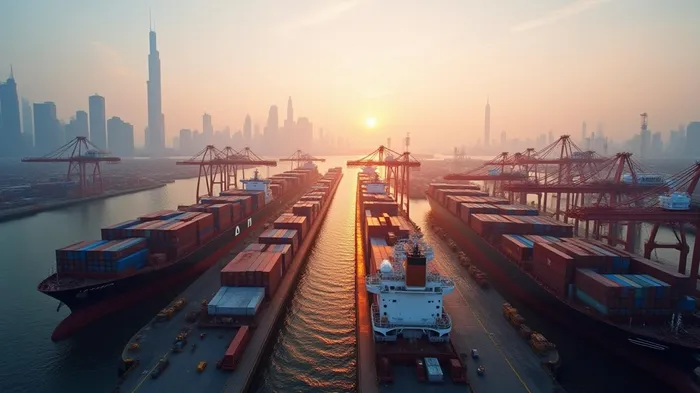
Export Momentum: High-Tech and Green Manufacturing Lead the Charge
The export surge was fueled by advanced sectors, with wind turbines, lithium batteries, and electric vehicles driving growth. Shipments of wind turbines jumped 43.2%, reflecting China’s dominance in renewable energy infrastructure, while lithium battery exports rose 18.8%, aligning with global demand for clean energy solutions.
Private enterprises, which now account for 56.8% of total trade, were instrumental in this growth. Their exports of industrial robots surged 67.4%, and imports of high-end equipment—including surgical robots (up 47.5%)—highlighted their role in upgrading domestic manufacturing capabilities.
Import Dynamics: Commodity Prices and Domestic Demand
Imports contracted due to falling global commodity prices, with iron ore and coal prices dropping over 20% and crude oil declining 5.7%. However, demand for machinery components and production equipment increased, signaling a gradual recovery in industrial activity.
The 6% import decline also reflects subdued domestic consumption, a concern for policymakers aiming to meet the 5% GDP growth target. Analysts note that weak consumer spending could limit the impact of export gains on broader economic growth.
Strategic Partnerships: BRI and ASEAN as Growth Drivers
Trade with Belt and Road Initiative (BRI) countries hit a record 5.26 trillion yuan, accounting for 51.1% of China’s total trade. This diversification strategy has insulated China from U.S.-imposed tariffs (now at 145%) by boosting ties with emerging markets.
ASEAN solidified its position as China’s top trading partner, with bilateral trade rising 7.1% to 1.71 trillion yuan. The GAC emphasized ASEAN’s role in regional integration, leveraging its 2 billion combined population and shared industrial chains.
Challenges Ahead: Trade Wars and Domestic Consumption
Despite the Q1 rebound, risks remain. The U.S.-China tariff war has intensified, with retaliatory measures now at 125% on selected U.S. goods. Analysts warn that tariff disruptions could reduce bilateral trade by up to 80%, prompting Goldman Sachs to revise China’s GDP forecast down to 4.0% for .
Domestically, weak consumer demand—evident in the 4.3% year-on-year decline in March imports—adds pressure. Private enterprises, while thriving in high-tech exports, face challenges in boosting domestic sales amid stagnant wages and precautionary spending.
Conclusion: A Resilient Engine, But Headwinds Loom
China’s trade performance in Q1 2025 is a testament to its strategic agility. The 6.9% export surge, driven by high-tech and green sectors, and the 51.1% BRI trade share, demonstrate a successful pivot toward innovation and regional integration. Private enterprises, now 56.8% of total trade, are key to sustaining this momentum, particularly in advanced manufacturing.
However, the 6% import decline and global trade tensions underscore vulnerabilities. With the U.S. tariff war showing no signs of abating and domestic consumption lagging, policymakers must balance export-led growth with measures to stimulate household spending.
The GAC’s confidence—that “the sky won’t fall”—finds support in China’s record trade surplus (1.96 trillion yuan) and its $1.41 trillion total trade volume. Yet, achieving the GDP target will require navigating a narrow path between global headwinds and domestic resilience. For investors, the data suggests opportunities in green energy, automation, and BRI-linked infrastructure—sectors where China’s exports are already surging ahead.
In the end, China’s trade story is one of adaptation: leveraging private innovation and regional partnerships to offset external pressures. The question now is whether this strategy can sustain growth in the face of an increasingly fractured global economy.







Comentarios
Aún no hay comentarios