
U.S.-China Trade Policy Shifts and Strategic Sector Reallocation in the Trump-Era Trade War
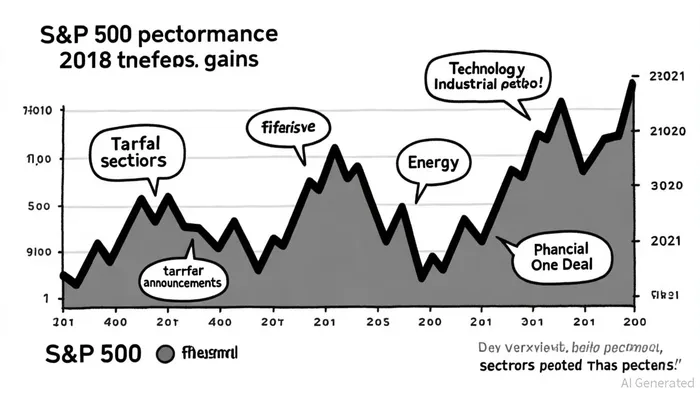
The Trump-era U.S.-China trade war, marked by escalating tariffs and retaliatory measures from 2018 to 2021, reshaped global equity markets through strategic sector reallocation. As trade tensions intensified, investors and corporations recalibrated their strategies, leading to pronounced shifts in capital flows, supply chains, and sector valuations. This analysis examines the mechanisms behind these reallocations, supported by quantitative data and sector-specific case studies.
Sector-Specific Impacts: Winners and Losers
The trade war's most immediate effects were felt in sectors deeply embedded in U.S.-China supply chains. According to a ScienceDirect study, firms with high export exposure to China saw their stock prices decline by an average of 0.8% for every 10 percentage-point increase in sales to China, while those reliant on Chinese inputs faced a 1.2% drop in cumulative returns due to input cost uncertainties. Technology and industrial sectors bore the brunt of these disruptions. For instance, AppleAAPL-- and Huawei faced supply chain bottlenecks, while Boeing's commercial aviation division suffered from reduced demand in China, a CEPR analysis notes.
Conversely, sectors aligned with Trump's deregulatory agenda-such as energy and finance-gained traction. The Energy Select Sector SPDR Fund (XLE) surged as oil and gas companies benefited from reduced environmental regulations and lower production costs, according to a Morgan Stanley report. Similarly, Morgan Stanley noted that financial institutions thrived on tax cuts and relaxed compliance rules, with the Financial Select Sector SPDR Fund (XLF) hitting multi-year highs.
Capital Reallocation and Global Supply Chain Shifts
The trade war also triggered a reallocation of capital to countries less exposed to U.S.-China tariffs. Vietnam, for example, became a key beneficiary, with its exports to the U.S. growing by 15% in 2019 alone, according to a Yale study. An ACIPerspectives analysis found that 3% of FDI redirected from China to Vietnam during this period, particularly in machinery and textiles. This shift was mirrored in equity markets, as ETFs tracking emerging markets like the iShares MSCI Emerging Markets ETF (EEM) outperformed China-specific funds.
Meanwhile, U.S.-listed China ETFs faced massive outflows. Bloomberg data revealed that $3.69 billion exited China-focused funds in a single week in April 2025, with the iShares China Large-Cap ETF (FXI) losing $1.2 billion. Bloomberg also reported that these outflows contrasted with short-term gains during periods of trade war optimism, such as the 4.6% single-day surge in the KraneShares CSI China Internet ETF (KWEB) following the Phase One Deal.
Quantitative Metrics and Market Volatility
The S&P 500's overall performance masked stark sector divergences. From 2017 to 2021, the index returned 63.0%, but the S&P 500 Growth index outperformed the Value index 115.4% to 37.3%, reflecting a flight to tech stocks amid uncertainty, according to a Visual Capitalist analysis. However, the MSCI China index lagged with a mere 7.4% return, underscoring investor caution.
Trade war-related volatility also impacted broader market sentiment. The VIX, or "fear index," spiked during key tariff announcements, peaking at 30 in August 2019-a level not seen since the 2008 financial crisis, as shown in a NeoxCapital analysis. This volatility disproportionately affected sectors like agriculture, where U.S. soybean exports to China plummeted by 60% in 2018, forcing farmers to seek alternative markets, Investing.com reported.
Strategic Implications for Investors
The trade war highlighted the importance of diversification and supply chain resilience. Firms with diversified sourcing and strong pricing power, such as semiconductor companies, outperformed peers reliant on China, according to a St. Louis Fed review. Investors also pivoted toward "safe-haven" assets, with gold rising 52.7% and BitcoinBTC-- surging over 3,300% during the period, as noted by Visual Capitalist.
For sectors like renewable energy, the trade war posed challenges. While Trump's policies favored fossil fuels, long-term sustainability concerns created uncertainty. The Invesco Solar ETF (TAN) underperformed, reflecting investor skepticism about policy continuity, a point Morgan Stanley highlighted.
Conclusion
The Trump-era trade war served as a catalyst for strategic reallocation in global equities, driven by tariff escalations, supply chain disruptions, and policy-driven sectoral shifts. While energy and finance thrived, technology and agriculture faced headwinds. Investors who navigated these dynamics by rebalancing portfolios toward resilient sectors and geographies emerged stronger. As U.S.-China relations remain volatile, understanding these patterns remains critical for future strategic decisions.





Comentarios
Aún no hay comentarios