
China's Trade Policy Outlook and Its Implications for Global Commerce: Strategic Positioning and Sectoral Opportunities in Export-Driven Industries
China's trade policy evolution from 2023 to 2025 reflects a calculated shift toward securing strategic resources, advancing high-tech industries, and reshaping global supply chains. As the world's largest exporter, China is leveraging its dominance in critical minerals, green technology, and digital trade to solidify its position as a global economic leader. This analysis explores the strategic positioning of China's export-driven sectors, their implications for international commerce, and the opportunities-and risks-they present for investors.
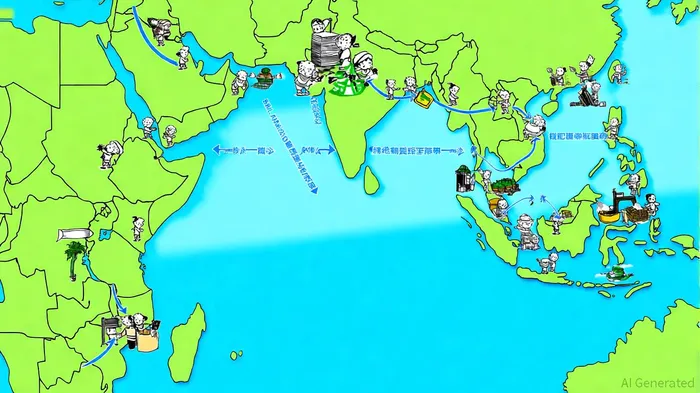
Strategic Minerals: The New Frontier of Geopolitical Leverage
China's tightening grip on strategic minerals has become a cornerstone of its trade strategy. By 2025, the country had expanded its export controls to include rare earth elements such as holmium, erbium, and ytterbium, critical for semiconductors, EVs, and defense systems, according to a RareEarthExchanges article. According to a Reuters report, China now controls over 90% of global rare earth processing and 60% of raw material production, enabling it to dictate terms in sectors ranging from renewable energy to advanced manufacturing. These moves are not merely economic but geopolitical, as Beijing seeks to counter Western export restrictions on semiconductorON-- technology and assert influence over supply chains.
The implications are profound. For instance, the U.S. automotive industry faced production halts in 2025 due to rare earth shortages, prompting calls for a coordinated "anchor market" strategy among allies to diversify sourcing, according to a CSIS analysis. Meanwhile, China's dual-circulation strategy-prioritizing domestic demand while maintaining export leverage-ensures it remains indispensable in the global transition to green technologies, as noted in a World Economic Forum piece.
Sectoral Opportunities: High-Tech, Green, and Digital Trade
China's 2025 Government Work Report underscores its focus on three pillars: service trade, green technology, and digital commerce. These sectors are not only driving domestic growth but also redefining global trade dynamics.
Green Energy and Electric Vehicles (EVs)
China's dominance in EVs and renewable energy is unparalleled. In 2023, the country produced 9.5 million new energy vehicles (NEVs), with EVs accounting for 80% of the total, according to AmCham China. By 2025, its solar and wind power capacity is projected to exceed 2,000 gigawatts, cementing its role as the world's largest clean energy producer, per a GoGlobal projection. The "Healthy China 2030" strategy further amplifies opportunities in biotechnology and medical devices, with foreign investors gaining access to a market driven by an aging population and rising healthcare demand, according to a GoPYD analysis.Artificial Intelligence and Advanced Manufacturing
China's AI market is forecasted to grow from $34.2 billion in 2024 to $154.8 billion by 2030, fueled by applications in smart cities, finance, and industrial automation, according to China Briefing. The government's push for "smart factories" is accelerating productivity gains, with AI-driven robotics and 5G infrastructure forming the backbone of its advanced manufacturing sector, as analyzed by Silk Road Consulting.Digital Trade and E-Commerce
Digital trade is another focal point, with China optimizing port logistics and expanding cross-border e-commerce platforms to sustain export competitiveness, according to a China Briefing analysis on tariffs. The Belt and Road Initiative (BRI) complements this by enhancing connectivity in Asia-Pacific regions, where investments in 2025 are projected to boost trade volumes by 15%, as discussed in a Diplomat piece.
Global Supply Chain Implications: Diversification vs. Dependency
China's export strategies have triggered a global "de-risking" response. The European Union and the U.S. are accelerating domestic production of critical minerals and forming alliances with resource-rich nations like Australia and Indonesia, according to a CleanTechnica analysis. However, these efforts face challenges, including high costs and long lead times for alternative sourcing.
Game theory models suggest that while diversification could reduce China's market dominance, its strategic mineral reserves and refining expertise will likely maintain its influence for the foreseeable future, as argued in an RFF brief. For investors, this duality presents both risks and opportunities: volatility in rare earth prices may disrupt short-term projects, but long-term gains are possible in sectors aligned with China's green and digital transitions.
Conclusion: Navigating the New Trade Landscape
China's trade policies are reshaping global commerce through a blend of resource control, technological innovation, and strategic diplomacy. For investors, the key lies in aligning with sectors where China's strengths-such as EVs, AI, and green energy-intersect with global demand. While geopolitical tensions and regulatory complexities persist, the rewards for those who navigate these dynamics effectively are substantial.
As the 2025 Government Work Report emphasizes, the future of China's trade strategy hinges on "stability and quality"-a mantra that underscores its ambition to lead the next industrial revolution.





Comentarios
Aún no hay comentarios