
U.S.-China Trade Dynamics: How the Trump-Xi Meeting Could Reshape Global Supply Chains and Investor Sentiment
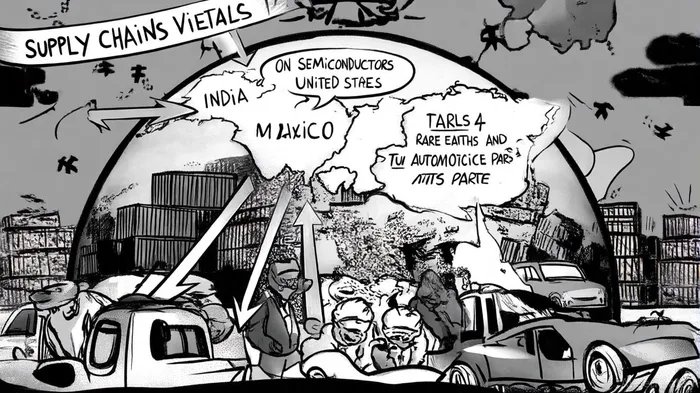
The upcoming Trump-Xi call on September 19, 2025, marks a pivotal moment in U.S.-China trade relations, with far-reaching implications for global supply chains and investor sentiment. As both nations navigate a complex web of tariffs, technology restrictions, and geopolitical tensions, the meeting's outcomes could either stabilize or further destabilize the delicate balance of global trade.
Supply Chain Strategies: A Fragile Truce Amid Structural Shifts
The Trump-Xi call aims to address immediate trade frictions, including rare-earth exports, semiconductor restrictions, and fentanyl enforcement[1]. While the Trump administration has temporarily reduced tariffs from 145% to 10% on Chinese goods for 90 days[4], structural shifts in supply chains persist. Multinational corporations (MNCs) are recalibrating their strategies amid the "China +1" approach, which involves diversifying production to countries like Vietnam and India[2]. However, Trump's recent escalation of tariffs to 46% on Vietnamese and 26% on Indian imports[2] has undermined these efforts, forcing companies to reconsider nearshoring to the U.S. or Mexico under the USMCA framework[3].
For example, the electronics and pharmaceutical sectors face acute challenges due to U.S. export controls on advanced chips and China's rare-earth dominance[1]. Companies like IntelINTC-- and TSMCTSM-- have already faced scrutiny under the U.S. entity list, while Chinese firms investigate American chipmakers[1]. This technological decoupling is driving investments in automation and AI-driven supply chain visibility tools[4], as businesses seek to mitigate risks from geopolitical volatility.
Investor Sentiment: Short-Term Relief, Long-Term Uncertainty
The temporary tariff reductions sparked a 2.6% surge in the S&P 500 and a 3.5% jump in the Nasdaq[1], reflecting investor relief over de-escalation. However, analysts caution that this optimism is fragile. Treasury Secretary Scott Bessent described the agreement as a "step in the right direction," but legal experts note that the 90-day pause offers limited clarity for long-term planning[2]. Private equity firms remain cautious, with many delaying deals until trade policies stabilize[4].
The automotive sector exemplifies this duality. While reduced tariffs on vehicles and parts may ease short-term costs, the Trump administration's 25% auto tariffs and reciprocal measures from Canada and Mexico[3] create uncertainty. Companies like Tesla and Ford are stockpiling inventory to hedge against potential tariff hikes[4], but this strategy risks overexposure if negotiations fail.
Sector-Specific Impacts and Strategic Adjustments
The Trump-Xi meeting's focus on rare-earth magnets and semiconductors underscores the strategic importance of critical materials. U.S. manufacturers, reliant on Chinese rare-earth exports, face bottlenecks as Beijing leverages its dominance[1]. Conversely, China's investigations into American chipmakers signal a reciprocal tightening of technology access[1].
In response, MNCs are adopting hybrid strategies:
- Reshoring: Companies like Boeing are lobbying for large Chinese aircraft orders[1], while pharmaceutical firms accelerate domestic production[4].
- Diversification: Electronics firms are splitting production between Vietnam and Mexico to avoid high tariffs[2].
- Technology Investment: Blockchain and AI tools are being deployed to enhance supply chain resilience[4].
The Road Ahead: APEC Summit and Geopolitical Risks
The October APEC summit in South Korea offers a potential platform for resolving broader disputes, including Taiwan-related tensions[1]. However, Trump's emphasis on short-term trade gains clashes with Xi's focus on territorial integrity, complicating progress[1]. Meanwhile, retaliatory tariffs from Canada and the EU[3] add layers of complexity, forcing companies to prioritize agility over cost efficiency.
For investors, the key takeaway is caution. While the Trump-Xi call may stabilize markets temporarily, structural trade tensions and policy unpredictability remain. Businesses must balance near-term cost management with long-term resilience, investing in diversification and technology to navigate an increasingly fragmented global trade landscape.





Comentarios
Aún no hay comentarios