
China-U.S. Trade Dynamics and Maritime Logistics: Fee Suspensions Signal Shifting Economic Policy and Asian Infrastructure Opportunities
The fee suspension underscores a broader reality: economic leverage in the China-U.S. relationship is increasingly tied to control over critical resources and trade routes. China's dominance in rare earth elements, essential for U.S. defense manufacturing, and its role as a soybean market for American farmers have forced a recalibration of priorities, the editorial argues. Yet this policy pivot also opens a window for investment in Asian shipping and port infrastructure, as companies and governments adapt to shifting trade dynamics.
The Ripple Effect on Asian Infrastructure
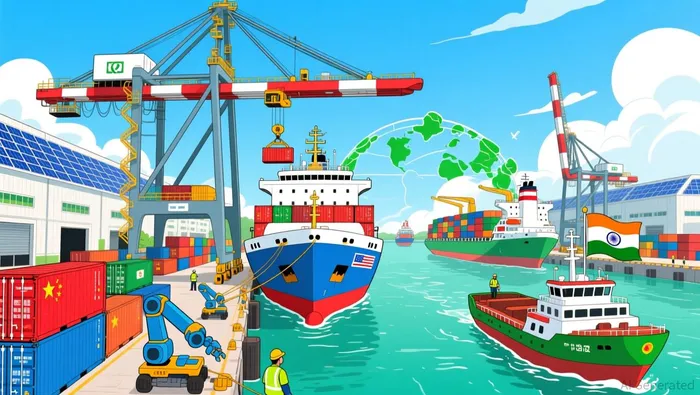
The U.S.-China trade war, now in its seventh year, has accelerated a global redistribution of manufacturing and logistics hubs. As companies diversify away from China to mitigate risks, Southeast Asia and India have emerged as beneficiaries. According to a Tradlinx report, Vietnam, Thailand, and Malaysia are now handling 12% more container traffic than in 2023, driven by firms relocating production and rerouting shipments. This trend is mirrored in infrastructure investment: ports in these countries are expanding capacity, with private equity and sovereign wealth funds pouring capital into modernization projects, the report notes.
For example, the easing of trade tensions in 2025 has spurred confidence in firms like Sinofert Holdings, a Singapore-based chemical company that saw a 65.7% surge in earnings year-over-year, according to a Yahoo Finance article. Similarly, Zijin Gold International, which recently acquired a gold mine in Kazakhstan, is positioned to capitalize on cross-border trade flows as supply chains diversify, the article notes. These companies exemplify how geopolitical shifts create asymmetrical opportunities for firms embedded in regional trade networks.
Tariffs, Port Fees, and the Cost of Diversification
The October 2025 implementation of reciprocal port fees and tariffs-vessel-based charges rising by $5 per ton annually through 2028-has further complicated logistics planning, according to the Tradlinx report. While these measures aim to level the playing field for domestic industries, they have inadvertently accelerated the search for alternative trade corridors. China's retaliatory port fees on U.S.-linked vessels, coupled with the collapse of the de minimis exemption for small imports, have pushed companies to prioritize cost efficiency, the report notes.
This environment has made Southeast Asia's ports, such as those in Laem Chabang (Thailand) and Cai Mep (Vietnam), increasingly attractive. These hubs offer lower labor costs, strategic geographic positioning, and government incentives to offset the higher costs of rerouted supply chains. Meanwhile, India's Chennai Port Expansion Project, backed by a $2.1 billion investment from the Asian Infrastructure Investment Bank (AIIB), is positioning the country as a counterweight to China-centric trade, the Tradlinx report notes.
Investment Opportunities in a Fragmented Landscape
For investors, the key lies in identifying firms and infrastructure projects that align with the dual forces of U.S.-China decoupling and regional integration. The Maritime Security Trust Fund, though sidelined by the fee suspension, remains a potential catalyst for U.S. shipyard subsidies, which could indirectly boost demand for Asian ports handling American-flagged vessels, according to the Maritime Executive editorial. Additionally, the rise of "friend-shoring" initiatives-such as the U.S.-India Trade Partnership and the Indo-Pacific Economic Framework-will likely drive further investment in ports serving non-China hubs, the Tradlinx report notes.
However, risks persist. The 17.8% decline in Chinese exports to the U.S. in 2025, coupled with a 16.6% drop in U.S. imports from China, highlights the fragility of current arrangements, according to a report from AzerNews. Investors must balance optimism about regional growth with caution regarding geopolitical volatility.
Conclusion
The suspension of U.S. port fees on China is more than a diplomatic gesture-it is a signal of evolving economic priorities and a harbinger of structural shifts in global trade. For Asian ports and logistics firms, this moment represents both a challenge and an opportunity. As supply chains fragment and reconfigure, the winners will be those who can adapt to a world where proximity to U.S. markets and resilience against Chinese dominance are equally vital.







Comentarios
Aún no hay comentarios