
U.S.-China Trade Dynamics 2025: Tariff Negotiations and the Reshaping of Global Supply Chains
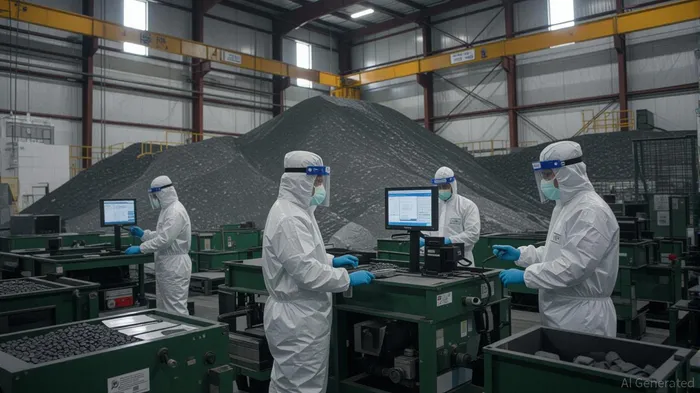
The Trump-Xi meeting in 2025 has ignited a pivotal shift in U.S.-China trade relations, with profound implications for global supply chains and investment opportunities. The preliminary trade agreement announced on June 26, 2025, marks a temporary de-escalation of tensions but underscores the fragility of long-term cooperation. At its core, the deal involves China easing restrictions on rare earth exports in exchange for the U.S. lifting certain tariffs and export controls. While the specifics remain fluid, the agreement signals a strategic pivot toward stabilizing critical sectors like technology, defense, and renewable energy.
The Fragile Truce and Legal Uncertainty
The June 26 agreement temporarily reduced reciprocal tariffs to 10% for 90 days, though the broader U.S. tariff regime on Chinese goods remains complex, with overlapping duties such as the 20% "fentanyl" tariff and 25% Section 301 tariffs. This means the effective tariff on Chinese imports still hovers above 30%. Meanwhile, legal challenges to these tariffs under the International Emergency Economic Powers Act (IEEPA) are pending in federal courts. A July 31, 2025, ruling by the U.S. Court of Appeals for the Federal Circuit could invalidate the tariffs entirely, creating further uncertainty for importers and investors.
The legal limbo is compounded by the Trump administration's ongoing negotiations with China to extend the August 1, 2025, deadline for higher tariffs. Treasury Secretary Scott Bessent's planned talks with Chinese officials in early August suggest a preference for prolonging the current arrangement, but the outcome remains contingent on enforcement mechanisms and geopolitical trust.
Critical Minerals: The New Frontier of Geopolitical Competition
The agreement's focus on rare earths highlights a broader global race for critical minerals. China has long dominated rare earth processing, controlling over 60% of global refining capacity. By easing export restrictions, China aims to maintain its role as a key supplier while the U.S. accelerates domestic production.
The U.S. is investing heavily in domestic critical mineral supply chains, driven by the CHIPS and Science Act and the Biden administration's reshoring initiatives. Companies like MP Materials (MP) and Albemarle (ALB) are poised to benefit from this push. MP, the largest rare earth producer in the U.S., is scaling up its Mountain Pass facility, while Albemarle's lithium operations in Australia and Chile align with the EV industry's insatiable demand.
Investors should also monitor partnerships with non-Chinese allies, such as Canada's Nechalacho mine and Australia's lithium reserves. These alliances are critical to diversifying supply chains and reducing exposure to geopolitical risks.
Manufacturing Reshoring and Supply Chain Diversification
The U.S.-China trade conflict has accelerated the reshoring of manufacturing, particularly in the EV and solar sectors. With tariffs on Chinese goods making imports less economically viable, companies are pivoting to alternative production hubs. Vietnam, India, and Malaysia have emerged as key beneficiaries, offering lower labor costs and proximity to U.S. markets.
Hon Hai Precision Industry (Foxconn), a major AppleAAPL-- supplier, has already shifted significant production to Vietnam. Similarly, India's manufacturing sector is gaining traction, with its Production-Linked Incentive (PLI) schemes attracting global firms. For investors, logistics and automation firms like Flex (FLEX) and ABB (ABB) are well-positioned to capitalize on the increased complexity of global supply chains.
Strategic Investment Opportunities
- Critical Minerals Producers: Prioritize companies with diversified sourcing and advanced processing capabilities. MP MaterialsMP-- and AlbemarleALB-- are strong candidates, but smaller firms like Livent (LTHM) and Lithium Americas (LAC) also offer high-growth potential.
- Reshoring Enablers: Automation and robotics firms (e.g., ABB, Fanuc) will benefit from the shift toward high-tech, low-labor manufacturing.
- Logistics and Supply Chain Tech: Companies like FlexFLEX-- and Expeditors International are essential for managing the fragmented global trade landscape.
- Alternative Production Hubs: Consider emerging markets with pro-business policies, such as Vietnam and India.
The Road Ahead
While the Trump-Xi deal provides short-term stability, the long-term decoupling of U.S. and Chinese economies is inevitable. Investors must prepare for a world where supply chain resilience and technological self-sufficiency trump cost efficiency. The winners will be those who invest in domestic and allied production, leverage automation, and hedge against geopolitical volatility.
As legal battles over tariffs unfold and trade negotiations continue, the next six months will be critical. The Federal Circuit's July 31 ruling could either solidify the current tariff framework or force a complete reset. For now, the market's focus should remain on companies building tomorrow's supply chains—those that are not just adapting to the new normal but leading the charge.





Comentarios
Aún no hay comentarios