
China Tech Stocks and the AI Revolution: Alibaba and Tencent as Strategic Bets in 2026
The AI revolution in China is reshaping the global technology landscape, with AlibabaBABA-- and Tencent emerging as pivotal players. As the sector transitions from algorithmic hype to tangible commercialization, investors are increasingly scrutinizing the strategic advantages and risks of these tech giants. Goldman SachsGS-- and Morgan StanleyMS--, two of the most influential voices in global finance, have provided critical insights into the AI-driven growth trajectories of Alibaba Cloud and Tencent's Hunyuan 2.0, offering a roadmap for investors navigating this high-stakes arena.
Alibaba Cloud: Enterprise AI and Global Expansion
Alibaba Cloud has solidified its dominance in China's public cloud market, capturing 47% of the sector in 2025. This leadership is underpinned by its aggressive investment in AI infrastructure, including the Qwen series of large language models and a diversified chip supply chain. Goldman Sachs highlights Alibaba's enterprise AI adoption as a key differentiator, noting a 363% surge in enterprise-level AI token consumption between late 2024 and mid-2025. This growth is driven by AI workloads such as model training and inference, which require significantly higher computing power-and thus generate greater revenue-than traditional cloud services.
The firm also emphasizes Alibaba's international expansion potential, particularly in Southeast Asia, where the company has shifted some AI training operations to circumvent U.S. chip restrictions. Goldman Sachs raised its target price for Alibaba, citing its robust enterprise AI ecosystem and capacity to scale globally. Morgan Stanley, meanwhile, underscores the broader AI infrastructure boom, estimating that Chinese hyperscalers will invest over $70 billion in 2025 to build data centers and AI chips.
Tencent's Hunyuan 2.0: Consumer-Centric AI Innovation
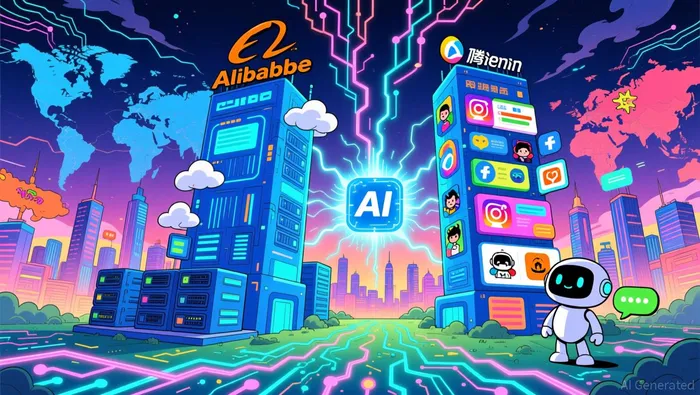 Tencent's strategic focus on consumer (2C) AI applications has positioned it as a leader in monetizing AI within its vast ecosystem. The launch of Hunyuan 2.0, a 406-billion-parameter model with a 256K context window, marks a significant leap in capabilities. This MoE (mixture-of-experts) architecture excels in complex reasoning, coding, and math tasks, enabling integration into products like Yuanbao and ima. Morgan Stanley's "Overweight" rating for Tencent reflects its confidence in the company's ability to leverage its WeChat platform and aggressive API pricing to drive AI adoption.
Goldman Sachs also acknowledges Tencent's progress, noting that its AI inference capabilities have exceeded expectations in advertising and gaming, two of its core revenue streams. The firm raised Tencent's capital expenditure forecast to RMB 350 billion and increased its share price target to HKD 770. Additionally, Tencent's rebranding of its overseas AI model to "Tencent HY 2.0" signals its intent to compete globally while maintaining a strong domestic presence.
Strategic Divergence and Market Positioning
The contrasting strategies of Alibaba and Tencent highlight the diversity of China's AI ecosystem. Alibaba's enterprise-centric approach aligns with its cloud infrastructure and international ambitions, while Tencent's consumer-focused model leverages its WeChat ecosystem and gaming expertise. Morgan Stanley emphasizes that Tencent is "the best practitioner of AI applications for the 2C sector," whereas Goldman Sachs views Alibaba as a leader in enterprise AI adoption.
This divergence is reflected in their financial performance: Alibaba Cloud's revenue grew 34% year-over-year in 2025, driven by AI-related services, while Tencent's AI monetization is expected to accelerate through its advertising and gaming verticals. Both firms, however, face similar challenges, including regulatory scrutiny and the need to sustain high capital expenditures in an increasingly competitive market.
Risk Assessment and 2026 Outlook
Despite their strengths, both companies operate in a sector marked by rapid innovation and macroeconomic uncertainty. Goldman Sachs cautions that AI capex by hyperscalers may need to reach $700 billion in 2026 to match historical investment cycles, up from a current projection of $527 billion. Morgan Stanley warns of potential "creative destruction" if funding for AI projects slows, particularly amid risks of U.S. inflation or geopolitical disruptions.
For Alibaba, the shift of AI training to Southeast Asia introduces operational complexities, while Tencent's aggressive API pricing could erode margins if not balanced with revenue growth. Both firms must also navigate antitrust regulations and platform competition, which could constrain their expansion.
Conclusion: Strategic Bets in a High-Stakes Era
The AI revolution in China presents a compelling case for investors willing to navigate its complexities. Alibaba Cloud's enterprise AI infrastructure and global ambitions, coupled with Tencent's consumer-centric innovation, position both as strategic bets for 2026. However, success hinges on their ability to sustain high capital expenditures, adapt to regulatory shifts, and capitalize on the $40 trillion in global operational efficiencies promised by AI.
As Goldman Sachs and Morgan Stanley underscore, the sector is entering a "second cycle" where competitive advantages in GPU utilization, implementation speed, and cash flow will determine long-term winners. For investors, the key lies in balancing optimism about AI's transformative potential with caution regarding the risks of overvaluation and macroeconomic volatility.







Comentarios
Aún no hay comentarios