
U.S.-China Tech and Manufacturing Tensions: Navigating Investment Risks and Opportunities in a Fractured Global Supply Chain
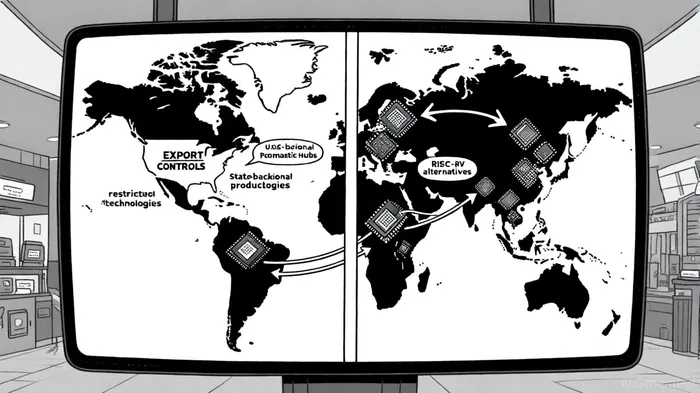
The U.S.-China technological and economic rivalry has entered a critical phase, with 2023–2025 policies reshaping global supply chains and investment dynamics. As export controls, tariffs, and industrial subsidies collide with China's push for self-sufficiency, investors face a complex landscape of risks and opportunities. This analysis unpacks sector-specific implications for tech and manufacturing, drawing on recent policy shifts and market responses.
U.S. Export Controls: Strategic Intent vs. Unintended Consequences
The Biden and Trump administrations have escalated export restrictions on semiconductors, AI, and quantum computing to China, adopting a "large yard, low fence" strategy that broadens the scope of controlled technologies[1]. By 2025 Q3, these measures had expanded to include advanced additive manufacturing equipment and AI model weights[5]. While the stated goal is to curb China's military and technological advancements, the economic fallout for U.S. firms is significant.
For example, U.S. semiconductor giants like NvidiaNVDA-- and AMDAMD-- have seen revenue declines due to restricted access to the Chinese market[3]. Additionally, circumvention tactics—such as smuggling and shellSHEL-- companies—have undermined the effectiveness of these controls[2]. A report by the Center for Strategic & International Studies (CSIS) notes that while U.S. policies aim to slow China's progress, they also risk eroding American leadership in global tech innovation by fragmenting supply chains and reducing market access[2].
China's Self-Sufficiency Drive: Progress and Persistent Gaps
China's response has been a dual strategy of state-backed industrial policy and technological innovation. The Made in China 2025 initiative, though falling short of its 70% self-sufficiency target, has pushed the country to 50% domestic production of semiconductors by early 2025[1]. The National IC Industry Investment Fund has injected over $40 billion into firms like SMIC and Huawei, accelerating advancements in 7nm chip production[2].
However, critical gaps remain. China still relies on foreign equipment for cutting-edge lithography and ion implantation, and its ability to produce 5nm chips—essential for AI and 5G—remains limited[3]. A Federal Reserve analysis highlights that even if Chinese firms develop individual components, the lack of integrated advanced equipment hinders mass production[1]. Meanwhile, U.S. export controls have cut off access to foreign expertise, stalling knowledge transfer crucial for R&D[1].
Investment Risks: Geopolitical Uncertainty and Supply Chain Fragility
For investors, the U.S.-China tech rivalry introduces three key risks:
1. Revenue Volatility for U.S. Firms: Companies dependent on the Chinese market, such as semiconductor equipment suppliers, face prolonged revenue declines. For instance, ASML's EUV lithography machines are now restricted to U.S. allies, limiting sales to China[4].
2. Supply Chain Disruptions: The decoupling of U.S. and Chinese supply chains has increased costs and lead times. A 2025 Forbes analysis notes that global manufacturers are now diversifying production to Southeast Asia, adding complexity and expense[3].
3. Regulatory Overreach: The Trump administration's 2025 Q4 AI export controls, including restrictions on model weights and end-use licensing, have created compliance burdens for tech firms[5].
Opportunities in a Fractured World
Despite the risks, the U.S.-China rivalry is creating new investment opportunities:
- Chinese Domestic Innovators: Firms like SMIC and Huawei are benefiting from state subsidies and a protected domestic market. SMIC's progress in 7nm chips, though trailing TSMCTSM--, positions it as a key player in the "China Plus One" manufacturing strategy[2].
- Regional Manufacturing Hubs: Southeast Asia and India are emerging as alternatives to China. Vietnam, for example, has attracted semiconductor investments from TSMC and IntelINTC--, leveraging lower costs and U.S. incentives[4].
- U.S. Tech Resilience Plays: Companies developing alternatives to Chinese inputs—such as U.S.-based rare earth processors or AI chip designers targeting non-China markets—stand to gain from the decoupling[5].
The Path Forward: Balancing Strategy and Pragmatism
The U.S. and China are locked in a long-term technological competition, but neither side has achieved a decisive advantage. For investors, the key is to hedge against geopolitical volatility while capitalizing on sector-specific trends. This means:
- Diversifying Supply Chains: Prioritizing companies with multi-regional manufacturing footprints.
- Supporting Innovation: Investing in firms developing open-source alternatives (e.g., RISC-V) or critical mineral processing.
- Monitoring Policy Shifts: Staying attuned to regulatory changes, such as the Trump administration's AI export controls[5], which could reshape market dynamics.







Comentarios
Aún no hay comentarios