
U.S.-China Tech Diplomacy and the Fate of TikTok: Geopolitical Risk and Equity Valuation Shifts
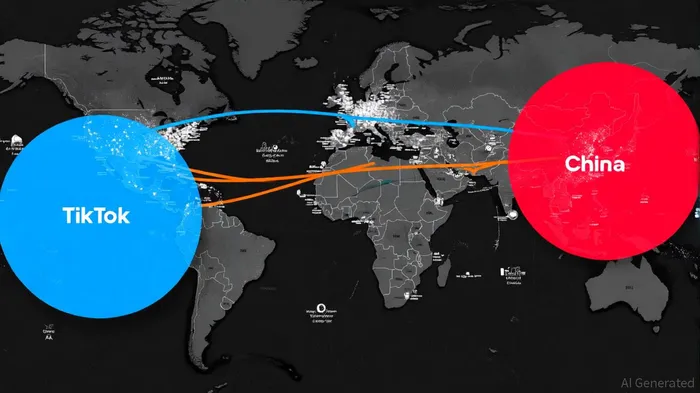
The U.S.-China tech rivalry has reached a critical inflection point, with TikTok at the epicenter of a high-stakes geopolitical and economic showdown. As the Trump administration and Beijing finalize a framework deal to avert a TikTok ban, the platform's fate underscores the broader implications of strategic geopolitical risk on tech equity valuations. This analysis examines how regulatory, legal, and diplomatic maneuvers are reshaping not only TikTok's trajectory but also the valuation dynamics of the global technology sector.
Regulatory and Legal Crossroads: TikTok's Uncertain Path
The Supreme Court's January 2025 ruling upholding the Protecting Americans from Foreign Adversary Controlled Applications Act (PAFACA) has forced TikTok's parent company, ByteDance, to divest its U.S. operations by January 19, 2025, or face a nationwide ban[1]. This decision, framed as a national security imperative, has created a binary outcome: either a successful sale to a U.S.-based entity or a collapse of TikTok's U.S. operations. The Trump administration's recent framework deal with China—announced in September 2025—seeks to navigate this impasse by transferring TikTok's ownership to a U.S. consortium while allowing ByteDance to retain a 19.9% stake[2].
However, the legal and technical hurdles remain formidable. A federal appeals court's December 2024 ruling had already affirmed the law's constitutionality, emphasizing TikTok's data collection risks[3]. Meanwhile, the separation of TikTok's algorithm from ByteDance's infrastructure poses operational challenges, with analysts estimating a potential $60 billion valuation for a successful U.S. sale[4]. The Trump administration's willingness to extend the deadline has added a layer of uncertainty, as China's potential retaliatory measures—such as tariffs on U.S. goods—could complicate negotiations[5].
Broader Sector-Wide Implications: Geopolitical Risk as a Valuation Factor
TikTok's case is emblematic of a larger trend: geopolitical risk is increasingly embedded in tech equity valuations. The U.S.-China rivalry has spurred regulatory fragmentation, with policies targeting foreign-owned platforms, semiconductor exports, and AI investments. For instance, Huawei's resilience in developing advanced semiconductors post-U.S. sanctions—such as the Ascend 910B chip—demonstrates how geopolitical pressures can drive domestic innovation but also create valuation volatility[6]. Similarly, ZTE's 2017-2023 sanctions crisis led to a 90% decline in its market capitalization before a 2023 reprieve allowed partial recovery[7].
The semiconductor sector, a linchpin of the tech rivalry, has seen its market cap surge from $3.4 trillion in mid-2023 to $6.5 trillion by mid-2024, driven by AI demand and U.S. export controls[8]. Nvidia's 83.6% revenue growth in 2024 highlights the sector's resilience, yet its exposure to Chinese markets—accounting for 20–25% of data center revenue—underscores the fragility of global supply chains[9]. Meanwhile, China's push for self-reliance in chip manufacturing, including a 31% global share of legacy chip production in 2023, signals a long-term shift in industry dynamics[10].
Investment Flows and AI: A New Geopolitical Battleground
The U.S. has tightened outbound investment rules to curb funding for Chinese AI and quantum computing firms, with the Biden administration's January 2025 final rule prohibiting investments in entities with military applications[11]. This has redirected capital toward U.S. tech giants like MetaMETA-- and MicrosoftMSFT--, which are projected to outspend Chinese counterparts on AI by $390 billion in 2025[12]. Conversely, Chinese tech firms—Alibaba, Tencent, and Baidu—have launched a $32 billion AI fundraising spree to close the gap[13].
For investors, the interplay of geopolitical risk and innovation is reshaping valuation models. Deloitte's 2025 tech industry outlook notes that AI infrastructure and cybersecurity are attracting dealmaking activity, but valuations have moderated due to macroeconomic headwinds[14]. The sector's resilience, however, is evident in the 20% share of global chip sales attributed to generative AI in 2024[15].
Strategic Considerations for Investors
The TikTok saga and broader U.S.-China tech diplomacy highlight three key investment themes:
1. Regulatory Arbitrage: Companies navigating dual regulatory regimes (e.g., TikTok's potential U.S. sale) face valuation swings tied to geopolitical outcomes.
2. Supply Chain Resilience: Diversification of supply chains and R&D into “legacy” technologies (e.g., 28 nm chips) is becoming a competitive necessity[16].
3. AI as a Geopolitical Asset: Control over AI infrastructure and data will increasingly dictate market power, with U.S. and Chinese firms vying for dominance[17].
Conclusion: A Tipping Point for Tech Valuations
TikTok's fate is not an isolated event but a microcosm of the U.S.-China tech rivalry's far-reaching consequences. As geopolitical risks become embedded in valuation models, investors must balance short-term volatility with long-term strategic shifts. The semiconductor and AI sectors, in particular, will serve as barometers for how nations and corporations navigate this new era of technological decoupling and reconfiguration.







Comentarios
Aún no hay comentarios