
China's Tech Boom: Navigating Growth Amid Geopolitical Crosscurrents
The rapid evolution of China’s technology sector is reshaping global industry dynamics, even as the nation grapples with trade wars and overcapacity. CNBC’s China Connection newsletter reveals a landscape of stark contrasts: cutting-edge advancements in electric vehicles (EVs), semiconductors, and AI coexist with systemic inefficiencies and geopolitical headwinds. For investors, the question is clear: Can China’s tech boomBOOM-- sustain its momentum, or will it falter under the weight of its own contradictions?
The Rise of Electric Vehicles: A Double-Edged Sword
China’s dominance in the EV sector is undeniable. Companies like BYD, which unveiled five new models at the Shanghai auto show, now rival global giants like Tesla. The nation accounts for 29% of global manufacturing value-added in EVs—nearly matching the combined output of the U.S. and Europe. However, this success has bred its own crisis.
A price war among automakers, driven by the pursuit of “neijuan” (involution), has left nearly 48% of mainland-listed firms reporting losses in 2024. The sector’s overcapacity is so severe that factory shutdowns in export hubs like Yiwu and Dongguan are now common.
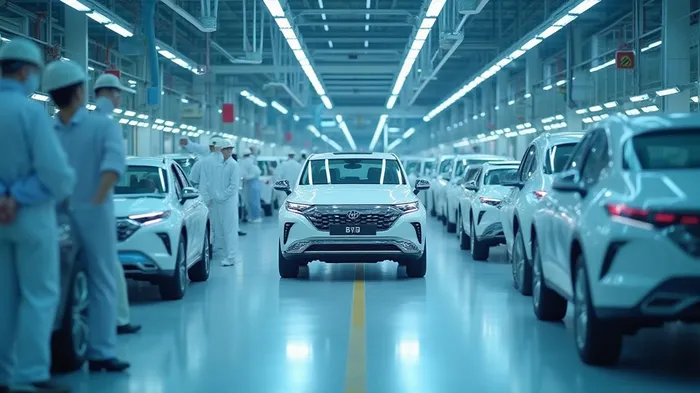
Investors should prioritize firms navigating this turbulence effectively. BYD’s stock has surged 140% over the past year, but its ability to pivot to software and AI-driven features—like Huawei’s new driver-assist systems—will be critical. Meanwhile, Tesla’s stock price, which has dipped 15% since early 2024 amid rising Chinese competition, highlights the sector’s shifting power dynamics.
Semiconductors: Sanctions Spur Innovation, but Challenges Remain
U.S. export controls, particularly on advanced AI chips, have backfired in one key respect: They’ve accelerated China’s self-reliance. Huawei, despite being blacklisted since 2019, now sources 33 out of 38 components domestically for its Pura 70 smartphone series. Its 2024 R&D spending hit 20.8% of revenue, far exceeding its 10% target and outpacing rivals like NVIDIA (14.2%) and ASML (15.2%).
Yet China’s semiconductor ambitions face hurdles. The C919 aircraft, a flagship project, still relies on U.S./European parts, and global supply chain disruptions persist. South Korea’s SK Hynix—a beneficiary of AI-driven demand—saw a 158% profit surge in Q1 2025, underscoring China’s uphill battle to capture market share in high-end chips.
AI and the Digital Economy: The New Frontier
China’s AI sector is booming, with startups like DeepSeek releasing models rivaling OpenAI’s ChatGPT. Alibaba’s Qwen 3 and Baidu’s virtual human tools are transforming industries, from media to e-commerce. Baidu’s AI livestreaming hosts now drive 80% lower costs than human counterparts, a breakthrough for small businesses.
The 14th Five-Year Plan’s focus on the digital economy has paid dividends. Analysts estimate Chinese tech stocks trade at a 52% discount to U.S. peers, making firms like Tencent (0700.HK) and Haier (600690.SH) undervalued bets on AI and smart manufacturing.
Policy and Geopolitics: Walking the Tightrope
Beijing’s pivot to domestic consumption faces headwinds. Retail sales growth lagged industrial output in 2024, signaling weak demand. Meanwhile, U.S. tariffs—now averaging 145% on some goods—have cost China an estimated 2% of GDP. The government’s response? Pledge 2 trillion yuan in fiscal stimulus and accelerate nuclear/hydrogen energy projects.
Conclusion: A Fragile Boom
China’s tech boom is real, but its longevity hinges on navigating three critical risks:
1. Overcapacity: EVs and semiconductors face structural oversupply. Investors should favor firms like BYD and Huawei with diversified revenue streams.
2. Trade Tensions: U.S. tariffs could erode profits unless Beijing secures tariff relief or diversifies exports. Firms pivoting to Africa (e.g., Ghana’s Cotrie Logistics) or Southeast Asia may outperform.
3. Innovation Efficiency: R&D spending must translate into marketable products. Alibaba’s Qwen 3 and Baidu’s AI tools offer promising bets, but scalability remains unproven.
The data paints a mixed picture: China’s EVs and AI sectors are global leaders, but over 48% of firms still lose money. For investors, the strategy is clear: Focus on domestic champions with sustainable tech pipelines and geographically diversified supply chains. The boom is real—but only for the agile.
In the end, China’s tech rise is less about hitting arbitrary “2025 targets” and more about adapting to a world where innovation thrives amid adversity. The companies that survive—and thrive—will be those that master both.







Comentarios
Aún no hay comentarios