
China's Strategic Solar Surge in the Middle East: Geopolitical Alliances and Renewable Energy Investment Opportunities
China's expanding footprint in the Middle East's solar energy sector has evolved from a commercial endeavor into a strategic geopolitical asset, reshaping regional dynamics and unlocking new investment opportunities. By 2025, Chinese firms have secured over $10 billion in contracts across the Gulf and North Africa, leveraging their manufacturing dominance, technological expertise, and geopolitical foresight to align with Middle Eastern nations' decarbonization goals. This surge is not merely about energy transition-it is a calculated move to deepen economic interdependence, counter Western trade barriers, and secure long-term influence in a region pivotal to global energy markets.
Geopolitical Leverage and Strategic Partnerships
China's Belt and Road Initiative (BRI) has provided a framework for its solar investments, transforming the Middle East into a critical node in its global energy network. For instance, the UAE's $2.5 billion 2 GW Al Dhafra Solar PV project, developed by China Machinery Engineering Corporation (CMEC), underscores this alignment: by 2026, the plant will supply clean energy to 160,000 households and reduce carbon emissions by 2.4 million tons annually, according to a Princeton analysis. Similarly, Saudi Arabia's Public Investment Fund (PIF) has partnered with Jinko Solar to establish 5 GW of local solar panel manufacturing capacity, a move directly tied to Vision 2030's ambition to diversify away from oil, as noted in a Saur Energy report. These projects are not isolated deals but part of a broader strategy to embed Chinese infrastructure and supply chains into the Gulf's energy architecture.
The geopolitical calculus is equally compelling. As Gulf states like Saudi Arabia and the UAE seek to balance their relationships with the U.S. and China, solar energy partnerships offer a non-zero-sum avenue for cooperation. Chinese investments in Oman's 30% renewable electricity target and Egypt's 1000MW Obelisk Solar + 100MW BESS project further illustrate this trend, as highlighted in a Nes Fircroft roundup. By 2025, Middle Eastern sovereign funds-most notably the UAE's Mubadala and Saudi PIF-have injected over $20 billion into China's photovoltaic industry, creating a symbiotic relationship where technology transfer and market access are exchanged for capital and infrastructure, according to a Solarbe Global analysis.
Economic Resilience and Overcoming Global Challenges
China's solar industry, long plagued by overcapacity and Western tariffs, has found a lifeline in the Middle East. Local manufacturing hubs, such as Drinda Energy's $1 billion facility in Oman, allow Chinese firms to bypass transportation costs and U.S.-EU trade restrictions while meeting surging regional demand, as discussed in an AgBi opinion. This strategy mirrors the "nearshoring" trends observed in other sectors, with the Gulf serving as a strategic bridge to Africa and South Asia.
For investors, the Middle East's solar boom presents dual opportunities:
1. Infrastructure Equity: Projects like the 2 GW Sadawi Solar Project in Saudi Arabia, led by Masdar and Shanghai Electric, offer long-term revenue streams through power purchase agreements (PPAs) and carbon credit markets. With initial power generation slated for May 2026, these assets are poised to capitalize on the region's $1.2 trillion renewable energy investment pipeline by 2030, according to Construction Review Online.
2. Supply Chain Integration: Chinese manufacturers like Sungrow Power Supply, which co-leads Saudi Arabia's 2.6 GW Al Shuaibah Solar PV project, are embedding themselves into Gulf supply chains. This not only secures recurring revenue but also insulates them from global protectionist policies, as detailed in an ACIEP report.
Risks and the Path Forward
Despite the momentum, challenges loom. Overcapacity in China's solar sector-exacerbated by aggressive state subsidies-risks creating a bubble, while U.S. and EU tariffs on Chinese solar modules could strain Gulf-based manufacturing. To mitigate these risks, policy recommendations include:
- For China: Phasing out subsidies to clear overcapacity and incentivizing technology upgrades.
- For Gulf States: Prioritizing local workforce training and technology transfer to avoid dependency on Chinese expertise.
Conclusion
China's solar investments in the Middle East are a masterclass in strategic alignment-merging economic pragmatism with geopolitical ambition. For investors, the region's renewable energy transition offers a unique confluence of high-growth markets, stable policy frameworks, and geopolitical stability. As the Gulf accelerates its green agenda, China's role as a partner, not just a supplier, will define the next decade of energy geopolitics.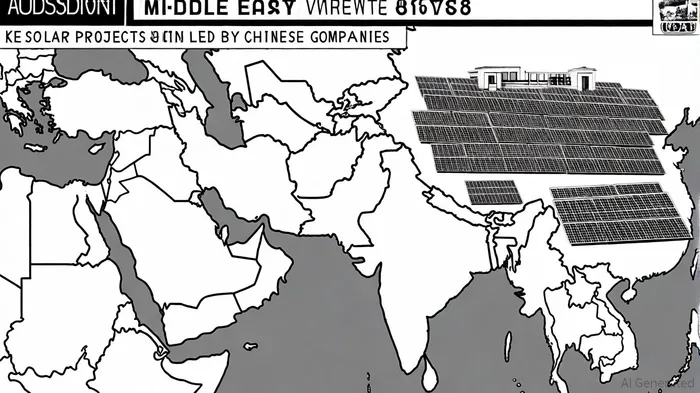







Comentarios
Aún no hay comentarios