
China's Strategic Energy Subsidies and AI Semiconductor Self-Reliance: Assessing the Long-Term Viability of Huawei-Led Innovation
State-Backed Energy Subsidies: A Double-Edged Sword
China has implemented aggressive energy subsidies to offset the inefficiencies of its domestic AI chips. Local governments in provinces like Gansu, Guizhou, and Inner Mongolia now offer up to 50% reductions in electricity bills for data centers using locally produced semiconductors, according to a Reuters report. This policy is conditional: foreign chips, including those from NVIDIANVDA-- and AMDAMD--, are excluded from these incentives, as reported by Tom's Hardware. For instance, Chinese AI chips reportedly consume 30–50% more electricity than equivalent NVIDIA H20 models, a finding detailed in a WCCF Tech analysis, making subsidies critical to maintaining cost competitiveness.
According to a Reuters report, this strategy is part of a $98 billion national AI spending plan for 2025, with nearly $50 billion allocated to semiconductor and AI infrastructure, as noted in a Asia Financial report. However, the sustainability of these subsidies remains uncertain. While they currently offset operational costs for firms like Huawei and Cambricon, long-term reliance on energy handouts risks creating a dependency that could strain regional budgets, particularly as demand for AI compute grows, as noted in the Asia Financial report.
Huawei's Semiconductor Ecosystem: Partnerships and Breakthroughs
Huawei's role in China's AI chip ecosystem is pivotal. The company has leveraged fabless-foundry partnerships to accelerate innovation, collaborating with firms like GlobalFoundries and Cyient Semiconductors to access advanced manufacturing capabilities and technical expertise, as noted in a MarketWatch analysis. This model allows Huawei to focus on design while outsourcing production, reducing barriers to entry in a capital-intensive industry.
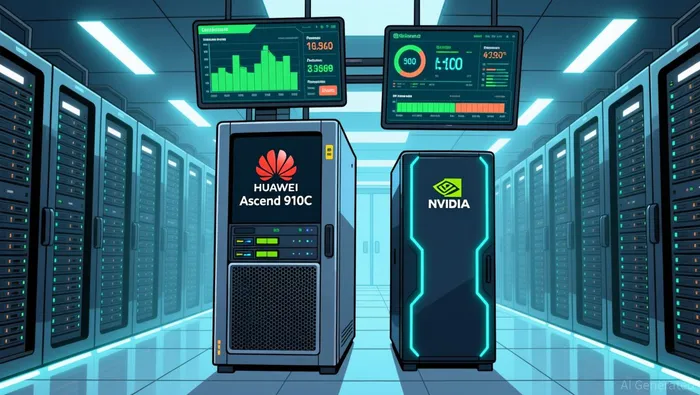
A landmark achievement came in 2023 with the launch of the Mate 60 Pro smartphone, which incorporated a 7-nanometer processor from SMIC. This demonstrated China's progress in overcoming U.S. export restrictions and signaled Huawei's growing influence in domestic chip production. By 2025, Huawei plans to double its output of the Ascend 910C AI chip to 600,000 units annually, as noted in a WebPR News report, directly challenging NVIDIA's dominance in the Chinese market.
Global Competition and Asymmetric Advantages
Despite Huawei's scaling efforts, its chips still lag behind NVIDIA's in raw performance. The Ascend 910C, while comparable to NVIDIA's H100 in theoretical specifications, is expected to underperform in real-world applications, as noted in a ChinaTalk analysis. Meanwhile, NVIDIA's roadmap projects a chip in Q3 2027 that will be 26 times more powerful than Huawei's current offerings, as also reported by the ChinaTalk analysis. This performance gap raises questions about Huawei's ability to compete globally without further breakthroughs.
However, energy subsidies provide a critical asymmetric advantage. By reducing electricity costs for data centers using Huawei chips, Beijing effectively subsidizes the higher power consumption of domestic hardware, as noted in a WCCF Tech analysis. This creates a cost buffer that allows Huawei to scale production and capture market share in China, even if its chips are less efficient. For investors, this dynamic suggests a short-to-medium-term edge for Huawei-led clusters, though long-term success will depend on closing the performance gap.
Sustainability and the Road Ahead
The long-term viability of China's energy subsidy model hinges on two factors: technological advancement and energy transition. While subsidies currently prop up domestic AI infrastructure, they may not offset the growing inefficiencies of less advanced chips as global competition intensifies, as noted in the ChinaTalk analysis. Additionally, China's broader green transition-driven by private equity and market forces rather than state handouts-could reduce emissions and lower energy costs over time.
By 2030, local governments plan to extend these subsidies further, ensuring continued support for data centers using domestic chips, as reported by an India Times report. However, without significant improvements in energy efficiency and performance, Huawei's dominance may remain confined to the Chinese market.
Investment Implications
For investors, Huawei's ecosystem represents both opportunity and risk. The company's partnerships, state support, and energy subsidies create a strong foundation for short-term growth in AI infrastructure. However, the long-term outlook depends on Huawei's ability to innovate beyond subsidies and match global leaders like NVIDIA in performance.
The asymmetric advantages of energy-driven scalability are clear, but they come with caveats. As China's AI industry matures, investors should monitor two key metrics: (1) Huawei's progress in chip performance relative to global benchmarks and (2) the sustainability of energy subsidies amid rising demand and environmental pressures.
In the global AI race, China's strategy is not just about catching up-it's about redefining the rules. Whether Huawei-led innovation clusters can sustain this momentum will determine the next chapter in semiconductor geopolitics.





Comentarios
Aún no hay comentarios