
China's Strategic Battery Industry and U.S. Trade Dynamics: Geopolitical Leverage and Investment Opportunities
The global race for clean energy dominance has crystallized into a high-stakes contest between China and the United States, with lithium-ion batteries at the center. China's near-total control of the battery supply chain-from raw material extraction to advanced manufacturing-has created a geopolitical and economic advantage that U.S. policymakers and investors are scrambling to counter. For investors, this dynamic presents both risks and opportunities, particularly in sectors tied to raw material suppliers, battery manufacturers, and recycling technologies.
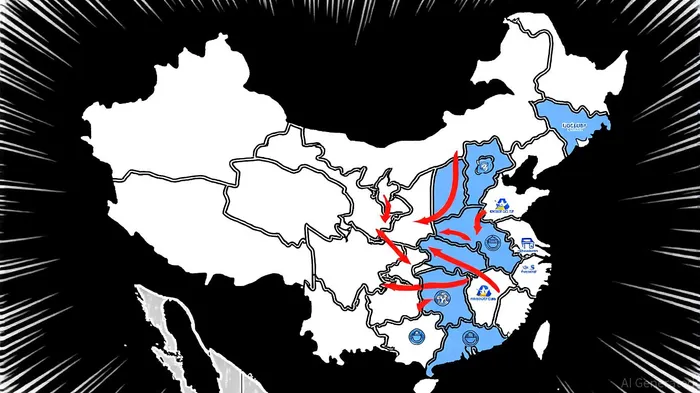
China's Supply Chain Supremacy: A Strategic Fortress
China's dominance in the lithium-ion battery industry is not accidental but the result of decades of strategic industrial policy. According to a ScienceDirect report, China controls over 98% of the global market for lithium iron phosphate (LFP) batteries, a critical technology for electric vehicles (EVs) and energy storage. This supremacy extends across the entire value chain: the country processes over 90% of the world's graphite, dominates cobalt and lithium refining, and accounts for 80% of global lithium-ion cell production, as noted in an EIA analysis. Chinese firms also hold significant stakes in lithium mines in Australia and cobalt operations in the Democratic Republic of the Congo, ensuring a steady supply of raw materials, according to a Fraunhofer study.
This vertical integration allows China to scale production rapidly and adapt to technological shifts, such as the rise of sodium-ion and semi-solid-state batteries, a trend highlighted in an ORF analysis. For investors, this means Chinese battery manufacturers and raw material suppliers are well-positioned to benefit from the global EV and renewable energy boom. However, it also raises concerns about supply chain vulnerabilities for countries reliant on Chinese inputs.
U.S. Trade Policies: Tariffs, Subsidies, and the Quest for Autonomy
The U.S. response to China's dominance has been multifaceted, combining punitive tariffs, subsidies for domestic production, and efforts to diversify supply chains. By August 2025, cumulative tariffs on Chinese lithium-ion batteries had reached 58%, with additional layers including a 34% reciprocal tariff and a 25% Section 301 duty, according to The Tariff Tangle. These measures have driven up battery costs by $7.00/kWh year-to-date, forcing U.S. manufacturers to seek alternatives like sodium-ion batteries or domestic partners, as explained in a UFINE analysis.
The Inflation Reduction Act (IRA) has also injected billions into U.S. battery production, offering tax credits for companies that source materials and manufacture batteries domestically, according to an AP News report. While these policies aim to reduce reliance on China, they face headwinds. For example, U.S. graphite imports from China face tariffs exceeding 160%, creating bottlenecks for battery producers, as reported by The National Interest. This highlights a paradox: while tariffs aim to insulate the U.S. market, they also expose its dependence on Chinese raw materials.
Corporate Counterstrategies: Recycling, Innovation, and Diversification
U.S. companies are adopting strategies to mitigate China's influence. Battery recycling has emerged as a key area, with firms like Redwood Materials and Lime recovering critical materials from end-of-life batteries, according to The EYE. Redwood alone recycled 20 gigawatt-hours of material in 2024, enough for 250,000 EVs, as reported by Forbes. Recycling not only reduces reliance on Chinese imports but also aligns with circular economy trends, which are gaining traction in Europe and North America, a point explored in an FDD analysis.
Innovation is another frontier. The U.S. government is funding research into next-generation battery chemistries, such as solid-state and sodium-ion, which could bypass China's dominance in cobalt and nickel, as discussed in a National Interest essay. Meanwhile, companies are exploring alternative sourcing, including lithium from Argentina's Lithium Triangle and graphite from Canada and Australia, according to Battery Tech Online.
Investment Implications: Balancing Risk and Reward
For investors, the interplay between China's supply chain control and U.S. countermeasures creates a complex landscape. Key opportunities include:
1. Chinese Battery Manufacturers and Raw Material Suppliers: Firms with expertise in LFP and sodium-ion batteries, as well as those controlling lithium and cobalt reserves, are likely to benefit from sustained global demand.
2. U.S. Recycling and Circular Economy Firms: Companies like Redwood Materials and Li-Cycle are positioned to profit from the growing emphasis on recycling and reducing supply chain risks.
3. Domestic Producers of Critical Minerals: U.S. firms involved in lithium extraction, graphite processing, and rare earth element refining could gain traction as part of the IRA's push for self-sufficiency.
However, risks remain. Geopolitical tensions could escalate, leading to further trade disruptions. Additionally, U.S. policies may struggle to offset China's cost advantages, particularly in raw material processing. Investors must also weigh the long-term viability of alternative technologies, such as sodium-ion batteries, which are still emerging.
Conclusion: A New Energy Cold War
The battle for battery supremacy is reshaping global trade and investment. China's entrenched position in the supply chain offers short-term gains for its manufacturers but raises long-term risks for countries dependent on its inputs. The U.S., meanwhile, is betting on tariffs, subsidies, and innovation to break China's grip, though success is far from guaranteed. For investors, the path forward lies in hedging bets: supporting Chinese firms with dominant market positions while backing U.S. and allied efforts to build resilient, diversified supply chains. In this high-stakes arena, adaptability-and a keen eye on geopolitical currents-will be the ultimate assets.







Comentarios
Aún no hay comentarios