
China's Strategic Advances in Space Defense: Unlocking Investment Opportunities in Aerospace and Defense Technology
China's aerospace and defense sector is undergoing a transformative phase, driven by a confluence of technological innovation, strategic military modernization, and ambitious commercialization goals. As the nation positions itself as a global leader in space power, investors are increasingly turning their attention to the opportunities-and risks-associated with this rapidly evolving landscape.
Technological Innovations: Reusable Rockets and Deep Space Ambitions
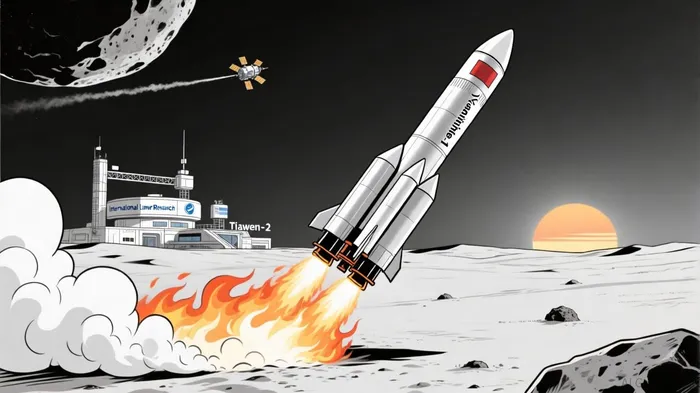
China's advancements in reusable rocket technology are reshaping the economics of space access. The China Aerospace Science and Technology Corporation (CASC) has made significant strides, with the successful vertical takeoff and landing test of the Yuanxingzhe-1 rocket in May 2025, according to How China Is Transforming Space Power. This achievement, coupled with plans for a fully reusable heavy-lift launcher, underscores China's commitment to reducing launch costs and enhancing operational flexibility. Private players like Landspace and iSpace are also contributing, developing rockets such as the Zhuque-3 and Hyperbola-2 to support both commercial and military applications, according to a Zona-Militar report.
Beyond Earth orbit, China's deep space exploration initiatives are gaining momentum. The Tiawen-2 probe, launched in 2025, is set to collect samples from asteroid 2016HO3 and conduct a gravitational slingshot maneuver to reach comet 311P/PANSTARRS, as reported by the Diplomat. These missions align with broader efforts to establish an asteroid defense system, including monitoring, early warning, and deflection capabilities. Meanwhile, the government's vision for a lunar industrial base by 2035-featuring a nuclear reactor and 3D printing using lunar regolith-highlights its long-term strategic goals noted in the Diplomat piece.
Military Integration: Space as a Core Domain of Power
The People's Liberation Army (PLA) has integrated space capabilities into its national power strategy, framing space as a critical domain for strategic autonomy. The Strategic Support Force (SSF) plays a central role in managing satellite networks, counterspace technologies, and space situational awareness systems, according to a New Space Economy report. The BeiDou Navigation Satellite System (BDS), now providing global coverage, enhances the PLA's precision strike capabilities and complements terrestrial military operations, the New Space Economy report adds.
Recent developments, such as the Shijian-21 and Shijian-25 satellites conducting the first geosynchronous orbit refueling in 2025, demonstrate China's focus on sustaining long-term space operations, according to the Diplomat. These capabilities are not only defensive but also serve as tools of deterrence, particularly as reusable rockets and in-orbit refueling technologies reduce reliance on terrestrial infrastructure.
Commercial Space Expansion: A Dual-Use Ecosystem
The Chinese government has prioritized commercial space development, as highlighted in the 2025 government work report, according to a SpaceNews report. Premier Li Qiang emphasized the sector's role in driving high-tech growth, with provinces like Beijing and Shanghai implementing action plans to foster innovation. Rapid satellite manufacturing, led by companies such as Geespace, has enabled mass production of up to 500 satellites annually, supporting large-scale constellations like Guowang, as noted by the Diplomat.
Private sector participation, though still under state oversight, is expanding. Firms like Landspace and iSpace are leveraging government contracts while exploring commercial opportunities in satellite launches and space-based services. However, regulatory constraints and the need for state approval remain barriers to disruptive innovation, according to a Financial Analyst report.
Investment Landscape: Budgets, Growth, and Geopolitical Dynamics
China's 2025 defense budget of $249 billion-a 7.2% increase from 2024-reflects its commitment to modernization, as reported by the New Space Economy report. A significant portion of this funding is allocated to aerospace and naval upgrades, including the Fujian (CV-18) aircraft carrier and the stealth J-35A fighter jet, as noted in the Zona-Militar analysis. The budget also supports hypersonic weapons, nuclear deterrence systems, and advanced UAVs, aligning with China's goal of building a "world-class" military by 2050, the Financial Analyst report observes.
Private equity and venture capital activity in the sector are surging. Globally, defense tech investments reached $19.1 billion in Q2 2025, with China's market poised to benefit from its focus on AI, quantum computing, and cybersecurity, according to the SpaceNews report. The China aerospace and defense market is projected to grow at a compound annual growth rate (CAGR) of 6.66%, reaching $472.17 million by 2035, the Zona-Militar analysis projects. The air defense systems segment alone is expected to grow at 7.4% CAGR, reaching $6,986.7 million by 2030, the New Space Economy report notes.
Challenges and Strategic Considerations
Investors must navigate regulatory complexities and geopolitical tensions. While China's state-driven model ensures stability, it also limits the agility of private firms. Additionally, U.S.-China trade dynamics, including export restrictions on rare earth minerals, could disrupt supply chains for next-generation defense systems, the Financial Analyst report warns. Geopolitical risks, such as Taiwan-related military exercises, further complicate the investment environment, the New Space Economy report adds.
Conclusion: A Calculated Path to High Returns
China's strategic advances in space defense present compelling opportunities for investors willing to navigate the sector's unique challenges. From reusable rocketry and lunar industrialization to military-space integration and commercial satellite networks, the ecosystem is rich with innovation. However, success requires a nuanced understanding of regulatory frameworks, geopolitical currents, and the interplay between state and private actors. For those who can align their strategies with China's long-term vision, the rewards are substantial-and the stakes, equally high.







Comentarios
Aún no hay comentarios