
China's Steel Export License Policy and Its Impact on Global Iron Ore Demand: Strategic Supply Chain Reallocation and High-Value Investment Opportunities
China's steel industry is undergoing a transformative shift in 2025–2026, driven by a newly implemented export licensing system for 300 steel products, including semi-finished goods like steel billets and finished products such as pipes and rail. Effective January 1, 2026, this policy, announced by the Ministry of Commerce and the General Administration of Customs, aims to curb global market saturation, address tax evasion, and stabilize domestic supply chains. The move marks a strategic pivot from volume-driven growth to quality-focused development, with profound implications for global iron ore demand and investment opportunities in high-value steel sectors.
Direct Impact on Global Iron Ore Demand
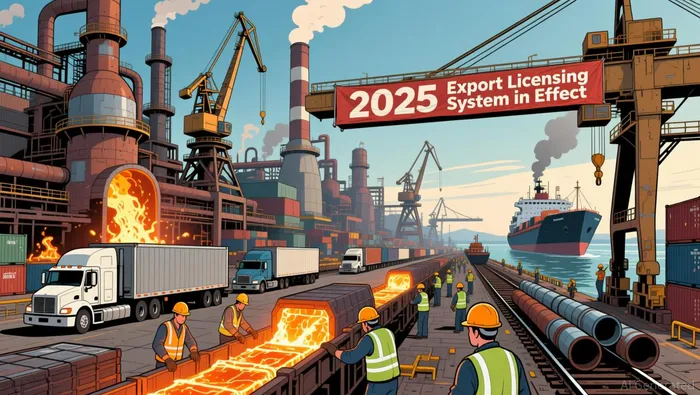 The licensing system is expected to reduce China's reliance on resource-intensive exports, particularly semi-finished steel products that consume significant iron ore. By restricting the outflow of low-value steel billets and slabs-products that require large quantities of raw materials-the policy indirectly curbs iron ore demand. For instance, semi-finished steel exports surged by 320% in the first seven months of 2025, but the new licensing requirements will likely slow this trend. This aligns with China's broader goal to optimize resource use and mitigate environmental pressures, as over 80% of its steel capacity is projected to meet ultra-low emissions standards by 2025.
Moreover, the policy's emphasis on high-end, value-added production-such as bearing steel, gear steel, and high-temperature alloys-reduces the need for raw material-heavy exports. These specialized materials, critical for automotive, aerospace, and renewable energy sectors, require advanced manufacturing techniques rather than bulk iron ore inputs. As a result, global iron ore markets may face a structural decline in demand from China, the world's largest consumer, as the country prioritizes domestic industrial upgrading over export-driven growth.
Strategic Supply Chain Reallocation and Regional Opportunities
China's policy shift is reshaping global supply chains, with Southeast Asia, the Middle East, and Africa emerging as key beneficiaries. These regions are absorbing high-value Chinese steel products, including coated sheets, electrical steel, and structural sections, to support infrastructure and industrial projects. For example, Saudi Arabia's construction boom and Indonesia's manufacturing expansion are increasingly reliant on Chinese semi-finished steel, which faces fewer trade barriers than finished goods.
Simultaneously, China's domestic steelmakers are pivoting toward green technologies to meet international environmental standards. Electric arc furnace (EAF) steelmaking and hydrogen metallurgy are gaining traction, with the government targeting 30% of crude steel production via EAF by 2035. This transition not only reduces carbon emissions but also enhances China's competitiveness in global markets where carbon border adjustment mechanisms (CBAM) are being implemented.
Investment Opportunities in High-Value Steel Sectors
The policy-driven reallocation of China's steel industry creates actionable investment opportunities in three key areas:
Advanced Materials and R&D-Driven Producers:
Companies specializing in high-performance steel, such as Baosteel, are gaining preferential support through fiscal incentives and fast-tracked approvals according to industry reports. Baosteel's focus on higher-margin, specialized grades for global markets positions it as a leader in the transition to value-added production as highlighted in market analysis. Similarly, joint ventures between Chinese steelmakers and research institutions are accelerating the development of bearing steel and high-temperature alloys, critical for EVs and renewable energy infrastructure.Green Steel and Decarbonization Technologies:
The integration of EAF and hydrogen-based production methods is attracting capital. For instance, Ganfeng's $2 billion investment in Argentina's lithium mining project and Tongkun Group's $5.9 billion refining complex in Indonesia highlight China's upstream expansion in clean energy supply chains. These projects secure critical inputs for low-carbon steel production while aligning with global decarbonization goals.Regional Infrastructure and Manufacturing Hubs:
Southeast Asia and Africa are becoming focal points for Chinese steel exports, driven by infrastructure demand and limited local production capacity. Projects in the Philippines, Turkey, and Saudi Arabia are leveraging Chinese semi-finished steel to build railways, power plants, and industrial parks. Investors with exposure to these regions stand to benefit from China's strategic export reallocation.
Conclusion: A New Era for Global Steel Markets
China's export licensing policy is a catalyst for structural change in the global steel industry. By curbing low-value exports and promoting high-end, green production, the country is reshaping iron ore demand and supply chain dynamics. For investors, the opportunities lie in advanced materials, decarbonization technologies, and regional markets poised to absorb China's high-value steel output. As the world's largest steel producer navigates trade tensions and environmental mandates, its strategic reallocation underscores the importance of aligning investments with quality, innovation, and sustainability.







Comentarios
Aún no hay comentarios