
China's Semiconductor Self-Reliance: Huawei and DeepSeek Lead the Charge in AI and Telecom
China's push for semiconductor self-reliance has entered a defining phase, driven by a mix of geopolitical necessity, strategic ambition, and technological innovation. At the heart of this effort are companies like Huawei and DeepSeek, which are reshaping the landscape of artificial intelligence (AI) and telecommunications. Their trajectories offer a compelling lens through which to assess the financial and strategic potential of China's broader semiconductor ecosystem.
The Strategic Imperative: From Survival to Sovereignty
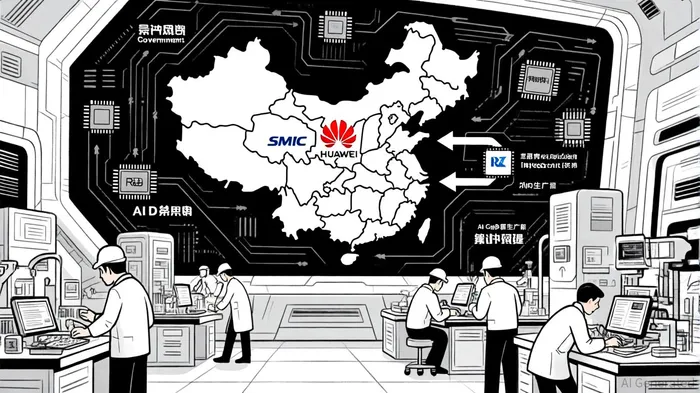
China's semiconductor strategy is no longer just about survival in the face of U.S. export controls—it is about asserting technological sovereignty. The third iteration of the National Integrated Circuit Industry Investment Fund, or “Big Fund 3.0,” allocated $47.5 billion in 2024 to bolster domestic production across the entire supply chain, from design to packaging[2]. This funding prioritizes advanced nodes for AI and high-bandwidth memory (HBM), reflecting a clear focus on strategic sectors[5].
Huawei, a poster child for this strategy, exemplifies the trade-offs between short-term profitability and long-term resilience. In 2024, the company reported a 22.4% year-on-year revenue increase to $118.67 billion but saw its net profit drop by 28% to $8.61 billion[2]. This decline is directly tied to Huawei's aggressive R&D spending, which consumed 20.8% of its revenue in 2024—$24.77 billion in total[2]. Over the past decade, Huawei has invested a staggering $172 billion in R&D[2], a commitment that has enabled breakthroughs like the 7nm chips in its Mate 60 smartphone, produced using domestic deep ultraviolet (DUV) lithography[1].
The geopolitical calculus is clear: Huawei's investments are not just about catching up but about building a self-sufficient ecosystem. Its Ascend AI chips, for instance, are now powering models like DeepSeek's AI systems[3], illustrating how domestic players are interlinking to circumvent foreign technology restrictions.
DeepSeek: Redefining AI Efficiency and Cost
While Huawei anchors China's telecom and semiconductor ambitions, DeepSeek has emerged as a disruptor in AI. The startup's DeepSeek-V3 model, trained for less than $6 million, challenges the cost structures of U.S. giants like OpenAI and Google[4]. This efficiency stems from innovative techniques such as the Mixture of Experts (MoE) architecture, which activates only a fraction of a model's parameters for each task, slashing computational costs[4].
DeepSeek's success is not accidental. It benefits from China's open-source AI policies, which mandate the sharing of software and hardware designs under the Model AI Law[1]. This legal framework, coupled with access to Huawei's Ascend chips, has allowed DeepSeek to scale rapidly. By late 2024, the company had deployed 50,000 Hopper-generation GPUs, with $1.63 billion spent on GPU server capital expenditures alone[2].
The implications are profound. DeepSeek's cost model threatens to democratize AI, making advanced capabilities accessible to smaller firms and emerging markets. However, its rise has also triggered a policy backlash in the U.S., where federal and state governments have banned its use on government devices over national security concerns[5]. This underscores the dual-edged nature of China's AI ambitions: they are both a competitive threat and a catalyst for global regulatory shifts.
Financial Realities and Strategic Risks
Despite these strides, challenges persist. China's lack of access to ASML's extreme ultraviolet (EUV) lithography machines remains a critical bottleneck, limiting its ability to produce sub-10nm chips[3]. While companies like SMIC have made progress with DUV technology, the gap with TSMCTSM-- and Samsung is stark. This technological lag is compounded by internal issues, including corruption scandals and the diminishing role of local governments in funding initiatives[3].
For Huawei, the financial risks are equally pronounced. Its smart automotive division, which grew 474.4% in 2024, now represents a beacon of hope[2], but the company's overall profitability remains under pressure. Huawei's “FOUR NEW” strategy—focusing on AI agents, smart services, and network automation—aims to offset this by capturing new markets in enterprise and consumer tech[5]. Yet, the company's reliance on state support, such as subsidies and tax breaks[1], raises questions about its long-term viability if geopolitical tensions ease or funding dries up.
The Global Chessboard: Disruption and Resilience
China's semiconductor push is not just a domestic story—it is reshaping global supply chains and trade dynamics. The expansion of mature-node chip production (28nm and above) has already led to oversupply concerns, with countries like the UK and South Korea reassessing their reliance on Chinese chips[3]. Meanwhile, the U.S. response, including restrictive policies on DeepSeek and other AI models, signals a broader effort to contain China's technological ascent[5].
For investors, the key question is whether China's state-led model can overcome its structural weaknesses. The answer lies in the interplay between government funding, private-sector innovation, and geopolitical resilience. Huawei and DeepSeek are not just beneficiaries of this model—they are its architects.
Conclusion: A Calculated Bet on the Future
China's semiconductor self-reliance is a high-stakes gamble, but one that Huawei and DeepSeek are betting on with conviction. Their strategies—combining aggressive R&D, state support, and innovative cost models—highlight the potential for China to not only survive but thrive in a fragmented global tech landscape. For investors, the rewards are significant, but so are the risks. The coming years will test whether this model can bridge the gap between ambition and reality.





Comentarios
Aún no hay comentarios