
China's Rising Unmanned Cargo Aviation Sector: Assessing the Strategic and Commercial Potential of Low-Cost, Multi-Functional Drones
China's unmanned cargo aviation sector is surging as a cornerstone of its low-altitude economy, driven by rapid technological innovation, government-led infrastructure development, and the dual-use potential of drones for both commercial and military applications. With over 1.11 million registered civilian unmanned aerial vehicles (UAVs) as of August 2023-a 16% increase from 2022-the sector is poised to unlock significant economic value, projected at up to $700 billion by 2025. This growth is underpinned by a confluence of regulatory reforms, such as the 2023 Interim Regulations on the Management of Unmanned Aircraft Flights, and strategic investments in low-altitude corridors and test zones. For investors, the sector represents a unique intersection of commercial scalability and national security imperatives, with implications that extend far beyond logistics.
Commercial Potential: Revolutionizing Logistics and Supply Chains
The commercial applications of China's low-cost, multi-functional drones are reshaping logistics, particularly in e-commerce and last-mile delivery. E-commerce giants like JDJD--.com, SF Express, and Meituan are deploying large-scale drone networks to reduce delivery times and operational costs. For instance, JD.com's drone delivery system has already achieved 100,000 deliveries in rural areas, leveraging low-altitude air routes to bypass terrestrial infrastructure bottlenecks. These advancements are supported by provincial governments, such as Guangdong's 2023 action plan, which aims to establish a network of eVTOL routes and integrate drones into regional transportation hubs.
The economic impact is equally compelling. As stated by a report, the sector's growth is not merely a commercial trend but a strategic national priority, with the government actively fostering an ecosystem where drones bridge the gap between urban and rural economies. 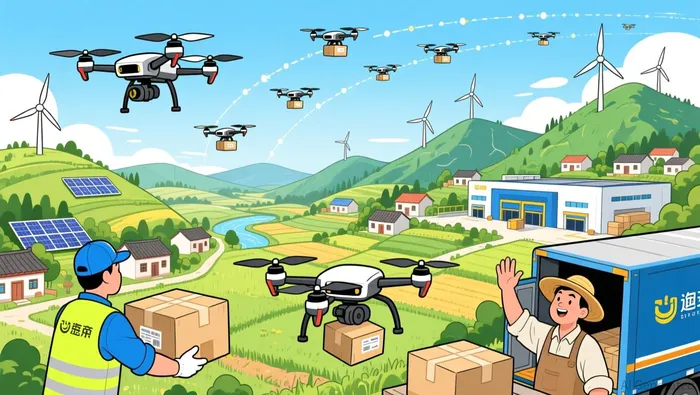
Strategic and Military Applications: Dual-Use Technologies and Civil-Military Fusion
Beyond commercial logistics, China's drone sector is deeply intertwined with its military modernization efforts. The country's civil-military fusion (MCF) policy has enabled the rapid adaptation of commercial drone technology for military use, creating a dual-use ecosystem that blurs the lines between civilian and defense applications. This model is exemplified by state-owned enterprises like Aviation Industry Corporation of China (AVIC) and China Aerospace Science and Technology Corporation (CASC), which produce both commercial and military drones, such as the Wing-Loong and Caihong series according to defense analysis.
The strategic implications are profound. China's dominance in the global commercial drone market-accounting for 70-80% of sales-grants it unparalleled leverage in supply chain control and "drone diplomacy," allowing it to export both hardware and expertise to allied nations. Simultaneously, the PLA is integrating low-cost, expendable drones into its operational doctrine, particularly for scenarios involving Taiwan. Military writings highlight the use of drone swarms to overwhelm enemy defenses, targeting infrastructure and command-and-control systems in a prelude to invasion. The Russian-Ukrainian war has further validated the efficacy of such tactics, prompting China to accelerate the development of ultra-low-cost drones that can be mass-produced and deployed en masse.
Government-Industry Synergy: Policy, Innovation, and Global Influence
The government's role in fostering this dual-use ecosystem is pivotal. Policies like Made in China 2025 and the upcoming 15th Five-Year Plan (2026–2030) are embedding military requirements into civilian R&D, particularly in AI and robotics. For example, defense-focused universities like Beihang University collaborate with state-owned enterprises and the PLA to advance technologies such as multi-drone coordination and autonomous targeting. Meanwhile, private firms like Sichuan Tengden Technology are producing advanced platforms, including the TB-001 attack drone, which has been observed near Japanese airspace.
This synergy extends to global influence. Through the Global Development Initiative (GDI), China is embedding dual-use technologies into infrastructure projects abroad, enhancing its geopolitical reach while promoting a state-controlled development model. Domestically, the integration of civilian AI into military systems has reduced training costs, as the 929,000 registered civilian drone operators in 2023 provide a ready pool of skilled personnel according to analysis.
Investment Outlook: Balancing Opportunity and Risk
For investors, the unmanned cargo aviation sector offers a compelling mix of high-growth commercial applications and strategic national security value. However, the dual-use nature of the technology also introduces geopolitical risks, particularly in the context of U.S.-China competition and potential conflicts over Taiwan. While Taiwan is investing in counter-drone systems like the T-Dome and asymmetric warfare capabilities, China's industrial capacity and supply chain dominance give it a significant edge in scaling drone production according to defense industry reports.
The key to successful investment lies in identifying firms that excel in both commercial and defense markets. State-owned enterprises like AVIC and CASC remain critical, but private innovators such as Sichuan Tengden Technology and emerging AI-driven logistics platforms are also worth monitoring. Additionally, companies involved in AI integration-such as those developing autonomous navigation and swarm coordination- stand to benefit from both domestic and international demand.
Conclusion
China's unmanned cargo aviation sector is a testament to the power of strategic foresight, policy alignment, and industrial innovation. By leveraging low-cost, multi-functional drones for logistics and military use, China is not only transforming its domestic economy but also reshaping global power dynamics. For investors, the sector presents a rare opportunity to capitalize on a technology that is simultaneously a commercial disruptor and a strategic asset. However, navigating this landscape requires a nuanced understanding of both the economic and geopolitical forces at play.





Comentarios
Aún no hay comentarios