
China's Rising Influence in the Global Memory and AI Chip Markets: Investment Opportunities in Underestimated Semiconductor Firms
The global semiconductor landscape is undergoing a seismic shift as China's domestic chip industry gains momentum amid U.S. export restrictions and global shortages. While Western policymakers aim to curb China's technological ascent, the unintended consequences of these measures are fueling innovation and self-reliance in Chinese semiconductor firms. For investors, this presents a unique opportunity to capitalize on underestimated players in memory and AI chips, which are now outpacing expectations in both performance and market share.
The Unintended Consequences of U.S. Export Controls
U.S. export restrictions on advanced semiconductors and manufacturing tools have not only failed to halt China's progress but have also accelerated its pivot to self-sufficiency. A report by the Information Technology and Innovation Foundation (ITIF) highlights that U.S. chipmakers lost over $33 billion in sales to Huawei between 2021 and 2024, as the company rapidly developed alternatives like its HarmonyOS operating system and Ascend AI chips. These losses are projected to escalate: if the U.S. fully cuts off semiconductor exports to China, domestic firms could face a $77 billion revenue drop in the first year, alongside a 24% reduction in R&D investment and 80,000 job losses.
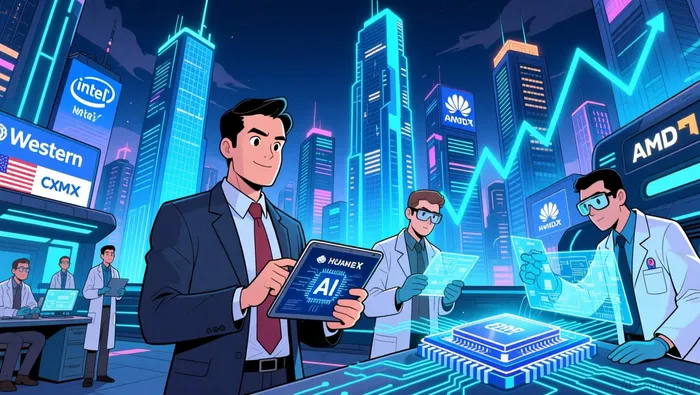
Meanwhile, Chinese firms are leveraging state-backed subsidies and surplus energy resources to scale production. For instance, Moore Threads Technology Co., a rising star in AI and graphics chips, is using IPO proceeds to fund next-generation projects. Similarly, ChangXin Memory Technologies (CXMT), a DRAM leader, plans to raise $4.22 billion via a Shanghai IPO to expand high-bandwidth memory (HBM) production, targeting a 12% global DRAM market share by 2025.
Underestimated Innovators: AI and Memory Chip Breakthroughs
Chinese startups and established firms alike are defying expectations. MetaX, a Shanghai-based AI chipmaker founded by former AMD engineers, has emerged as a formidable competitor. Its C500 series benchmarks against NVIDIA's A100, while the upcoming C700 aims to rival the H100. The company's transparent IPO disclosures-uncommon in China's opaque semiconductor sector-reveal a 2–3 year technological lag but a clear trajectory of improvement. MetaX's $600 million IPO in late 2025 underscores investor confidence in its potential to disrupt the AI chip market.
In memory chips, CXMT has achieved a financial turnaround, reporting its first annual profit in 2025 amid surging DRAM prices. The company's DDR5 and HBM2 roadmap positions it to challenge global giants like Samsung and SK Hynix. By 2026, CXMT aims to produce HBM for AI processors, a critical component for high-performance computing.
Huawei remains a cornerstone of China's AI ambitions. Its Ascend 910C AI chip, despite manufacturing constraints, delivers 60% of the performance of NVIDIA's H100. The company's 40% yield rate for this chip and plans to launch the Ascend 950 in 2026 signal a strategic push to close the performance gap.
Strategic Advantages and Market Dynamics
China's state-led innovation model is a key differentiator. Government initiatives like "Made in China 2025" and a proposed $70 billion investment plan are driving a 15% annual growth in chip output. This contrasts sharply with U.S. energy infrastructure limitations, which hinder data center expansion despite surging AI demand.
Moreover, China's domestic market is a testing ground for scaling. Alibaba's inference-focused AI chips and Baidu's five-year Kunlun roadmap highlight the integration of homegrown solutions into cloud and enterprise applications. Cambricon, another AI chip leader, reported a 4,000% revenue surge in H1 2025, demonstrating strong market acceptance.
Risks and Realities
While the outlook is optimistic, challenges persist. Chinese AI chips still lag in complex analytics and user-friendliness, and access to advanced manufacturing tools remains constrained by U.S. export controls. However, these gaps are narrowing rapidly. For instance, DeepSeek's R1 model was trained at a fraction of the cost of Western counterparts using domestic hardware, and Huawei's RISC-V adoption offers a workaround for process node limitations.
Conclusion: A Strategic Investment Opportunity
The confluence of U.S. policy missteps, Chinese resilience, and technological breakthroughs creates a compelling case for investing in underestimated Chinese semiconductor firms. Companies like MetaX, CXMT, and Huawei are not only surviving but thriving in a constrained environment, backed by state support and a $70 billion industry growth plan. For investors, these firms represent a high-conviction opportunity to benefit from China's ascendance in memory and AI chips-a sector poised to redefine global technology leadership.





Comentarios
Aún no hay comentarios