
China's Resilient Trade Amid U.S. Geopolitical Pressures: Supply Chain Diversification and Asian Investment Opportunities
In the shadow of escalating U.S.-China trade tensions, China's export sector has demonstrated remarkable resilience, adapting to geopolitical headwinds through strategic supply chain diversification. Despite U.S. tariffs peaking at 145% in early 2025, Chinese exporters have not only mitigated the impact but also unlocked new opportunities in non-U.S. markets. This shift underscores a broader realignment of global trade dynamics and presents compelling long-term investment prospects in Asia's export-driven sectors.
The Resilience of China's Export Sector
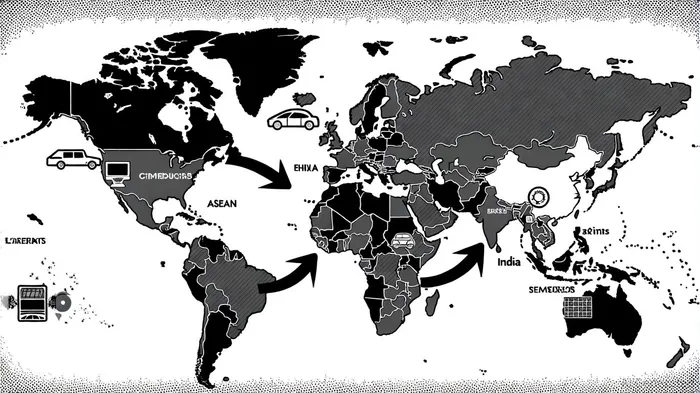
China's ability to weather U.S. sanctions is rooted in its rapid pivot to alternative markets. By March 2023, exports surged 12.4% year-on-year, driven by frontloading shipments ahead of impending tariffs, according to a Glottis report. By 2025, as U.S. tariffs averaged 126.5%, Chinese exporters redirected trade to the European Union and ASEAN, with exports to these regions growing 10.3% and 11.6%, respectively, the Glottis report found. This strategic realignment reflects a calculated response to geopolitical pressures, leveraging China's manufacturing scale and cost advantages.
A partial reprieve came in May 2025, when U.S. tariffs on Chinese goods were rolled back to an average of 51.1%, according to a McKinsey analysis. However, the damage to U.S.-China trade relations remains, with a June 2025 deal reducing U.S. tariffs to 55% and China lowering its tariffs on American goods to 10%, the Glottis report noted. While this agreement stabilizes bilateral trade, the broader trend of decoupling continues, with Chinese firms prioritizing diversification over dependency.
Supply Chain Diversification: A Strategic Imperative
The U.S.-China trade war has pushed global supply chains to a breaking point, as highlighted by the GEP Global Supply Chain Volatility Index. U.S. companies have aggressively stockpiled inputs, while Asian manufacturers face declining purchasing activity. In response, China has accelerated its pivot to emerging markets, with Vietnam, India, and Mexico emerging as key hubs under the "China plus one" strategy, according to an EDB report.
China's Belt and Road Initiative (BRI) further amplifies this diversification, creating new trade corridors across Asia, Africa, and Europe, as the Glottis report notes. These investments in infrastructure and localized production are not only reducing reliance on the U.S. but also fostering economic interdependence with partner nations. For investors, this signals a shift from a U.S.-centric trade model to a multipolar one, with Asia at its core.
Asian Export-Driven Sectors: The New Frontiers
The reallocation of supply chains has created fertile ground for specific Asian sectors to thrive. Southeast Asia, in particular, is emerging as a beneficiary of China's outward investment and manufacturing relocation:
Vietnam's Electronics Sector: Vietnam has become a critical node in global electronics supply chains, with companies like Samsung and Intel expanding production facilities, per McKinsey. The country's labor costs, which are 30% lower than China's, and its integration into the Regional Comprehensive Economic Partnership (RCEP) make it an attractive alternative, as noted by an ASEAN Hub analysis.
Indonesia's Metals and Chemicals Industry: As China's raw material demands grow, Indonesia's nickel and copper reserves are being tapped to support green energy transitions. Chinese investments in smelting and refining infrastructure are accelerating, positioning Indonesia as a key player in the EV battery supply chain.
Malaysia's Semiconductor Industry: Malaysia's semiconductor sector, already a global leader in packaging and testing, is seeing renewed interest from U.S. and Chinese firms. Intel and GlobalFoundries have announced expansions, leveraging Malaysia's skilled workforce and strategic location.
Thailand's EV and PCB Manufacturing: Thailand's "EV 2.0" strategy, coupled with its competitive printed circuit board (PCB) industry, has attracted Chinese automakers and tech firms. The country's 2025 EV production targets aim to capture 10% of the global market, according to the EDB report.
Singapore's Technology and Regional Hubs: Singapore's role as a regional headquarters for Chinese tech giants like Alibaba and Tencent highlights its strengths in logistics, finance, and R&D. The city-state's advanced infrastructure and pro-business policies make it a gateway for China's outward investments, the EDB report observes.
Long-Term Investment Opportunities
For investors, the key takeaway is clear: China's trade resilience is not a temporary phenomenon but a structural shift driven by geopolitical realities. The following sectors and regions warrant attention:
- ASEAN Infrastructure and Logistics: As supply chains decentralize, investments in ports, rail, and digital infrastructure across ASEAN will be critical. Singapore's Changi Airport expansion and Vietnam's deepwater ports are prime examples, as outlined by the ASEAN Hub analysis.
- Green Energy and Critical Minerals: Indonesia's nickel and Vietnam's rare earth processing capabilities align with global decarbonization goals. Chinese firms are already partnering with local governments to secure supply chains, per the McKinsey analysis.
- High-Tech Manufacturing in Southeast Asia: The "China plus one" strategy is driving capital inflows into Vietnam, Thailand, and Malaysia. Companies with exposure to these markets, particularly in semiconductors and EVs, are well-positioned for growth, the EDB report suggests.
Conclusion
China's trade resilience amid U.S. pressures is a testament to its adaptability and the enduring strength of its manufacturing base. However, the true beneficiaries of this shift are the Asian economies and sectors that have capitalized on supply chain diversification. For investors, the message is unequivocal: the future of global trade is multipolar, and Asia's export-driven sectors are at the forefront of this transformation.







Comentarios
Aún no hay comentarios