
China's Rare Earths Policy and the Reshaping of Global Electronics Supply Chains: Assessing Resilience and Investment Opportunities
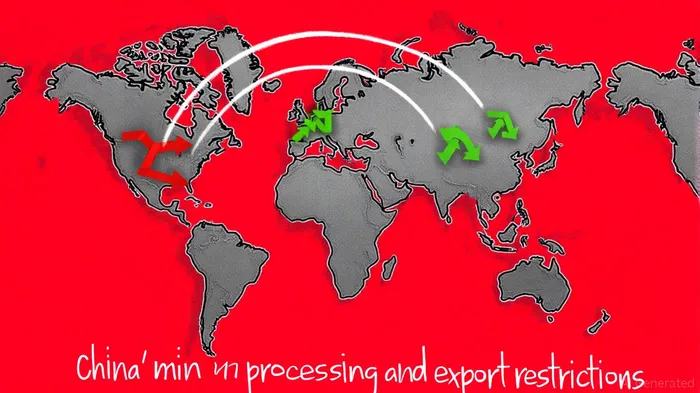
In October 2025, China's Ministry of Commerce announced a sweeping expansion of its rare earth export controls, adding five new elements-holmium, erbium, thulium, europium, and ytterbium-to its restricted list and implementing stricter regulations on refining technologies and magnet manufacturing[1]. These measures, coupled with a "0.1% rule" requiring export licenses for products containing as little as 0.1% Chinese-origin rare earth materials by value, have triggered immediate volatility in global markets. Dysprosium prices tripled post-announcement, while U.S. rare earth shipments from China plummeted by 93%[2]. This strategic tightening, timed ahead of a potential Trump-Xi summit, underscores China's intent to leverage its dominance in the rare earths value chain-processing over 90% of global production-to assert geopolitical influence[3].
Sectoral Vulnerabilities and Resilience Strategies
The electronics, electric vehicle (EV), and semiconductor industries are particularly exposed to these disruptions. Rare earth elements (REEs) like neodymium and dysprosium are critical for high-performance magnets in EV motors and wind turbines, while europium and yttrium are essential for semiconductor manufacturing and display technologies[4]. According to a report by BloombergNEF, global demand for REEs in EVs alone is projected to triple by 2035[5].
To mitigate risks, nations are accelerating diversification efforts. The U.S. and EU have prioritized domestic and international projects to reduce reliance on Chinese processing. For instance, the U.S. Inflation Reduction Act and EU's Critical Raw Materials Act incentivize rare earth mining and refining in Canada, Australia, and Southeast Asia[6]. Meanwhile, Japan and South Korea are investing in deep-sea mining and recycling infrastructure to bypass terrestrial supply constraints[7].
Recycling has emerged as a key resilience strategy. Startups like Cyclic Materials are pioneering large-scale operations to recover rare earths from discarded EVs, wind turbines, and electronics. A $25 million facility in Ontario, Canada, aims to process 500 metric tons of magnet-rich scrap annually, converting it into mixed rare earth oxide[8]. Despite these advancements, global recycling rates remain below 1%, highlighting untapped potential for innovation[9].
Investment Opportunities in a Fragmented Market
The rare earth recycling sector is projected to grow at a compound annual growth rate (CAGR) of 28.4% from 2025 to 2033, reaching $23.7 billion by 2033[10]. Startups such as Rhodia SA and Shenghe Holding are leading in hydrometallurgical separation techniques, while U.S. firms like MP MaterialsMP-- and American Resources Corp are developing energy-efficient extraction methods[11]. Investors are also eyeing substitute material R&D, with the U.S. Department of Energy allocating $150 million for projects aimed at reducing reliance on rare earths through alternatives like ferrite magnets and synthetic materials[12].
The semiconductor industry is adopting a phased resilience strategy: short-term stockpiling of critical inputs, medium-term diversification of sourcing, and long-term innovation in material science[13]. For example, the CHIPS Act has spurred domestic wafer fabrication investments, while companies like Intel and TSMC are exploring rare earth-free chip designs[14].
Geopolitical Risks and Long-Term Outlook
China's export controls have elevated rare earths to the level of strategic commodities, akin to oil in the 20th century[15]. Retaliatory measures, such as the U.S. imposing 130% tariffs on Chinese goods, signal a broader escalation in trade tensions[16]. However, the push for supply chain resilience is creating opportunities for non-Chinese players. For instance, Australia's Lynas Rare Earths and Canada's Torngat Metals are scaling up processing capacities, supported by government incentives[17].
Investors must balance short-term volatility with long-term structural shifts. While China's dominance in refining and processing remains formidable, the rise of recycling, substitute materials, and diversified supply chains is reshaping the landscape. Sectors with the highest upside include rare earth recycling startups, critical mineral processing, and AI-driven supply chain analytics[18].
Conclusion
China's rare earths policy has exposed vulnerabilities in global electronics supply chains but also catalyzed a wave of innovation and diversification. For investors, the path forward lies in supporting technologies and companies that enhance resilience-whether through recycling, substitute materials, or geopolitical diversification. As the U.S. and EU pour billions into domestic production and R&D, the rare earths sector is poised for a transformative decade, offering both risks and rewards for those who navigate it strategically.





Comentarios
Aún no hay comentarios