
The China-U.S. Rare Earths Dilemma: Strategic Opportunities in a Shifting Supply Chain Landscape
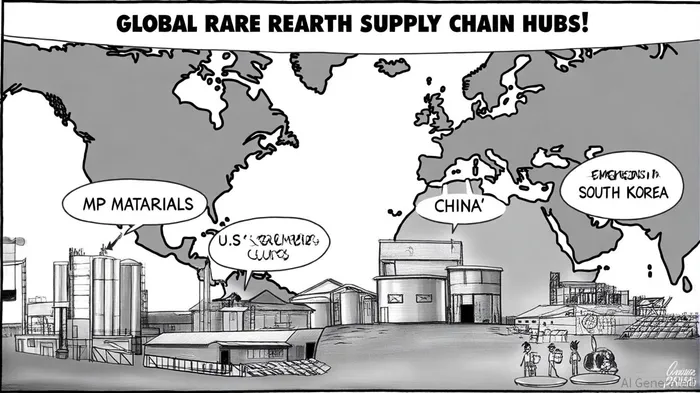
The rare earths supply chain has become a geopolitical battleground, with China's dominance and the U.S.-led push for diversification reshaping investment landscapes. As demand for rare earth elements (REEs) triples by 2035, driven by clean energy and electric vehicle (EV) technologies, the race to secure resilient supply chains is accelerating. For investors, this dynamic environment presents both risks and opportunities—particularly in recycling technologies, alternative materials, and cross-border collaborations.
China's Leverage and the U.S. Counteroffensive
China's control over 80% of rare earth refining and 90% of magnet production has made it a critical player in trade negotiations[1]. Export controls in 2023 disrupted access to gallium, germanium, and heavy rare earths, forcing the U.S. and its allies to act. The Department of Defense's $400 million investment in MP Materials to expand magnet production and its stake in the company signal a strategic pivot toward self-sufficiency[1]. Similarly, Energy Fuels is scaling up heavy rare earth processing in Utah, targeting dysprosium and terbium—elements vital for high-temperature magnets[1].
However, the U.S. still lacks full capacity for high-performance magnet production, leaving it vulnerable to Chinese leverage[5]. This gap underscores the urgency of initiatives like the $1 billion in DOE funding for recycling and processing technologies, including the Battery Materials Processing and Recycling Grant Program[1].
A Global Race for Supply Chain Independence
The U.S. is not alone in its efforts. South Korea's JS Link is building a $223 million magnet plant in Georgia, while Canada's Torngat Metals and Germany's VAC have partnered to secure dysprosium and terbium from Quebec's Strange Lake deposit[3]. These collaborations highlight a broader trend: nations are prioritizing regional partnerships to bypass China's stranglehold.
Emerging players are also gaining traction. Australia's Lynas Rare Earths and Africa's Rainbow Rare Earths in South Africa are backed by institutions like the U.S. DFC and the European Raw Materials AllianceAENT-- (ERMA), signaling a shift toward diversified global supply chains[2].
Recycling and Alternative Materials: The Next Frontier
Recycling is emerging as a critical pillar of supply chain resilience. Companies like Phoenix Tailings are pioneering methods to extract rare earths from mining waste without toxic emissions, offering a cost-competitive and sustainable alternative[2]. Meanwhile, Illumynt and Cyclic Materials are scaling advanced chemical processes to recover neodymium and dysprosium from electronics and hard drives[2].
Government support is amplifying these efforts. ReElement Technologies secured $2 million from the U.S. DoD to refine rare earths, aligning with the military's goal of a “mine-to-magnet” supply chain by 2027[4]. The global rare earth recycling market, valued at $2 billion in 2025, is projected to grow at a 15% CAGR through 2033, driven by environmental regulations and technological advancements[1].
Yet challenges persist. Recycling rates for REEs remain below 1% in the U.S., lagging behind China's infrastructure[4]. Technical hurdles in separating heavy rare earths and the high costs of purification processes also hinder scalability[5].
Strategic Investment Opportunities
For investors, the key lies in balancing short-term realities with long-term potential:
1. Recycling Innovators: Firms like Electrified Materials (backed by a $911,519 Indiana grant) and Phoenix Tailings are positioned to benefit from policy tailwinds and circular economy trends[6].
2. Alternative Materials: While still nascent, research into rare-earth-free technologies and substitutes for neodymium-based magnets could disrupt the market in the next decade[3].
3. Global Supply Chain Players: Companies securing critical deposits in Canada, Australia, and Africa—such as Torngat Metals and Lynas Rare Earths—offer exposure to diversified supply chains[2].
Conclusion: Navigating the Dilemma
The China-U.S. rare earths rivalry is not just a trade issue—it's a battle for the future of clean energy and technological leadership. While China's dominance persists, the U.S. and its allies are making strides through strategic investments, recycling innovation, and global partnerships. For investors, the path forward lies in supporting companies that bridge the gap between today's supply chain vulnerabilities and tomorrow's resilient, sustainable solutions.





Comentarios
Aún no hay comentarios