
China's Rare Earth Export Curbs: Implications for Global Supply Chains and Strategic Investment Opportunities
China's rare earth export curbs in 2025 have reshaped the global supply chain landscape, creating both geopolitical risks and strategic investment opportunities. By tightening quotas, introducing licensing requirements, and extending control to foreign-made products containing Chinese-origin materials, Beijing has weaponized its dominance in the rare earth value chain-a sector critical to defense, renewable energy, and advanced manufacturing. This analysis explores the implications of these policies and identifies actionable investment opportunities for navigating the new era of supply chain diversification.
China's 2025 Export Curbs: A Geopolitical Playbook
China's 2025 policy updates represent a calculated escalation in its rare earth strategy. The introduction of special export licenses for seven medium and heavy rare earths-including dysprosium, terbium, and neodymium-has created administrative bottlenecks, with license processing times stretching up to 45 working days. These measures, coupled with extended control over foreign products using Chinese-origin materials, signal a shift from physical export management to strategic technological control.
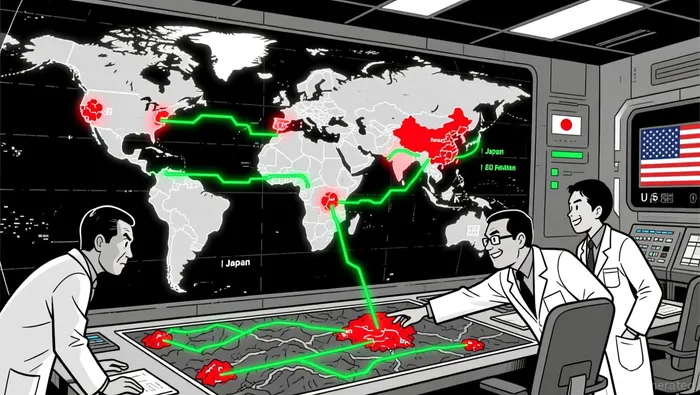
The geopolitical context is clear: these curbs coincided with U.S. President Donald Trump's tariff hikes on Chinese goods, prompting China to retaliate by adding U.S. entities to its export control list. The immediate impact was stark: rare earth magnet exports to the U.S. plummeted by 93.3% year-on-year in May 2025, the lowest level since the pandemic. This disruption has exposed vulnerabilities in global supply chains, particularly in defense (e.g., radar systems, precision-guided missiles) and electric vehicles (EVs), where rare earths are indispensable for high-performance magnets.
Global Supply Chain Diversification: A Race Against Time
The U.S. and its allies are racing to mitigate China's leverage. The Department of Defense has allocated over $439 million since 2020 to build a domestic mine-to-magnet supply chain, while the U.S.-Japan Framework for Securing Critical Minerals emphasizes joint investment in mining, processing, and recycling. Similarly, the EU's Critical Raw Materials Act sets ambitious benchmarks for domestic sourcing and processing capacity.
However, these efforts face headwinds. China controls 60% of global raw material production and 85% of processing capacity, making short-term alternatives scarce. Recycling technologies and international partnerships are thus critical. The International Energy Agency (IEA) has prioritized recycling innovation, noting that only 0.2% of rare earths are currently recycled globally. Startups like Cyclic Materials are pioneering large-scale rare earth recycling, with a two-part system to recover materials from EVs, wind turbines, and electronics.
Strategic Investment Opportunities: Innovation and Resilience
The rare earth sector in 2025 is ripe for investors who prioritize resilience and innovation. Key opportunities include:
Recycling Technologies:
Cyclic Materials, a Canadian startup, is scaling rare earth magnet recycling with a $25 million funding round and partnerships with Solvay. Its "spoke-hub" model could revolutionize material recovery, reducing reliance on Chinese supply chains. Similarly, U.S. battery recyclers like Ascend Elements and Redwood Materials have raised $3 billion in equity and debt, signaling growing demand for closed-loop systems.Mining and Processing Startups:
Companies like Torngat Metals and Phoenix Tailings are extracting rare earths from unconventional sources, such as mining waste, to bypass geopolitical bottlenecks. These ventures address both environmental and supply chain risks.Vertical Integration:
Major players like MP MaterialsMP-- (U.S.) and Lynas Rare Earths (Australia) are expanding vertically integrated supply chains to reduce China dependency. MP Materials' partnership with Apple to manufacture magnets domestically underscores this trend.Global Partnerships:
The U.S.-Japan and EU frameworks highlight the importance of cross-border collaboration. Investors should monitor joint ventures in mining and recycling, as well as policy-driven incentives for domestic production.
Risks and the Road Ahead
While the market is projected to grow from $5.73 billion in 2025 to over $11 billion by 2030, challenges persist. Recycling remains economically complex, and geopolitical tensions could disrupt supply chains further. Investors must balance short-term volatility with long-term structural shifts, prioritizing companies that combine technological innovation with geopolitical agility.
In conclusion, China's rare earth export curbs have accelerated a global pivot toward supply chain resilience. For investors, the path forward lies in supporting recycling innovation, diversifying sourcing strategies, and backing startups that redefine the rare earth value chain. The next decade will belong to those who recognize that rare earths are not just materials-they are the new geopolitical currency.





Comentarios
Aún no hay comentarios